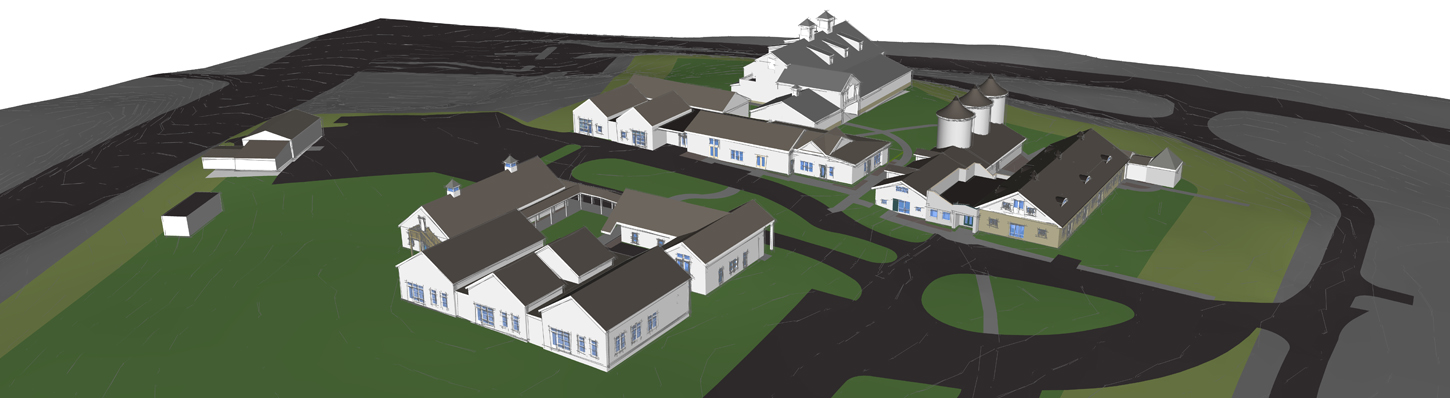
The time is finally here! We are delighted to share that our building project is finally beginning! There will be a great deal of activity on campus beginning next week as we begin the big work of creating a truly prepared environment for our children and adolescents.
I want to make you aware of a few of the major undertakings you will see and hear about over the coming month or so.
The first signs that the project is underway will appear this coming Monday, January 30. During the inaugural week there will be a growing stream of activity as sediment controls will be staked out and set in place along with various site and building boundary markers, surveying of roadways and utility lines will commence, test pits will be dug in various locations to gauge water pressure, and fencing will be set in place. If all goes well, we are also hoping to see the installation of a gravel road running along the Falls Road end of the soccer field. We will be installing fencing to ensure that the playground and the roadway are safely separated and that we can maintain the use of our soccer field and play equipment.
Once the initial site prep is complete, we will be constructing a bio retention pond up near the old chicken coop location. As we are required to install this first to address the environmental issues associated with run-off during and after the project, we will need to remove the play structure that is currently there. You will be pleased to know that we have found a good home for it at the Boys and Girls Club of Howard County.
We are told that we can maintain access to the Multi-Purpose Building for three more weeks, until February 17. That is very good news. At that time, Discovery for Children’s House, Elementary and Adolescents will be moved to the gym. Toddlers will stay happily nestled in their classroom in the Main Building.
Due to the need for widening, repaving and the utilities work all around the loop road at various intervals during the construction period, sections of the roadways will be torn up for extended and intermittent periods. When this happens you will be sure to be given plenty of advanced notice that we will move to the new carline procedures attached herein. (Note that carline for children in the Main Building will not change for the time being.)
We will do our very best to keep you posted each step of the way. We thank you now for your patience and flexibility as our community self-constructs – and builds a beautiful, updated home away from home for your children.
With much excitement,
Tamara Sheesley Balis
Head of School

Every year, we celebrate the International Day of Peace here at Greenspring Montessori. This isn’t a particularly well-known holiday in many circles, I know, but to us this day is both a cause for celebration and a chance for reflection. Peace education is a huge aspect of the Montessori Method, and as a member of a Montessori community, the opportunity to honor and remember the importance of peace on this special day is one that I feel lucky to share.
Maria Montessori saw the education of young children as the human race’s opportunity to recreate itself in a way that would eliminate war. As with most things, Dr. Montessori did not think that meant children needed to be lectured on the subject, but rather that they needed to be given an opportunity to discover peace for themselves. From a very early age, our students learn to think globally about the human race and its place in the entire system of our planet. As they get older and their thinking becomes more abstract, they learn more about the ways that different cultures have coexisted with the geography and biology of their parts of the world to meet the basic needs that all humans have in common.
Once students get to our Adolescent program, they go through several-month units exploring questions like, “Are all humans created equal?” and “What brings humans together into groups?” Here, these questions are taken very seriously and are never assumed to have simple answers. We help children seek insight by looking at world history, at the differing cultures of the world’s people, and at the interactions between humanity and the environment. Perhaps most importantly, we think about how future history might be written in a way more in keeping with the harmony that seems possible between people and the world, or between one group of people and the next.
Peace is also, essentially, a habit that Montessori students learn. Lessons in Grace and Courtesy and the Peace Tables we have in every classroom teach our students the habit of viewing and treating others with respect, and then to continue to try to forge understandings where they encounter conflict. These lessons are present in Montessori classrooms from such an early age that the habits they create become as natural to our students as using a spoon, or putting on shoes.
The benefits of peace education are not just altruistic, but eminently practical – no matter your politics, or what you think about the current situation in Syria or Kenya. Most adults who have navigated the many changes to the world (or even just the job market) in the last several years have had reason to think about how much more connected everything seems to be getting – countries thousands of miles away can be regular business partners in ways that they might not have a decade or two ago, and people are truly mobile on a global scale for the first time in our planet’s history. Prejudice in favor of one’s own tribe – whether that tribe is formed by religion or geography or your school’s alumni association – has become more and more counterproductive to operating in a world where diversity cannot be avoided and is to be celebrated.
We so often encounter situations in which we need to work with people who are coming from different points of view. I wonder, as an adult who did not have a Montessori education, how much easier that might have been if from an early age I’d had the habits of respect, conflict resolution, and looking at the ways various groups have solved problems differently with more wonder and curiosity. Then I look at this school, and I talk with its faculty, and I meet other adults who did have the benefit of this education – and I know that the tools we are giving our students are incredible ones and am proud to be a part of making it happen.
Peace is an amazing concept, a useful tool, and, through Montessori education, an attainable goal. One worth celebrating and giving serious consideration to – and, to honor this holiday each year, we raise our voices to recognize its importance.