
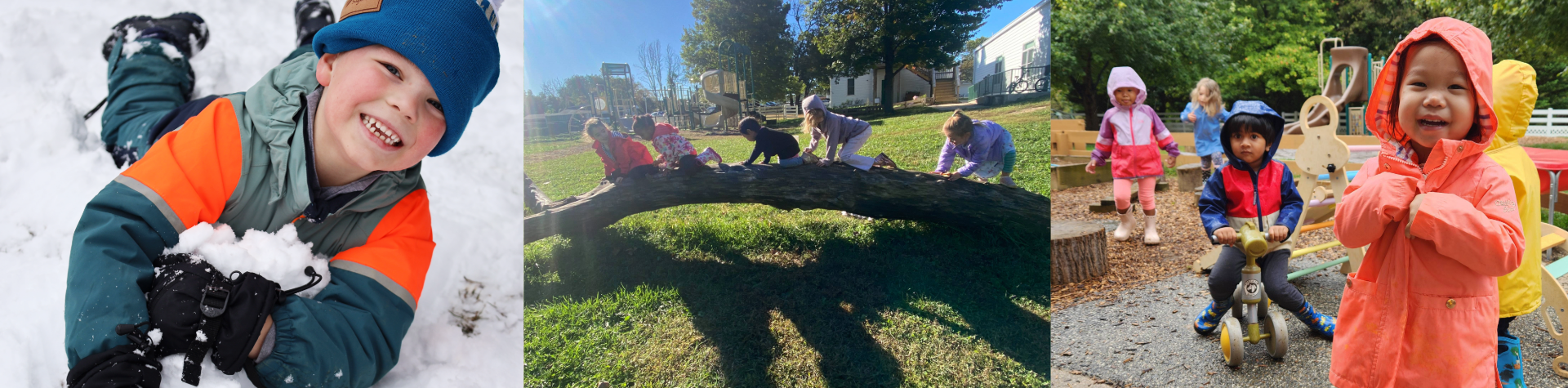
Outdoor Education at Greenspring Montessori
At Greenspring Montessori School in Baltimore, outdoor education isn’t an occasional enrichment—it’s an essential part of every child’s daily experience.
As a Certified Maryland Green School, we are deeply committed to environmental stewardship, sustainability, and meaningful connection with the natural world. Our campus is designed so that learning flows between indoors and outdoors, giving children the freedom to explore, discover, and grow in a dynamic, natural environment.
With seven acres of accessible outdoor space, children don’t just go outside for recess. They learn, work, and play outdoors for hours each day, in all seasons and weather conditions.
A Campus Designed for Outdoor Learning
Our environment makes outdoor education possible in a way most schools simply cannot.
- Classrooms have direct access to outdoor learning spaces
- At the Toddler level, children are able to move freely between indoor and outdoor work areas
- Natural landscapes become extensions of the classroom
- Gardens, wooded areas, and open spaces invite exploration and discovery
This integration allows learning to feel alive, relevant, and deeply engaging.
Why Outdoor Learning Matters
A growing body of research confirms what educators and parents are observing every day: children thrive when they spend meaningful time outdoors.
- Outdoor learning supports academic growth, including improved literacy and engagement
- Time in nature improves mental health, mood, and overall well-being
- Outdoor activity increases physical health and development, including strength, coordination, and cardiovascular health
- Nature-based learning enhances social skills, collaboration, and self-confidence
Children who spend more time outside are also more physically active and better able to focus, regulate emotions, and engage deeply in their learning.
How Our Approach Is Different
In many conventional schools, children spend the vast majority of their day indoors, often sitting at desks, with limited outdoor time reserved for short recess periods.
At Greenspring Montessori, we take a fundamentally different approach:
| Conventional Model | Greenspring Montessori |
|---|---|
| Learning happens primarily indoors | Learning flows between indoor & outdoor environments |
| Outdoor time is limited to recess | Multiple hours outside daily |
| Nature is often separate from academics | Nature is integrated into the curriculum |
| Movement is restricted | Movement is essential to learning |
Research shows that regular, sustained outdoor learning—not just short breaks—has the strongest impact on children’s well-being and social development. That’s why we prioritize extended, meaningful time outside every day.
A Certified Maryland Green School
Greenspring Montessori is proud to be a Maryland Green Schools Program Certified Maryland Green School, a designation awarded by the Maryland Association for Environmental and Outdoor Education (MAEOE).
This recognition reflects our deep commitment to environmental education, sustainability, and meaningful outdoor learning experiences.
To earn and maintain this certification, schools must demonstrate excellence in:
- Environmental literacy and curriculum integration
- Outdoor learning and student engagement with nature
- Sustainable practices, including waste reduction and energy conservation
- Community partnerships and environmental stewardship
At Greenspring Montessori, this work is woven into daily life. Children actively participate in caring for their environment through gardening, composting, observing ecosystems, and developing a sense of responsibility for the natural world.
Being a Maryland Green School is a reflection of how we prepare children to become thoughtful, informed stewards of their environment.
Research on Outdoor Learning and Play
Our approach is aligned with widely respected research and thought leadership in education and child development. We highly recommend reading the books Last Child in the Woods by Richard Louv and Stolen Focus by Johann Hari. Richard Louv describes the growing “nature deficit” in children’s lives—and the profound benefits of reconnecting children with the natural world. In Stolen Focus, Johann Hari explores how modern environments impact attention and well-being, highlighting the importance of experiences that restore focus, curiosity, and deep engagement—qualities naturally fostered through outdoor learning.
At Greenspring, we intentionally design an environment that counters these challenges and supports the whole child.
The Lasting Impact of Outdoor Education
When children spend significant time outdoors, they develop:
- A strong sense of independence and confidence
- Deep connection to nature and environmental responsibility
- Greater focus, creativity, and problem-solving skills
- A lifelong love of learning and exploration
These are not just school skills—they are life skills.
How do you balance outdoor learning and academics?
Outdoor learning at Greenspring Montessori is not separate from academics—it is one of the ways academics come to life.
Children engage in reading, writing, math, science, and cultural studies both indoors and outdoors. For example:
- Measuring garden beds reinforces math concepts
- Observing seasonal changes supports scientific thinking
- Journaling outdoors strengthens writing skills
Because Montessori education is hands-on and experiential, the outdoor environment naturally supports deep academic engagement. Children are not “losing academic time”—they are learning in a way that is more meaningful, memorable, and connected to the real world.
How is this different from recess at other schools?
In many schools, outdoor time is limited to short recess periods that are separate from academic learning.
At Greenspring Montessori:
- Outdoor time is extended and integrated into the school day
- Learning happens both indoors and outdoors
- Children engage in purposeful work, exploration, and play in nature
This leads to deeper learning, greater engagement, and stronger developmental outcomes.
What does my child need to be successful in an outdoor learning environment?
We partner with families to ensure children have weather-appropriate clothing (rain gear, boots, layers, sun protection). Children quickly adapt to being outdoors in all seasons. With consistent routines and guidance, they become confident, capable, and comfortable in a wide range of conditions.
Do children go off campus for outdoor learning?
Most outdoor learning takes place right here on our seven-acre campus, which provides a rich and diverse environment for exploration.
Starting in the Kindergarten year, students also participate in supervised off-campus experiences. We partner with local organizations including Ladew Gardens, Oregon Ridge Nature Center, Marshy Point Nature Center, Priegel Creamery, Patapsco State Park, and many others for nature-based experiences.
In Upper Elementary and our Adolescent Program (4th through 8th grade), students also plan overnight experiences as part of their outdoor education. Past trips have gone to Echo Hill Outdoor School, Susquehanna State Park, Chincoteague Island, Fox Haven Farm, and many other locations.
What happens in bad weather?
Outdoor learning continues in a wide range of weather conditions, including rain and cold temperatures. We believe there is no such thing as bad weather, only unsuitable clothing. With proper clothing, children are comfortable, engaged, and eager to participate.
In some rare situations, we may be required to keep children indoors. We follow clear safety guidelines and make thoughtful decisions based on conditions such as severe weather, extreme temperatures, or safety concerns. For more details, please see our Family & Student Handbook.
Is outdoor learning safe?
Safety is a top priority in everything we do.
Our campus is intentionally designed for children, and staff closely supervise all outdoor activity. Students are guided in:
- Risk awareness and decision-making
- Respect for boundaries and expectations
- Safe use of natural materials and tools
This approach not only keeps children safe—it helps them develop confidence, judgment, and responsibility.
Will my child be prepared academically for the future?
Yes. Children in Montessori environments, including those with strong outdoor components, consistently demonstrate strong academic outcomes.
Outdoor learning enhances:
- Focus and attention
- Problem-solving skills
- Intrinsic motivation
These are critical foundations for long-term academic success. Children leave our program not only prepared, but often deeply engaged learners who know how to think, not just what to memorize.
Experience our Outdoor Education
Outdoor education at Greenspring Montessori School is foundational to supporting your child. We invite you to visit our campus, step outside, and see how learning comes alive in nature.