We all know that young children thrive on consistency and routine. Dr. Montessori discovered that children from ages one to four are actually in a “sensitive period” for order. This means that not only do they crave consistency from their environment and schedule, but that toddlers are particularly attuned to developing an internal sense of order at this age, if given opportunities to develop this skill.
For this reason, Montessori environments – both at school and in the home – are carefully prepared so that every item has a place. (I have previously posted about setting up Montessori spaces in the home – the bedroom and the bathroom – and am currently working on a piece about the kitchen.) But while it’s fairly easy to create physical places for things, creating a sense of order throughout the day is far more difficult. Young children have a strong need to feel in control and yet so much of what happens during the day is determined by others. Plus, toddlers can’t yet grasp the concept of time – today, tomorrow and yesterday – because the part of the brain that is able to plan ahead and make predictions about the future is still developing.
Creating a few simple routines at home can help your toddler practice making simple predictions, as well as understand concepts such as “before and after.” A consistent routine can (sometimes) eliminate power struggles because your child feels more control over what is happening. A routine is especially helpful during difficult times of day, such as at bedtime or when getting ready for school in the morning.
I’ve collected a few tips good from the experts:
Include preparation for transitions in the routine. For example, say, “We have 10 minutes left before we start getting ready for bed. Since toddlers can’t read a clock, try setting a timer. When the timer goes off, it’s time to start the bedtime routine.
Include opportunities for (limited) choice. Toddlers like to feel in control. You can create the illusion of choice, such as “Are you going to wear the blue shirt or the red shirt?” By putting clothes where your child can access them, this also allows for greater control (aka, independence!) over the process.

Get silly! Even with consistent routines, toddlers will still test the limits. Recently, my daughter, Lila, started to resist getting dressed in the morning. Now my husband helps her “hop” into her clothes and then challenges her to see how high she can jump on the trampoline in her “jumping pants.” Hey, whatever works! And when this stops working, we’ll have to change it up again.
Try creating a picture schedule for your child. During her transition to a Montessori toddler program, Lila began to ask every morning, “Is there school today?” So we created a photo schedule that would show what was going to happen each day of the week. It allows us to discuss the next day’s schedule and Lila can refer to the schedule when she wants to know what is going to happen next. I have found several websites that offer free printables for daily routines, such as these on pricelessparenting.com. Older children may enjoy drawing pictures for their charts.
 Practice routines with activities that are fun, as well as chores. Routines aren’t only for things kids have to do. Lila enjoys making coffee with her daddy on Saturday mornings. She loves being the taskmaster: “Step 1: Grind the beans!”
Keep your daily schedule as predictable as possible. Your child will take comfort in knowing that she goes to school in the morning, comes home for lunch and a nap, and then has playtime in the afternoon. For this reason, we chose to enroll Lila in a Montessori toddler program five mornings a week. Her adjustment to school still included separation anxiety, but thanks to the consistent schedule, Lila quickly began to learn what to expect each day, and this knowledge provided some comfort. In a matter of a few weeks, Lila began to see school as a joyful place where she belonged; now she walks through that classroom door without looking back!
Stay flexible. Of course, children do need to learn how be flexible and deal with minor changes. But that’s why we offer children a predictable routine as a foundation–so they can rise to the occasion to handle big changes when they need to. If there is an interruption to the routine, you can tell your child, “I know we usually do ___, but today we are going to do ___ because (reason). Tomorrow we will go back to our usual schedule.”
It is never too late to start a routine. You can introduce a new routine by saying, “The way that we have been doing things has not been working. We are going to try something new. Here is our new schedule.” Give the new routine some time before making adjustments. Your toddler will resist at first; consistency is key!
To read more about the benefits of setting up routines for your toddler, check out this article by Aha! Parenting.
If you would like to learn more about our Toddler program, please click here.
Does this sound familiar?
“How was your day?” … “Fine.”
“What did you do at school?” … “Nothing.”
It can be hard to get children to open up about what’s going on in their world, especially after a long day at school. Here are a few different communication strategies you can try. Find ones that work best for your family and then practice until they become part of your daily routine. This process takes time but can lead to more satisfying conversations in the long run.
Strategies to Try:
Wait at least a half an hour
After a long day at school wait at least 30 minutes to trying to engage in a conversation. Give your child a chance to take off the backpack, relax, and have a snack.
Ask open-ended questions
“Do you have homework?” or “Did you give your speech?” are questions that only invite a yes or no response. So try to pose open ended questions. Get creative! (There is a list of examples below.)
Be present
The moment your child starts to engage in conversation, stop what you are doing, and give your full attention. It can be hard to tear yourself away from what you’re doing to focus on a child’s question or comment, but your response can either encourage or shut down the conversation. Don’t forget to look interested!
Listen! And stretch the conversation…
Don’t talk, listen! Try comments like “Really?” “Uh-huh?” “I don’t believe it!” “Wow!” to stretch the conversation. They are non-threatening and invite the child to open up. You can also reflect back what the child is saying so they know you understand, and then be quiet so they can talk more. Child: “I played on the swing.” You: “You played on the swing.” The trick is to repeat the tidbit in a matter-of-fact but interested way to get your child to open up and add more.
Try to listen without judgement
Pushing, prodding, demanding, coaxing, lecturing, and threatening are sure ways to end conversations. Questions that begin with “Why” often make kids defensive. “Why did you wear that?” won’t work nearly as well as, “What do you think most of the kids will be wearing to the theater?”
Resist the urge to jump in with solutions and advice
Your child needs a chance to vent and can’t hear advice until she does. Then she needs a chance to figure out her own solutions, which is how she develops confidence and competence. When we can reflect feelings and then help children brainstorm solutions, kids find us more useful to talk to — and they’re more likely to seek us out when they have problems.
Take advantage of indirect communication
Kids often open more in the car, on a walk, or in the dark — all times when eye contact is limited. Remember that these are great times to get kids talking. Another opportunity for indirect communication is when their friends are over or in your car. Just keep quiet and listen. Your child knows you’re there, of course, but often is more willing to talk than if you were speaking directly.

Questions a child might answer at the end of a long school day:
What made you laugh today?
Did anything silly happen?
Did anyone do anything super nice for you?
What is the nicest thing you did for someone else?
Was there an example of unkindness? How did you respond?
What games did you play at recess?
Does everyone have a friend at recess?
Who did you sit with at lunch?
Who do you want to make friends with but haven’t yet? Why not?
Did you help anyone today?
Did you tell anyone “thank you?”
Who inspired you today?
What is something that surprised you?
What is something that challenged you?
What made you feel proud?
How were you brave today?
Will you teach me a song you learned at school?
What was your least favorite part of the day?
Tell me something good (or three!) that happened today.
What are you looking forward to tomorrow?
Do you have a teenager? Huffington Post has some great ideas about starting the conversation with your teenage children. Take a look here – https://www.huffingtonpost.com/liz-evans/28-ways-to-ask-your-teens-how-was-school-today-without-asking-them-how-was-school-today_b_5751546.html
If you are interested in learning more about Greenspring Montessori School, please click here to request more information.

A student is developing fine motor skills by working with scissors, glue, and crayons.
Art in the Montessori Classroom
An Essential Part of the Child’s Work
Written by Michelle Dickson-Feeney, Art Enrichment Guide
www.michelledickson.com
Art is an essential component of learning in Montessori classrooms. In each classroom there are dedicated art shelves ensuring students always have access to art materials for creative expression. We are focused on providing our students with the skills, materials, and exposure to art that they need in order to express their creativity at their own pace and level. From Toddlers to Adolescents, you will see students naturally turning to art in response to what they are learning and studying in other lessons. For example, a student in Children’s House learning about the parts of a plant may want to make a painting about it, while a Lower Elementary student studying France may spend weeks in Open Studio building an intricate model of the Palace of Versailles.
In the Toddler and Children’s House classrooms, art plays an important role in developing fine motor skills, hand strength, and coordination. Cutting, gluing, modeling, crayoning, and painting are five foundational skills that prepare students for the next phase in their creative journeys. Once students master basic lessons in these areas they move on to activities which involve more steps, colors, and materials.

Children’s House students enjoy art and creativity in the classroom.
Supporting your child’s creative process
In these lessons, the process is about the focus, not the product. Toddlers and younger Children’s House students often won’t even want to keep their artwork. For them it is entirely about the process—the act of cutting, gluing, or painting. It’s our job as guides and parents to respect this and not force our feelings onto the child. Of course we’re proud of their accomplishments and want to say, “Good job!” but this creates a cycle where the child begins to make art to elicit that “approval” reaction from us, instead of satisfying herself.
A more appropriate guideline to go by is to match the child’s response to her work. If a toddler has made a painting and abandoned it on the table, resist the urge to bring it to her and praise it. That doesn’t mean you have to throw it away—you can keep it for yourself! Remember, we are working towards reflecting children’s feelings about their art, not our own.
If a child is excited about what she has made and brings it to you with the question ”Do you like it?” now is the perfect time to celebrate her accomplishment and engage in a discussion about the work. Match her excitement, but try to direct the conversation back to the art itself. Ask her to tell you about it, or ask what she likes about it, or make an observation about something you see. Be genuine and encouraging—never judgmental. Just telling a child that you like it is certainly easier, but it often ends the conversation and again, it makes it about us and our approval—not the child. Responding instead with real questions and observations shows the child that you see what they’ve made and you are interested.

Students work on art of their choice during open art studio.
Responding to a child’s disappointment
In the situation where a child comes to you with art she is not happy with, accept this as a valid emotion. Tell her that artists don’t like everything they make (as a working artist I can definitely vouch for that!) and maybe share an experience you have had. Resist the urge to reassure her that her artwork is good and that you like it. This often will frustrate the child further. Instead, ask them what they don’t like about it and brainstorm how to make it better if they’re interested. It’s also fine for them to throw it away. Is there a part they do like? Maybe they can cut it out and use it to start a new piece.

In preparation for Elementary Big Works Day, many students visited the Open Art Studio to work on their models.
When I began teaching at Greenspring Montessori School I was unfamiliar with this approach to art education. At first I was worried that my students wouldn’t develop art skills if I didn’t teach a project based lesson where everyone made different versions of the same thing. It was really hard (and still is at times!) for me to stop saying “Good job!” and “I like it!” But the more I read about it and observed in the classrooms, the more I came to believe that this is the best way to teach art. I see my students taking real ownership over their art, because it is truly theirs.
Students retain skills better because it’s something they care deeply about, rather than something they were told to do. At Greenspring Montessori, students become creative problem-solvers as they figure out what materials they need and how to use them to bring their ideas to life.
-

-
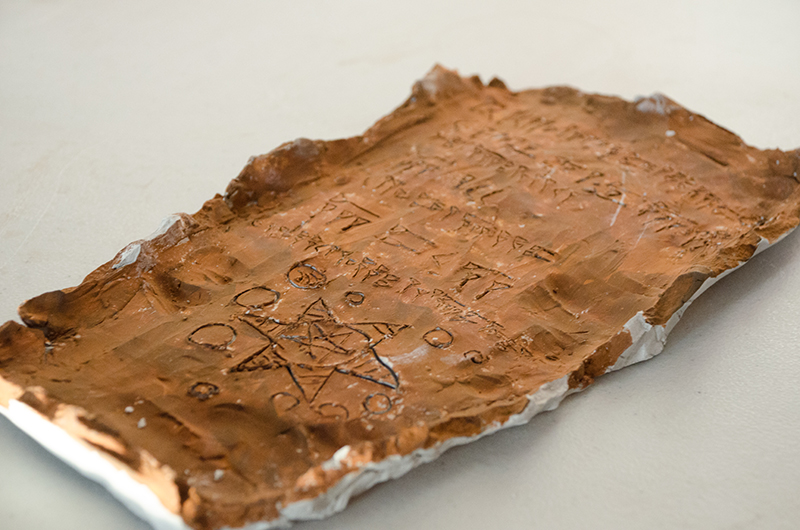
An Elementary student’s model representation of a clay tablet from ancient Sumer.
-
-
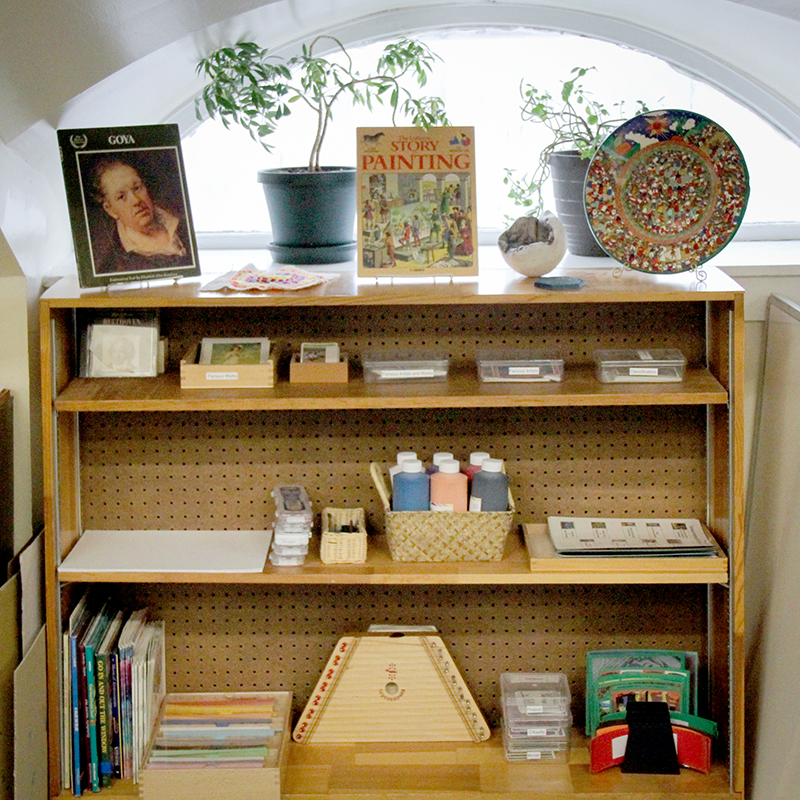
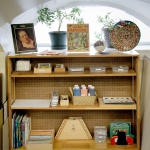
Art shelves in classrooms give students access to materials and art history resources.
-
-
Art shelves in classrooms give students access to materials and art history resources.
-
-
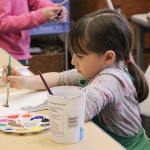
A student paints during Open Art Studio.
-
-
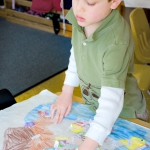
A Children’s House student painting a detailed map of Europe in his classroom.
-
-
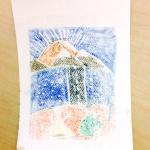
A Lower Elementary student’s styrofoam plate print.

“Intelligence plus character – that is the goal of education.” – Dr. Martin Luther King, Jr.
During many of our parent education events, we talk quite a bit about fostering the development of soft skills in our children. Soft skills – also referred to as “people skills” – include a person’s social graces, habits, personality traits, and interpersonal skills.
When thinking about education for our children, parents often have high academic aspirations. But of course, we also want our children to be good. This goes without saying. We want them to be caring, compassionate individuals. We want them to be problem-solvers and leaders. It may seem obvious to parents, but how many schools are actually focusing on developing these skills?
At Greenspring Montessori School, we are constantly emphasizing these values in our children. We’ve also provided more resources below showing how essential these skills are in our adult lives, and how to focus on their development with your child.
Articles:
“Are you raising nice kids?” – A Harvard psychologist gives 5 ways to raise children to be kind
http://www.washingtonpost.com/news/parenting/wp/2014/07/18/are-you-raising-nice-kids-a-harvard-psychologist-gives-5-ways-to-raise-them-to-be-kind/
“Why What You Learned in Preschool Is Crucial at Work” – Sharing, working together, thinking critically… do these sound familiar?
http://www.nytimes.com/2015/10/18/upshot/how-the-modern-workplace-has-become-more-like-preschool.html?_r=0
“How Schools Are Handling An ‘Overparenting’ Crisis” – Living in the era of helicopter parenting
http://www.npr.org/sections/ed/2015/08/28/434350484/how-schools-are-handling-an-overparenting-crisis
“Opting Out of the ‘Rug Rat Race'”
http://www.wsj.com/articles/SB10000872396390443819404577635352783638934
“The Gift of Failure”
http://www.jessicalahey.com/the-gift-of-failure/