The Benefits of Learning Cursive Writing

The Benefits of Learning Cursive Writing

“Learning cursive is good for children’s fine motor skills, and writing in longhand generally helps students retain more information and generate more ideas. Studies have also shown that kids who learn cursive rather than simply manuscript writing score better on reading and spelling tests, perhaps because the linked-up cursive forces writers to think of words as wholes instead of parts.” – Katy Steinmetz, Time Magazine

Elementary Cursive Writing - Greenspring Montessori School

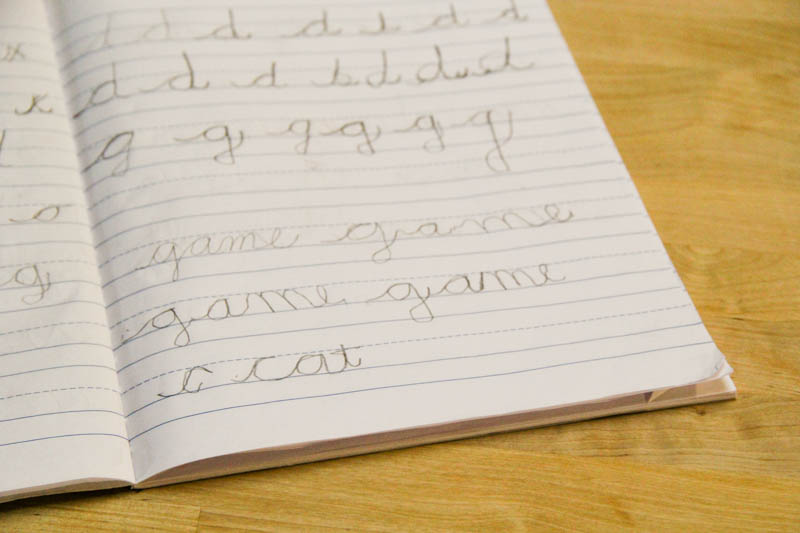
A sample of early cursive writing from a Lower Elementary (first grade) student at Greenspring Montessori School.

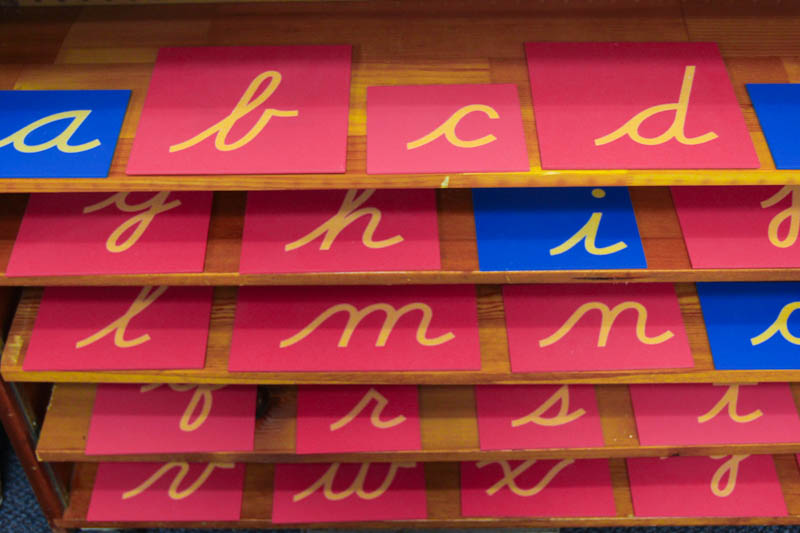
At Greenspring Montessori School, we have extended our commitment to teaching cursive writing to our Children’s House students. Starting at age 3, students now have access to cursive sandpaper letters, cursive name tags, and lessons on cursive handwriting.

Teaching Cursive Writing - Greenspring Montessori School

It been proven that cursive writing engages more of the brain and helps students become better at spelling. As they are writing, children are able to slow down and focus on the precision, allowing them to think about what they are trying to say, instead of simply copying letter for letter. Our Children’s House guides look out for signs that an individual student is ready to begin learning cursive, as they also work on their print handwriting.

Teaching Cursive Writing - Greenspring Montessori School

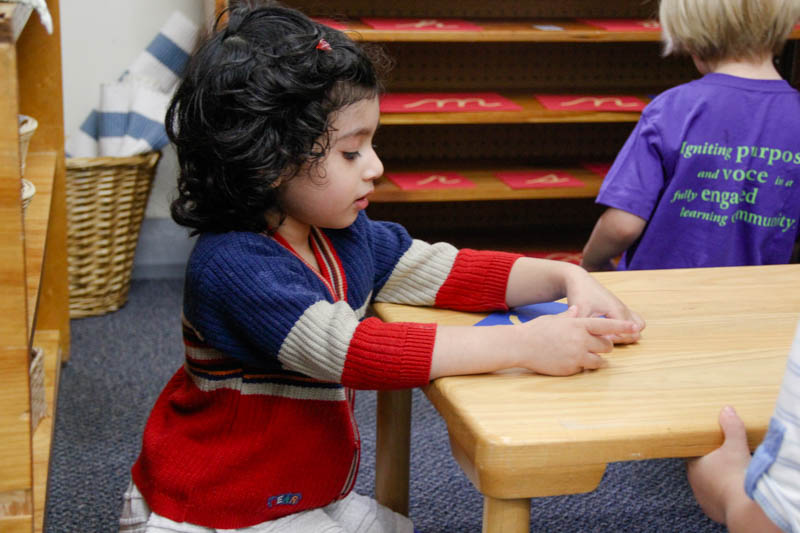
True to the Montessori model, our guides teach to the individual child. We know our students learn in different ways and at different speeds. In any one of our Montessori Children’s House classrooms, the students are spread about working on all kinds of different activities that interest them. If a student, for example, is drawn to the cursive sandpaper letters, the guide may give the child a lesson on the different parts of the letters, or on spelling out words using the large tangible pieces. If they are working on their pencil grip, the guide may suggest they try a word they know in cursive.

By the time the child enters Lower Elementary, they are working on the precision of their handwriting, creating more elaborate writing pieces to express themselves.

Want to learn more about our emphasis on cursive writing? Please contact us at inform@www.greenspringmontessori-b.dev.


Here are a few more articles and resources on cursive writing:

5 Reasons Kids Should Still Learn Cursive Writing,” Time Magazine.

Ten Reasons People Still Need Cursive,” The Federalist.

What’s Lost as Handwriting Fades,” The New York Times.

Developing Soft Skills in Montessori Classrooms

Developing Soft Skills in Montessori Classrooms

Developing Soft Skills in your Child - Greenspring Montessori School

“Intelligence plus character – that is the goal of education.” – Dr. Martin Luther King, Jr.

During many of our parent education events, we talk quite a bit about fostering the development of soft skills in our children. Soft skills – also referred to as “people skills” – include a person’s social graces, habits, personality traits, and interpersonal skills.

When thinking about education for our children, parents often have high academic aspirations. But of course, we also want our children to be good. This goes without saying. We want them to be caring, compassionate individuals. We want them to be problem-solvers and leaders. It may seem obvious to parents, but how many schools are actually focusing on developing these skills?

At Greenspring Montessori School, we are constantly emphasizing these values in our children. We’ve also provided more resources below showing how essential these skills are in our adult lives, and how to focus on their development with your child.


Articles:

“Are you raising nice kids?” – A Harvard psychologist gives 5 ways to raise children to be kind
http://www.washingtonpost.com/news/parenting/wp/2014/07/18/are-you-raising-nice-kids-a-harvard-psychologist-gives-5-ways-to-raise-them-to-be-kind/

“Why What You Learned in Preschool Is Crucial at Work” – Sharing, working together, thinking critically… do these sound familiar?
http://www.nytimes.com/2015/10/18/upshot/how-the-modern-workplace-has-become-more-like-preschool.html?_r=0

“How Schools Are Handling An ‘Overparenting’ Crisis” – Living in the era of helicopter parenting
http://www.npr.org/sections/ed/2015/08/28/434350484/how-schools-are-handling-an-overparenting-crisis

“Opting Out of the ‘Rug Rat Race'”
http://www.wsj.com/articles/SB10000872396390443819404577635352783638934

“The Gift of Failure”
http://www.jessicalahey.com/the-gift-of-failure/


Peace Education in the Montessori Classroom

Peace Education in the Montessori Classroom

In our modern world, it is so easy to get sucked in to conflict – online, on the news, with our family and friends. It is important that at a very young age, we begin to learn how to settle our differences and appropriately handle strong emotions.

Peace education is a major component of the Montessori classroom. Adults model peaceful and respectful behavior, and because Montessori classrooms are composed of mixed age groups, older students serve as role models for younger children.

Peace Corner - Greenspring Montessori School

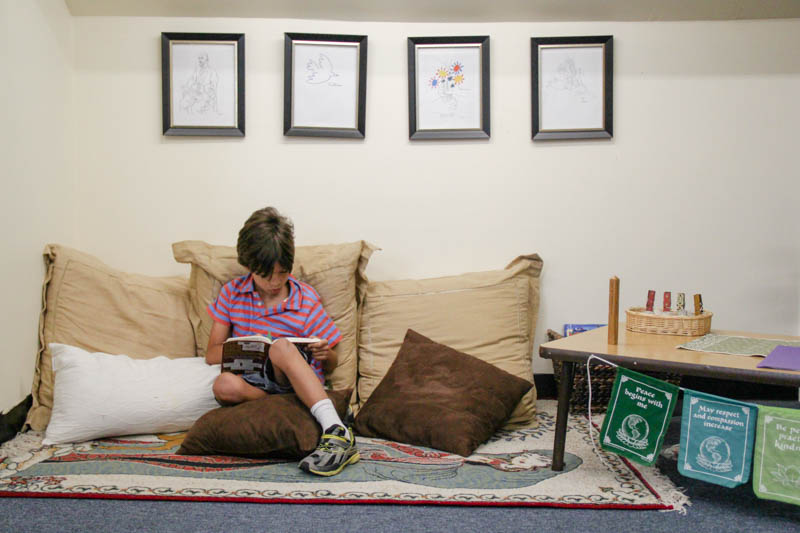
Most classrooms have a peace corner or peace table, at which two students can go to resolve a conflict or a single child can go to calm down and feel peaceful. One strategy is the use of a peace rose. Children learn to take turns holding the peace rose while speaking about how they feel. They stay at the peace table until they have heard each other and resolved their conflict. With very young children, adults model and coach the children with words they can use. Older students can do this independently. At the Elementary level, when the imagination takes off, students enjoy role playing and solving problems in small groups. Elementary and Middle School age students may participate in student-led community meetings, in which conflicts are discussed, brainstormed, and resolved as a group.

Going hand-in-hand with peace education is the Montessori Grace & Courtesy curriculum. Students practice simple lessons such as how to greet others, say please and thank you, tuck in chairs. At the core of these lessons is respect for others, self, and the environment. Montessori students engage in community service at every level – within the classroom for youngest students and outside the classroom and the school for older students.

Below are some additional resources related to Peace Education in the Montessori classroom. For more information on our programs at Greenspring Montessori School, please contact us at inform@www.greenspringmontessori-b.dev or give us a call at 410-321-8555.


Video:
Educating for Peace: The Essence of Montessori


Articles:
The Montessori Approach to Discipline
http://www.montessori.org/parents-information#22363

Cultivating Peace in the Classroom
http://www.montessoriservices.com/ideas-insights/cultivating-peace-in-the-classroom

The Peace Corner
http://www.montessoricircle.com/peace-corner-creates-harmony-in-classrooms-and-at-home/


Books about Peace Education in the Montessori Classroom:
Education and Peace by Dr. Maria Montessori
http://www.amazon.com/What-Peace-students-Montessori-Washington/dp/1938609344/ref=sr_1_4?ie=UTF8&qid=1445357492&sr=8-4&keywords=montessori+peace

The Peace Table by Mary Da Prato
http://www.amazon.com/PeaceTable-Montessori-Mystery-Unveiled/dp/1507613873/ref=sr_1_3?ie=UTF8&qid=1445357492&sr=8-3&keywords=montessori+peace


Picture books for children about Peace:
The Peace Rose
http://www.amazon.com/The-Peace-Rose/dp/0939195348/ref=sr_1_1?ie=UTF8&qid=1445357371&sr=8-1&keywords=montessori+peace

Our Peaceful Classroom by Aline Wolf
http://www.amazon.com/Our-Peaceful-Classroom-Aline-Wolf/dp/0939195046/ref=pd_sim_14_1?ie=UTF8&refRID=0C9FWEF57N7T83HXHTSV&dpID=61ZRZ21WRYL&dpSrc=sims&preST=_AC_UL160_SR160%2C160_

What is Peace? by Louise Kelley
http://www.amazon.com/What-Peace-students-Montessori-Washington/dp/1938609344/ref=sr_1_4?ie=UTF8&qid=1445357492&sr=8-4&keywords=montessori+peace


These are just a few of the many wonderful picture books about Peace for children! Current parents are always welcome to visit our library to check out books on peace education.

Discipline in a Montessori Classroom

Discipline in a Montessori Classroom

by Emily Shattuck, Children’s House Guide

After the field trip to Rodgers’ Farm last week, a parent commented how amazed she was by the children’s discipline. When it was time to leave the farm to return back to school, the children immediately stopped climbing on hay bales, bouncing on hippity-hops, playing tag and lined up. She said it was as if I had a magic ‘dog-whistle’ and wondered how I achieved this. I am often asked how the Guide disciplines children in a Montessori classroom. My answer is: we don’t discipline the children; the children develop self-discipline themselves through purposeful movement with a determined goal. It is concentration with the Montessori materials that aids the child in creating self-discipline.

I realize that this sounds very mystical and vague. I will begin by stating methods that are NOT used to develop discipline in a Montessori environment. Commands, bribes, praise and threats are not viable methods to help the child develop self-discipline. Discipline is NOT adult-driven. In fact, in order for the child to develop self-discipline, the adult needs to get out of the child’s way! “Children decide on their actions under the prompting of natural laws. Adults do it by taking thought. If the child is to exercise this power, it is necessary that he be not directed by someone telling him what to do at every moment in his life. Inner forces affect his choice, and if someone usurps the function of this guide, the child is prevented from developing either his will or his concentration. So if we want him to acquire these traits, the first thing we must do is to make him independent of the adult.” (Dr. Maria Montessori, The Absorbent Mind, p.218)

By providing an environment with engaging materials, a three-hour work cycle, and minimal distractions, the Montessori Guide creates an opportunity for concentration that will lead to self-discipline. When a new student enters the Montessori environment for the first time, he can be disorderly, resistant to adults, and have a short attention span. The Guide respects the child and recognizes that he has an inner directive and must create his own personality. The Guide gives timely lessons to help the child engage with the materials. The child is given freedom to choose when to have snack, when to spend time with friends, when to work in the garden, when to sit quietly and look at a book, and when to work purposefully with the materials. When the child freely chooses work, he is following his inner directive. “By means of these exercises, children not only exercise their muscles but they also give order to, and enrich their minds. These activities strengthen the will and develop understanding. The child becomes ever more conscious of himself and his environment.” (Dr. Maria Montessori, The Discovery of the Child, p.306)

The child is never rushed, praised, or critiqued. She is given the time and space to develop herself. Even when an error is made, the child is then challenged to problem solve or practice to achieve perfection. For example, a few weeks ago, on Grandfriends’ Day, a child was not moving carefully while carrying a tray and dropped a glass vase on the floor. When the glass shattered, many grandparents rushed in to help the child. I intervened and asked them to step back and observe. The child calmly got a dustpan and brush and cleaned the broken shards of glass. If an adult had rushed in to help the child, she would have been robbed of her independence and the opportunity to problem solve and persevere! I did NOT say, “Now look what you have done! What a mess to clean up!” I knew that this child was capable of cleaning up broken glass because she previously had lessons cleaning up a spill. When something is dropped or broken in the classroom, I have faith that the children will take care of cleaning it up because they are not told to do it, but because it is their choice. When a child concentrates on his work, he develop self-discipline, self-awareness, and self-satisfaction. Discipline begins within the child.

There are occasions when a child is disruptive, disrespectful, or dangerous. When this occurs, the Guide must intervene to protect the concentration of the other children working in the classroom. Disrespectful or disruptive behavior also gives children the opportunity to practice their grace and courtesy skills. If a child is disruptive to another student, the classmate can politely ask that child to find her own work. The children thus develop peaceful conflict resolution skills which are practiced daily via lessons of grace and courtesy. It is also very valuable to have mixed-ages in the class to model peaceful behavior. The third-year students are well-versed in conflict resolution after two years of practice! Third-year children serve as models and help the younger children that have not yet developed self-discipline. Since the three year olds idolize the third-year students, their example is far more powerful than any words of an adult.

Although I do not possess a ‘magic dog whistle’ to beckon the children to do my bidding, I do have faith in the Montessori method and the wisdom of the child (plus lots and lots of patience). Time and time again, I observe the change in a child after she has been engaged with a material. After a child concentrates on a work and fully attends with body and mind, I know that she is on the path to discipline.

I also want to thank you, the parents, for helping us achieve concentration in our environments. By supporting us in our school policies such as arriving on time, adhering to the no-carton clothing guidelines, and leaving toys at home, you help minimize distractions so our children can concentrate on the important work of disciplining themselves.

If you would like to learn more about how Maria Montessori’s century-old observations about concentration are supported by current neuroscience, there are some great explanations in these videos: