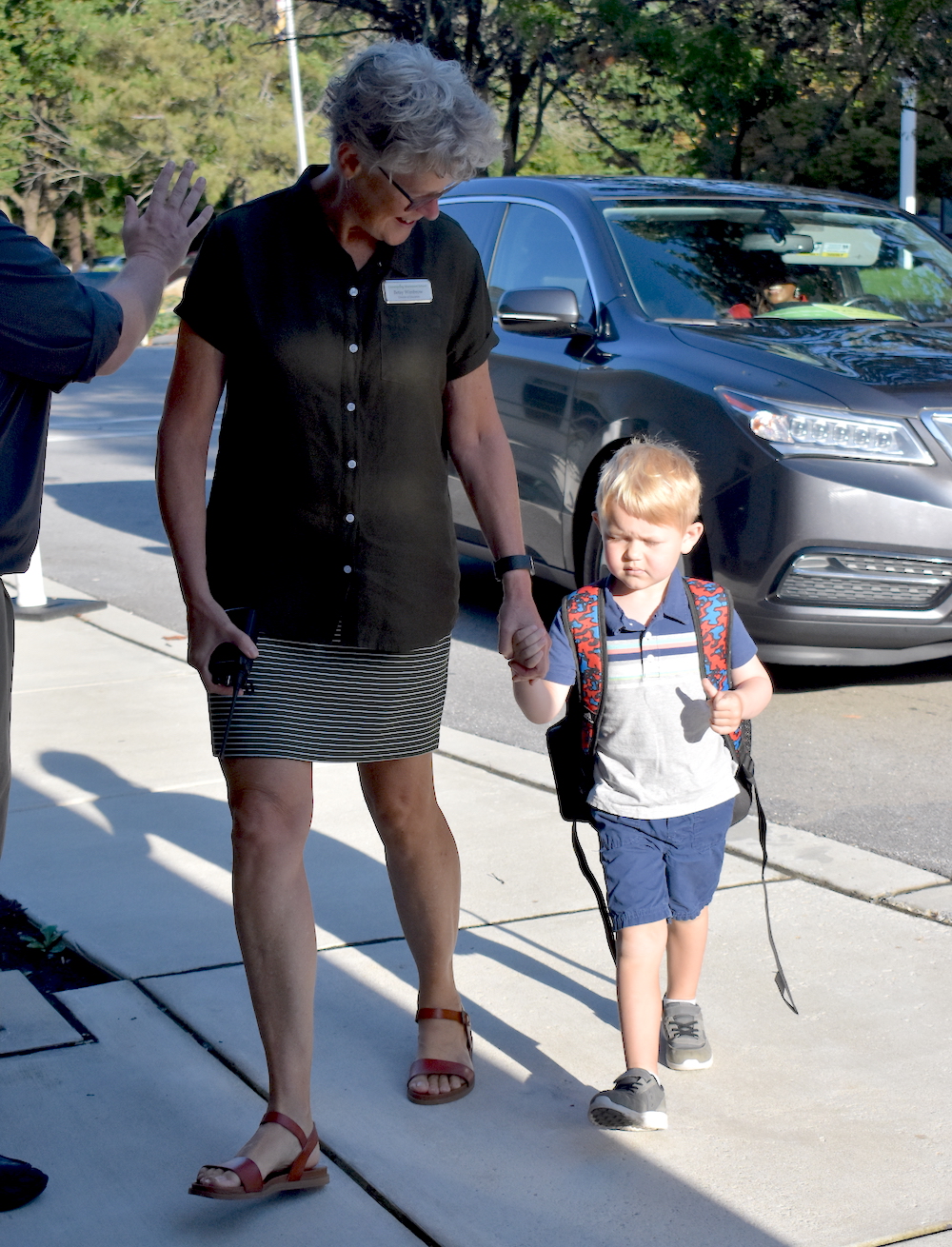
Beginning a new school year is a time of excitement and uncertainty for many new children. For some, it is their first time being away from home for a stretch of time. It is common for students (and parents) to experience feelings of anxiety; this is perfectly normal. These feelings are often caused by a fear of the unknown, as the child has no point of reference to draw upon when faced with a new environment or experience.
Separation anxiety can also be attributed to a child’s stage of development. Separation anxiety is a normal part of development, and most common for children aged eight months to two years; however, it can affect children of all ages. The first day of school, in a new room or level, can bring on a reoccurrence of separation anxiety in children who were previously settled. It takes time for young children to build relationships and establish a sense of trust with their new guides, so that they come to understand that their new environment is a safe and happy place. This is not uncommon, and is likely to settle once a new routine and relationships have been established.

Below you will find a number of strategies published by the Montessori Academy to help Montessori parents settle their children into preschool. Remember separation anxiety is a phase, it is perfectly normal, and will pass in time.
Positive Behaviors and Attitudes
Modeling positive behaviors and attitudes plays an important role in the success of the first day of school, and the weeks thereafter. Keep discussions about school positive, and focus on things that your child is likely to enjoy. Children pick up on parent’s feelings, behaviors, and emotions, and are likely to emulate them if you are feeling upset or uncertain.
Morning Routines
Establish a positive and happy morning routine for preschool days. For children over two, this may include encouraging your child to pack their own school bag or sing a happy ‘school day’ themed song. Always give yourself plenty of time to get ready and arrive on time. Feeling late or rushed can cause children to feel additional anxiety.
Acknowledge your Child’s Feelings
It is important to accept that your child’s unhappiness at being separated from you is real, very normal, and temporary. Reinforce that you understand that leaving your child makes them unhappy, but that it is important that you leave, and they will have a good time. Avoid offering your child bribes for good behavior or not crying as this is only a temporary solution. Learning to cope with sadness is an important part of your child’s development and learning about emotions.
Positive and Prompt Goodbyes
When you drop your child off, don’t linger outside the classroom or stay for “just one more minute.” As a parent, the best thing you can do is give your child a hug and a kiss as they get out of the car, let them know you love them, and reassure them that you will be back soon. It is important for your child that you do not delay the inevitable.
Establish a Goodbye Routine
Montessori parents who establish a consistent goodbye routine typically have better luck with successful goodbyes. Take a special moment with your child to say goodbye, and do it the same way, every day. This may be as simple as a kiss and a cuddle, giving your child a thumbs up, or establishing a ‘secret’ hand shake. A special goodbye is a great way for your child to start their day feeling happy and reassured.
Encourage Friendships
Make a point of getting to know your child’s friends and classmates at school, and encourage friendships outside of school. These friendships will help make your child’s transition to the new Montessori environment easier.
Pick Up Routines
It is important to be punctual when picking up your child. It easy to lose track of time, but no matter who is picking your child up, always be on time. If you are late, it can cause your child to feel more anxiety, and makes drop off the next time much harder.
Positive Daily Reflections
On the way home, establish a routine where you talk to your child about their school day. Focus on the positive aspects of their day, such as their favorite activity, or playing with their best friend. By consistently reinforcing the positive aspects of their school day, your child will learn that their new environment is a fun and happy place, and their feelings of anxiety will decrease over time.
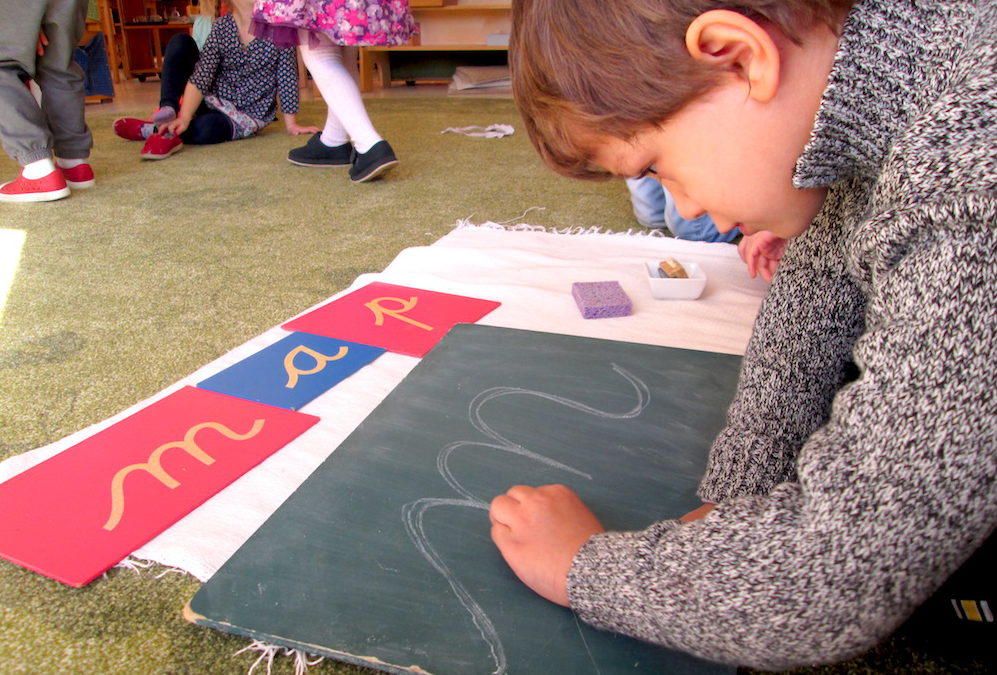
Stages of Language Development:
Step 1: Spoken Language: create an internal dictionary and practice using the words in it
Step 2: Phonemic Awareness: learn the sounds within words and the sounds/symbols of our alphabet
Step 3: Creating Words (Writing): learn to put those sounds/symbols together to make words
Step 4: Reading: Learn to decode those sounds/symbols to decipher words
Questions and Answers
Why do you teach letter sounds rather than letter names?
What does a child need to learn to be able to write or read? That the letter “a” has a name, pronounced “aye,” or that it makes a sound, “æ” in the international phonetic alphabet, like in “apple” or “cat”? From a literacy perspective, the answer is clear: to write and read, children need to learn the sounds letters make, not their names. “Cee-aye-tee”, no matter how fast you say it, never blends together to make the sound “cat.” Yet most commercial products and educational television programs focus on teaching letter names. At best, they introduce sounds and names simultaneously, with emphasis on the name of the letters. In Montessori, in contrast, we start literacy by teaching sounds exclusively. (Download a list of Phonetic Letter Sounds here.) Because we don’t focus on letter names, the process is much less confusing for children, and it enables them to more quickly begin to write and read.
Why do you present only lowercase letters at first?
Most commercial materials and much public school instruction starts with capital print letters. This is contrary to what a child actually needs: 93% of what we read and write is written in lowercase letters, as is most of the writing they’ll do. That’s why in Montessori classrooms, we introduce lower-case letters first, and introduce capitals only later. Children in Montessori learn to associate letter sounds with letter shapes using a material called the Montessori Sandpaper Letters.


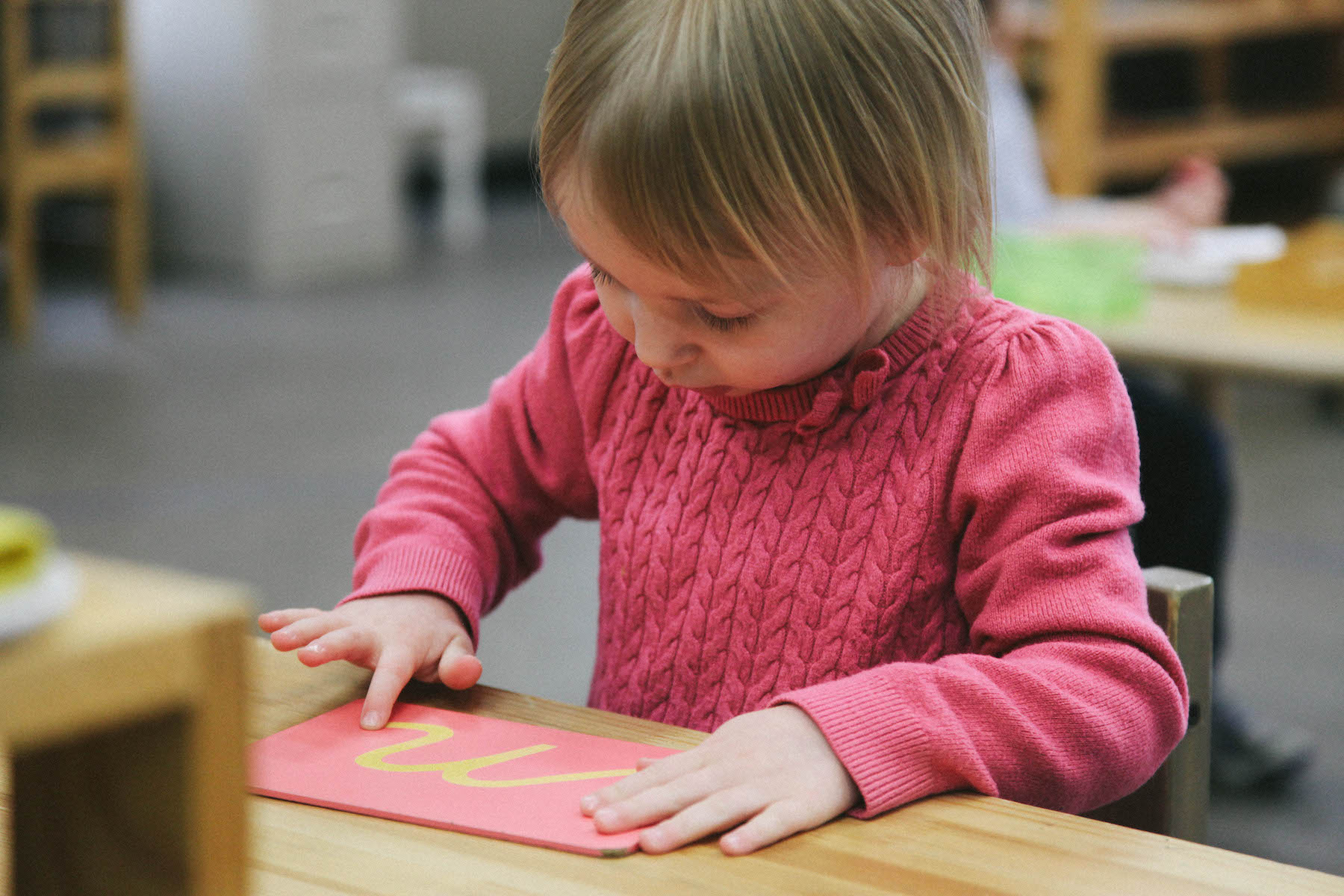
Children begin learning the letter sounds using sandpaper letters, which incorporate the sense of touch to further reinforce learning. They trace the letter with their fingers on a textured sandpaper inscription of the letter, learning the strokes used eventually to write that letter on paper.
Why do you present the letters out of (alphabetical) order?
When giving these lessons, Montessori guides present no more than three letter sounds at a time. There is no specified order of introduction, other than making sure that the letters don’t look and/or sound alike. One example of a presentation order is:
First set: c m a t
Second set: s r i p
Third set: b f o g
Fourth set: h j u l
Fifth set: d w e n
Sixth set: k q v x y z
Some Montessorians first introduce the first letter of the child’s name as a point of interest.
Why does writing precede reading?
The process and connection to writing will always precede that of reading. Cognitively, writing is just an analytical process that involves breaking down a word into its sounds. Reading is a more advanced mental process, requiring both analysis AND synthesis (putting the parts together).
Usually, children begins reading about six months after they start writing (composing words). Why? When you are writing, you are expressing your own thoughts. You are coupling sounds together to express your own intended meaning. Reading, on the other hand, involves putting sounds together and analyzing their meaning and order to comprehend an unknown meaning.
Why do you use hands-on materials to teach writing and reading?
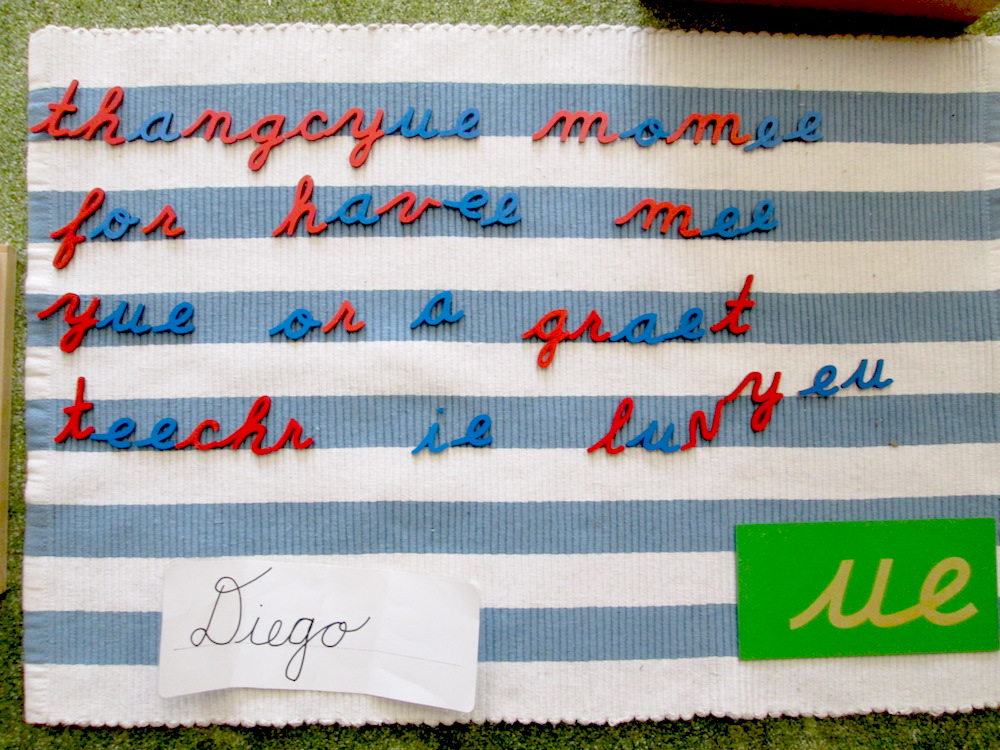
Separate handwriting from word-building. For a child to write a word, he needs to combine two separate skills: he needs to segment the word into sounds, represented by letters—and he needs to have the motor skills to write these letters on a piece of paper. Often, children can associate sounds with letters long before they can easily form the letters: their conceptual understanding of language is more advanced than their motor skills. That’s why in the Montessori program, children first “write” by building words with the Montessori Moveable Alphabet, a set of wooden letters that a child can arrange in different orders. They make words by placing the letters on a rug. This enables them to practice putting sounds together to make words—separated from the more challenging task of forming the letters with a pencil.


Children in Montessori classrooms also prepare the hand for writing with physical exercises, such as those found in our Practical Life and Sensorial areas. Children need to cut with scissors; they need to paint, to sew, to peel eggs, to wash tables; they need to build towers, hold puzzles by little knobs and carry big materials. These indirect preparatory materials strengthen shoulder, arm, wrist and finger muscles! The Montessori Metal Insets then help children joyfully master full pencil control: as they trace the inside and outside of the shapes, and color them in with careful, parallel lines, they have fun creating art and are imperceptibly and steadily improving their pencil control.
Why do you teach cursive first?
While cursive letters seem intimidating to most adults, they actually prove to be easier to learn than print letters: while writing in cursive, you don’t have to continuously lift the pencil off the page. This makes the act of writing fluid and continuous, without the extra stops and starts associated with print letters. In addition, letters that are easy to confuse in print are distinct in cursive, so children are less likely to reverse these letters.


Fascinating new research points out the benefits of cursive writing for cognitive development. A recent article in Psychology Today cited research which shows that:
- Students “wrote more words, faster, and expressed more ideas when writing essays by hand versus with a keyboard.” This study included second, fourth, and sixth graders.
- “Cursive writing helps train the brain to integrate visual (and) tactile information, and fine motor dexterity.”
- The regions of the brain that are activated during reading were “activated during handwriting, but not during typing.”
How can parents help at home?
You can help by:
- Articulating slowly and carefully
- Encouraging the children to speak and pronounce words
- Repeating new words
- Singing songs
- Reading books
- Reciting poetry
- Playing sound games like “I Spy” (see below)
- Please do not teach your child to memorize the names of the letters! Instead, emphasize the sound that each letter makes.
- Write in cursive when writing with your child
- Use lowercase letters when writing with your child
- Enjoy activities that build the muscles needed for writing (cutting, painting, etc.)
The “I Spy” Game
Here’s a great way to start on letter sounds, suitable for children of about 2 ½ years or older: Play a sound “I spy” game. Collect a few items with different beginning sounds (a fork, a cup, a napkin, for example). Place each item in your hand, and focus your child’s interest on the sound at the beginning of the word: “I spy something in my hand that starts with fffff: a f f f fork.” Once your child has mastered the sounds, you can advance to playing real “I spy”, asking them to look around and find items in their environment that start with the letter sound you mention. You can play this game at home, while on a walk, or in the car!

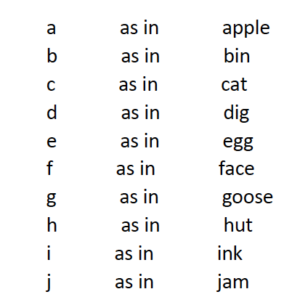
An important note: When making letter sounds with your child, be careful not to add the sound “uh” to the end. Letter sounds should be clipped to include only the consonant itself, such as “c” as in “cat” – and not “cuh.” You can download a list of Phonetic Letter Sounds here.

Greetings from Florida! For those of you who don’t know me, I was a Lower Elementary guide and then the Director of Admissions at Greenspring before moving to Florida. I began this series on Montessori in the Home to help parents find creative ways to implement Montessori practices at home. My daughter, Lila, just turned four. Her play space has evolved since she was an infant, but the guiding principles remain the same.
Setting up a Montessori-inspired play space at home does not require a great deal of time or expense. The goal is simply to create a space that encourages independence and concentration. Here are some key components to keep in mind:
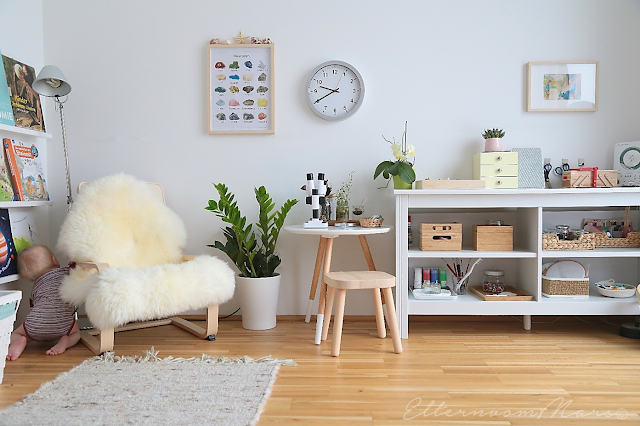
Simplify: Montessori spaces use more neutral colors and have very little (or nothing) hanging on the walls. What is displayed on the walls is carefully chosen and hanging at the child’s eye level. The goal is to reduce the visual stimulation of the environment, so that the child will be attracted to the materials (toys) and be able to concentrate on her work (play).


A sample play space for a young toddler A sample play space for a six year old
Reduce: Consider reducing the number of toys available. You may use a small shelving unit with two or three shelves and just a few items on each shelf. Putting out just a few toys at once, and rotating them regularly, allows your child to focus on what’s available. Also, rotating toys will rekindle your child’s interest in older toys that they haven’t seen for a while. When a toy has remained on the shelf for a whole week untouched, you know it’s time to put it away and put out something different.
Organize: Children have a sensitive period for order from birth through age five, peaking in early toddlerhood. You can see this through young children’s love for routine and repetition. Young children are most comfortable when their physical environments are orderly. Montessori environments support this desire for order by designating a specific spot for each material. In a play area, instead of a big toy bins full of many unrelated things, each toy has a space where it belongs on a shelf. Toys with multiple pieces, like blocks or play animals, can be organized in small baskets or trays on the shelf. You can even attach photos to each bin or shelf so that the child knows exactly where each toy belongs.
Provide varied work spaces: The furniture in Montessori classrooms is child-sized and the materials are kept on low shelves so that the child can access them independently. If you have the space at home, it’s ideal to include a child-size table and chair(s), an open space allowing for movement and large floor work, and a cozy spot for resting or recovering from an upsetting moment.
Include nature: If possible, choose a room with natural light. House plants offer children a chance to take care of something, as well as adding natural beauty to the room. Young children also love watching fish or other pets and older children can help feed and care for them as well. You might also consider setting up an outdoor play area where your child can dig in the dirt, water plants, enjoy sand and water play, and do messy art projects.
Choose toys carefully: While there is no need to fill your home with “academic” work, you can select toys that help your child develop in different ways. You might think about including toys that develop fine motor (small muscles), gross motor (big muscles), art and music, books, and open-ended items (like blocks) for creative play. It’s also important to include toys that offer a varying degree of difficulty. You want a mix of challenging toys and things that are easy and familiar for her to play with when she needs a mental break. Open-ended toys that engage rather than entertain (such as those that light up or make noises) will encourage creativity and concentration.
Give it a try! This might seem like a lot to think about, but you can pick and choose what works for your child and your home. I feel free to “break the rules.” I still keep all of Lila’s stuffed animals in one large bin. And though most gifts made of plastic or requiring batteries “disappear” after a few days, a few favorites have been allowed to stay. And despite my best intentions, getting Lila interested in “clean up time” is still a constant struggle. So don’t be too hard on yourself. Just have fun with it!
*By the way, you don’t need to spend a lot of money on toys, especially for young children. These have been some of Lila’s favorites over the years:


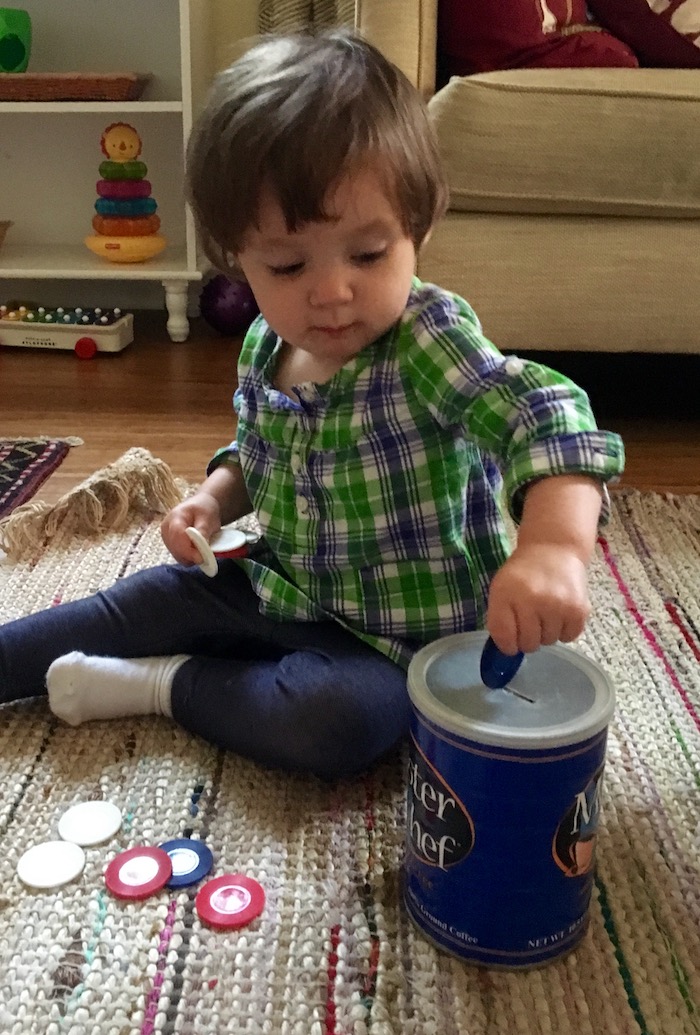
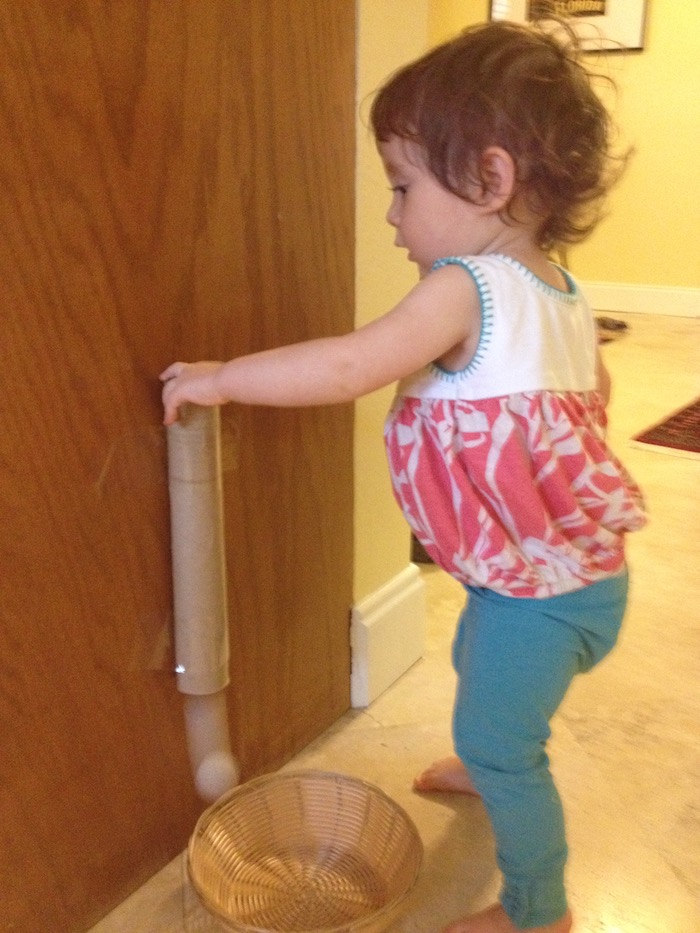
Scooping jingle bells into a metal muffin tin, posting poker chips into a coffee can, and posting ping pong balls through a paper towel tube.


As a toddler, Lila enjoyed the sound that polished stones made when dropped into a glass bowl; later she enjoyed sorting them by size and color; now she is interested in rocks and minerals.


Lila keeps a collection of natural treasures; recyclable materials make wonderful art supplies. Now Lila stops me on the way to the recycling bin and says, “Wait, we can make art with that!”
I have also written about setting up a Montessori kitchen, Montessori bedroom and a Montessori bathroom. Questions, comments, suggestions? Email me at mjarrell@greenspringmontessori.org.
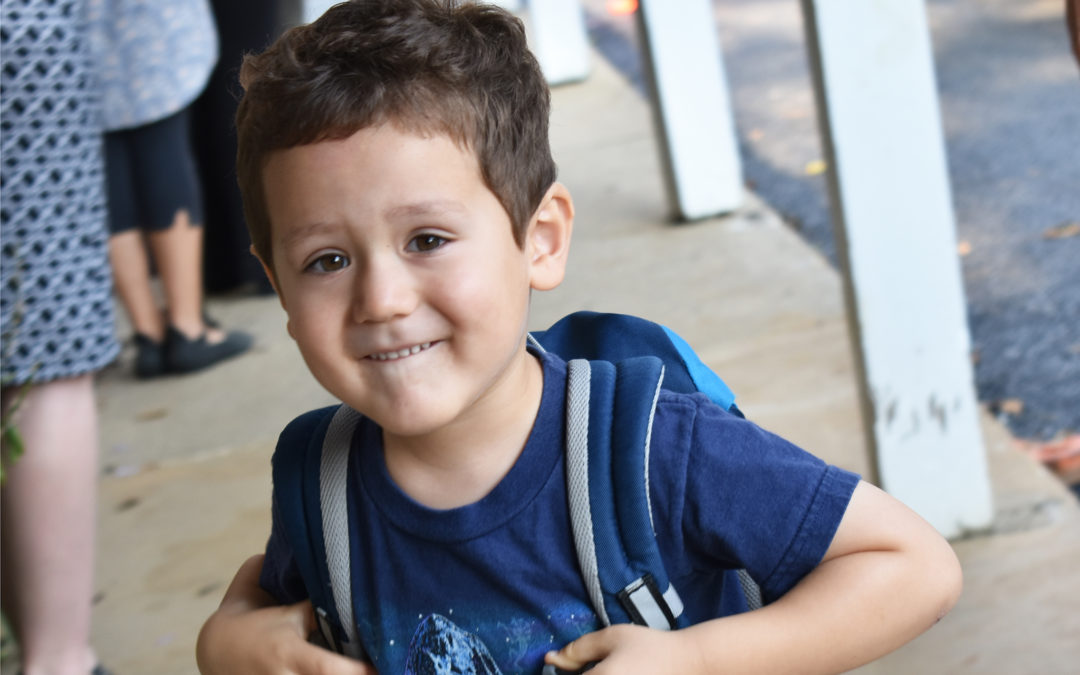
Does this sound familiar?
“How was your day?” … “Fine.”
“What did you do at school?” … “Nothing.”
It can be hard to get children to open up about what’s going on in their world, especially after a long day at school. Here are a few different communication strategies you can try. Find ones that work best for your family and then practice until they become part of your daily routine. This process takes time but can lead to more satisfying conversations in the long run.
Strategies to Try:
Wait at least a half an hour
After a long day at school wait at least 30 minutes to trying to engage in a conversation. Give your child a chance to take off the backpack, relax, and have a snack.
Ask open-ended questions
“Do you have homework?” or “Did you give your speech?” are questions that only invite a yes or no response. So try to pose open ended questions. Get creative! (There is a list of examples below.)
Be present
The moment your child starts to engage in conversation, stop what you are doing, and give your full attention. It can be hard to tear yourself away from what you’re doing to focus on a child’s question or comment, but your response can either encourage or shut down the conversation. Don’t forget to look interested!
Listen! And stretch the conversation…
Don’t talk, listen! Try comments like “Really?” “Uh-huh?” “I don’t believe it!” “Wow!” to stretch the conversation. They are non-threatening and invite the child to open up. You can also reflect back what the child is saying so they know you understand, and then be quiet so they can talk more. Child: “I played on the swing.” You: “You played on the swing.” The trick is to repeat the tidbit in a matter-of-fact but interested way to get your child to open up and add more.
Try to listen without judgement
Pushing, prodding, demanding, coaxing, lecturing, and threatening are sure ways to end conversations. Questions that begin with “Why” often make kids defensive. “Why did you wear that?” won’t work nearly as well as, “What do you think most of the kids will be wearing to the theater?”
Resist the urge to jump in with solutions and advice
Your child needs a chance to vent and can’t hear advice until she does. Then she needs a chance to figure out her own solutions, which is how she develops confidence and competence. When we can reflect feelings and then help children brainstorm solutions, kids find us more useful to talk to — and they’re more likely to seek us out when they have problems.
Take advantage of indirect communication
Kids often open more in the car, on a walk, or in the dark — all times when eye contact is limited. Remember that these are great times to get kids talking. Another opportunity for indirect communication is when their friends are over or in your car. Just keep quiet and listen. Your child knows you’re there, of course, but often is more willing to talk than if you were speaking directly.

Questions a child might answer at the end of a long school day:
What made you laugh today?
Did anything silly happen?
Did anyone do anything super nice for you?
What is the nicest thing you did for someone else?
Was there an example of unkindness? How did you respond?
What games did you play at recess?
Does everyone have a friend at recess?
Who did you sit with at lunch?
Who do you want to make friends with but haven’t yet? Why not?
Did you help anyone today?
Did you tell anyone “thank you?”
Who inspired you today?
What is something that surprised you?
What is something that challenged you?
What made you feel proud?
How were you brave today?
Will you teach me a song you learned at school?
What was your least favorite part of the day?
Tell me something good (or three!) that happened today.
What are you looking forward to tomorrow?
Do you have a teenager? Huffington Post has some great ideas about starting the conversation with your teenage children. Take a look here – https://www.huffingtonpost.com/liz-evans/28-ways-to-ask-your-teens-how-was-school-today-without-asking-them-how-was-school-today_b_5751546.html
If you are interested in learning more about Greenspring Montessori School, please click here to request more information.
Written by Emily Shattuck, Children’s House Lead Guide (and Mother of Two)
“Your job as a parent is to put yourself out of a job by raising your kid to independent adulthood (where independence equals not turning to you to handle/fix/resolve everything) and when you appreciate that every day offers a chance to build that independence, no matter what age and stage your kid’s at.”
~ Julie Lythcott-Haims author of How to Raise an Adult: Break Free of the Overparenting Trap
I agree with this quotation, but as a parent, I am also saddened by its truth. We all love our children and take great pride in caring for them: feeding them, dressing them, making sure they get enough rest, waking them in the morning, cleaning them, entertaining them, and educating them. As a parent of a 16 year-old high school junior and a 12 year-old seventh grader, I have fond memories of caring for my children as infants, toddlers, pre-schoolers, and through the elementary years. It is wonderful to feel needed and loved by our children. Being a parent is a very rewarding, fulfilling, and exhausting job and we would not trade it for the world!
While my children were young, however, I also was wary of the cultural norms to over-parent or “helicopter parent.” I know my children needed to develop skills to eventually leave the house at 18 and find their way in the world and it is my job to prepare them. With just two years remaining before my daughter’s 18th birthday, I decided to prepare myself for the craziness of the college application process and I picked up How to Raise an Adult, written in 2015 by Julie Lyhtcott-Haim, the former Stanford Freshman Dean of students. As a Montessori Children’s House guide, I was delighted when Montessori education was mentioned throughout the book. It states, “Despite the evidence that Montessori’s student-driven learning approach is a springboard to success in life, Montessori has yet to become a mainstream model for education in the in the United States.” (p. 158) It was both a relief and a validation that my children were Montessori students and had the benefit of a Montessori education.


Although many aspects of the Montessori curriculum lends itself to creating resilient, creative, caring, responsible adults, the Practical Life lessons in the Children’s House build the strongest foundation for a path to independence. When developing her first school in Rome circa 1907, Maria Montessori observed that children between the ages of two and a half to six years delighted in helping to care for their classroom. Montessori created child-size tables, chairs, brooms, mops, and other materials so the children could practice sweeping, mopping, and cleaning. She noticed that children enjoyed helping prepare food, set the table, do laundry, garden, and clean as adults do. An entire curriculum was created to fulfill the child’s need to contribute to his community and the Exercises of Practical Life were born.
There are four components of the Practical Life curriculum: Preliminary Exercises, Applied Exercises, Lessons of Grace and Courtesy, and Control of Movement Exercises. The Preliminary Exercises are lessons to give the child the opportunity to practice movements that she will use on a daily basis to perform tasks such as pouring, using a spoon, spreading with a knife, cutting food, or folding laundry. In the Applied Exercises, the child utilizes these developing skills to care for herself and the classroom environment, such as with hand washing, dressing herself, washing a table, or mopping the floor. The lessons of Grace and Courtesy provide the child with the opportunity to learn and practice social graces. Grace and Courtesy lessons include blowing one’s nose, saying excuse me, greeting a guest, introducing oneself, and walking around a work rug. The Control of Movement Exercises help develop self-control and include walking on the line and the Silence Game. The aim of all the Practical Life lessons is to promote independence, responsibility, coordination, concentration, respect for one’s self and their environment, and provide the child the opportunity to develop their identity as a contributing citizen of the community.


As a parent, it is comforting to know that our children are exposed to the lessons of Practical Life and are establishing themselves as members of their Montessori community. But we can also help our children develop these skills by allowing them to play a contributing role in the home environment. “A longitudinal study conducted by Dr. Diana Baumrind concluded that those who were most successful began doing chores at age three or four years of age, whereas those who waited until their teen years to start doing chores were comparatively less successful.” (Lythcott-Haim p. 198) This is wonderful news to parents of current Children’s House children because your children are already accustomed to this role in the classroom. By bridging the gap between school and home, you can assist your child in developing resilience, responsibility, and independence.
Montessori guides have an advantage since they can design the entire environment to serve the construction of the child’s personality. At home the surroundings and pace of life are designed for adults. Our job, as parents, therefore, is to remove obstacles to our children’s independence in the home life. Parents can begin this process as the Montessori guide does – by observing the child. Observe what the child can do for himself already, his interests, what causes frustration, and which skills that he needs to work on. Once we have observed the child, we can begin to prepare lessons that will serve the child’s development. For instance, if we see that a child cannot put on his own shoes or pour his own drink for snack, we present simplified lessons so the child can practice these skills in order to gain mastery. This requires thoughtfulness and patience. We cannot rush the child when he is doing the hard work of self-construction. We should move slowly, carefully, and with precision. As adults, we do not realize how fast we are moving! Children at this age have not developed the visual acuteness to track fast movements, so we must remind ourselves to slow down when we are giving a child a lesson. The Practical Life Exercises are also given in silence. You can name the activity and the tools used for the work, but the movements are not accompanied by language. We are silent so that the children can process the steps and actions visually and are not confused or bogged down by auditory processing as well.


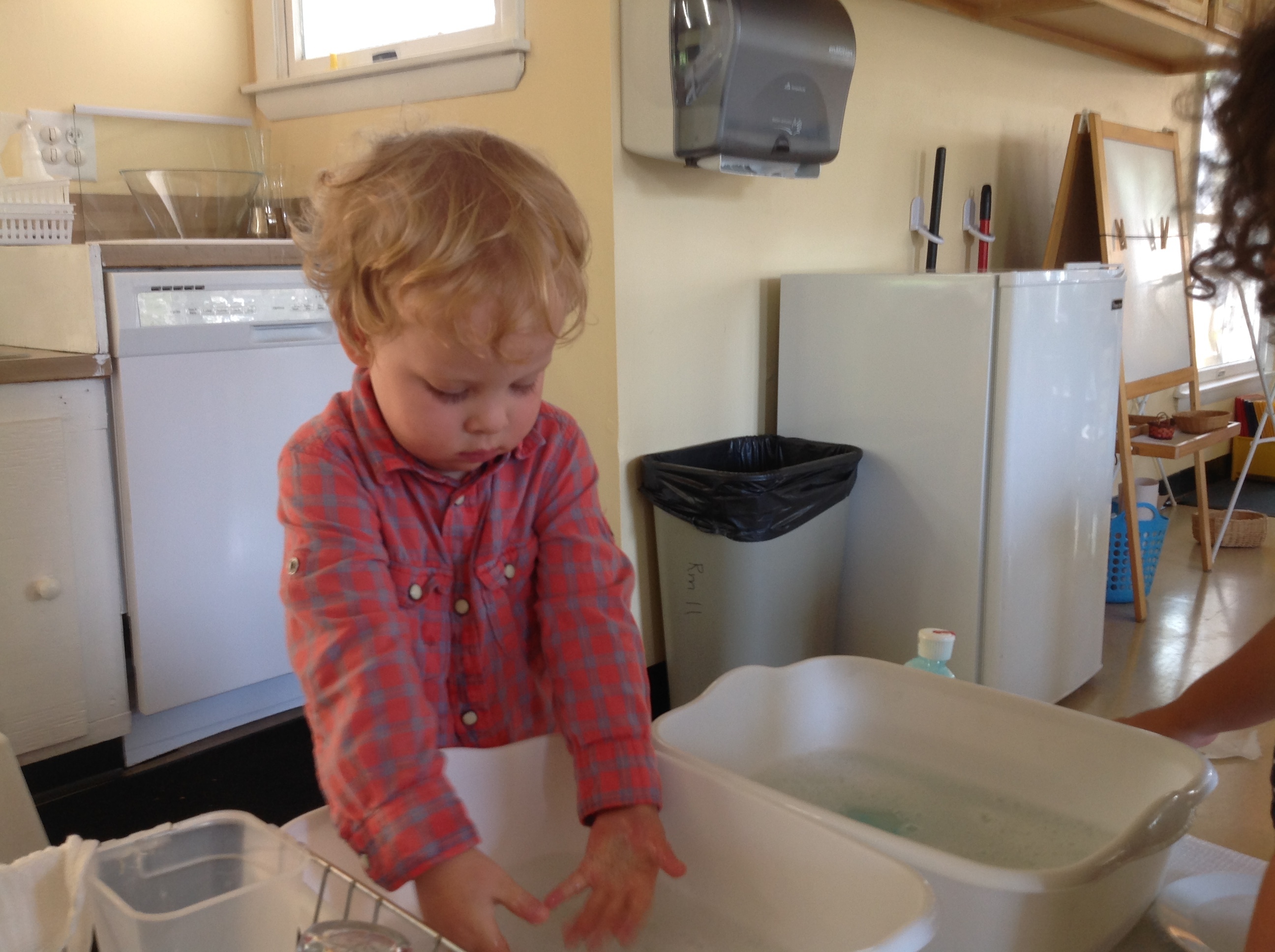
For instance, if you would like to give your child a lesson on washing his face you could introduce the lesson, “Today I will give you a lesson on washing your face.” You can name the tools used, “This is a wash cloth. This is soap. This is a towel.” Then you can demonstrate slowly how to turn on the faucet, wet the washcloth, rub it on the soap, rub it on your face, rinse the washcloth with water, rub your face again, turn off the faucet, hang up the washcloth to dry, and dry your hands and face. When preparing to give your child a lesson, practice yourself first and gather the necessary supplies. Make sure the supplies needed are suited to the child’s size and are accessible by the child independently. Practice the actions yourself, breaking them into steps, moving mindfully and slowly. When you are ready you can give a lesson to your child, finish the lesson by saying, “Now it’s your turn!” and give your child a turn to practice. You can end the lesson by saying, “You can wash your face whenever you like!” You do not praise the child, as the lesson it is not for your benefit, but a gift for your child.
Vicki Hoefle, author of Duct Tape Parenting, gives examples of skills and tasks children should learn and master at age four, including getting dressed on their own, making toast, brushing teeth, setting the table, taking dirty dishes to the dishwasher, making the bed, combing hair, packing own back pack, taking a bath, waking up with an alarm clock, wiping the table after meals, feeding pets, and cleaning the kitchen sink. (p. 143) Lythcott-Haims also includes tasks such as putting dirty clothes in the hamper, putting away toys, dusting, and washing one’s face (p. 167) as basic life-skills children age 3-5 should learn. “Children are innately interested and open to learning basic life skills, and if allowed and encouraged to do so, they grow into confident people who know that they matter within the family and within the community. This in turn affects how they develop socially. By the time they are teenagers, if they’ve mastered basic self and life skills, they can focus on developing their social skills.” (Hoefle p. 133)


Keep in mind that you must have patience, understanding, and self-restraint to actually make this work in your home. Your child is not going to perform these tasks perfectly the first time, or maybe even the 60th time. This is a process. It is our job to observe, give the lesson, and then move out of the way! Above all, do not follow behind them and do it for them if it is not done to your standards! That undermines their work and their self-worth. Also these tasks or chores should not be tied to an allowance, reward, or praise. They should be expectations as your child’s contribution to the household. (If you do want to introduce an allowance to help your child learn about financial responsibility, more guidance is given in Duct Tape Parenting.)
For more ideas on how to raise respectful, responsible, and resilient children, I highly recommend reading Duct Tape Parenting. If you are concerned that you may be one of those parents on the path to writing your child’s college essays, then I suggest How to Raise an Adult.
Your challenge this month:
Choose a time of day that you wish your child was more independent (for example, preparing for school, mealtime, or bedtime) and observe for fifteen minutes without stepping in. Then make a plan to determine what is going well and what your child needs to still work on. Develop a lesson to support your child with one skill. Then observe over the next few weeks to see how your child is progressing.
I hope you are as inspired as I am about current parenting books echoing what Maria Montessori knew over a century ago. “Children are the constructors of men whom they build. Childhood constructs with what it finds. If the materials are poor, the construction is also poor.” (Maria Montessori, letter to a government official,1947) And how fortunate to have your own child beginning the exciting work of creating the person he is to become!