Why do you teach letter sounds rather than letter names? (And other good questions about language acquisition…)
Stages of Language Development:
Step 1: Spoken Language: create an internal dictionary and practice using the words in it
Step 2: Phonemic Awareness: learn the sounds within words and the sounds/symbols of our alphabet
Step 3: Creating Words (Writing): learn to put those sounds/symbols together to make words
Step 4: Reading: Learn to decode those sounds/symbols to decipher words
Questions and Answers
Why do you teach letter sounds rather than letter names?
What does a child need to learn to be able to write or read? That the letter “a” has a name, pronounced “aye,” or that it makes a sound, “æ” in the international phonetic alphabet, like in “apple” or “cat”? From a literacy perspective, the answer is clear: to write and read, children need to learn the sounds letters make, not their names. “Cee-aye-tee”, no matter how fast you say it, never blends together to make the sound “cat.” Yet most commercial products and educational television programs focus on teaching letter names. At best, they introduce sounds and names simultaneously, with emphasis on the name of the letters. In Montessori, in contrast, we start literacy by teaching sounds exclusively. (Download a list of Phonetic Letter Sounds here.) Because we don’t focus on letter names, the process is much less confusing for children, and it enables them to more quickly begin to write and read.
Why do you present only lowercase letters at first?
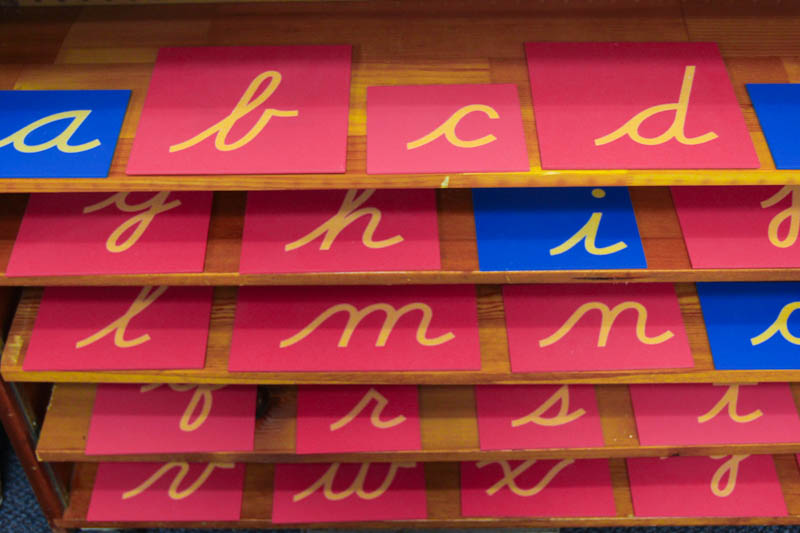
Most commercial materials and much public school instruction starts with capital print letters. This is contrary to what a child actually needs: 93% of what we read and write is written in lowercase letters, as is most of the writing they’ll do. That’s why in Montessori classrooms, we introduce lower-case letters first, and introduce capitals only later. Children in Montessori learn to associate letter sounds with letter shapes using a material called the Montessori Sandpaper Letters.
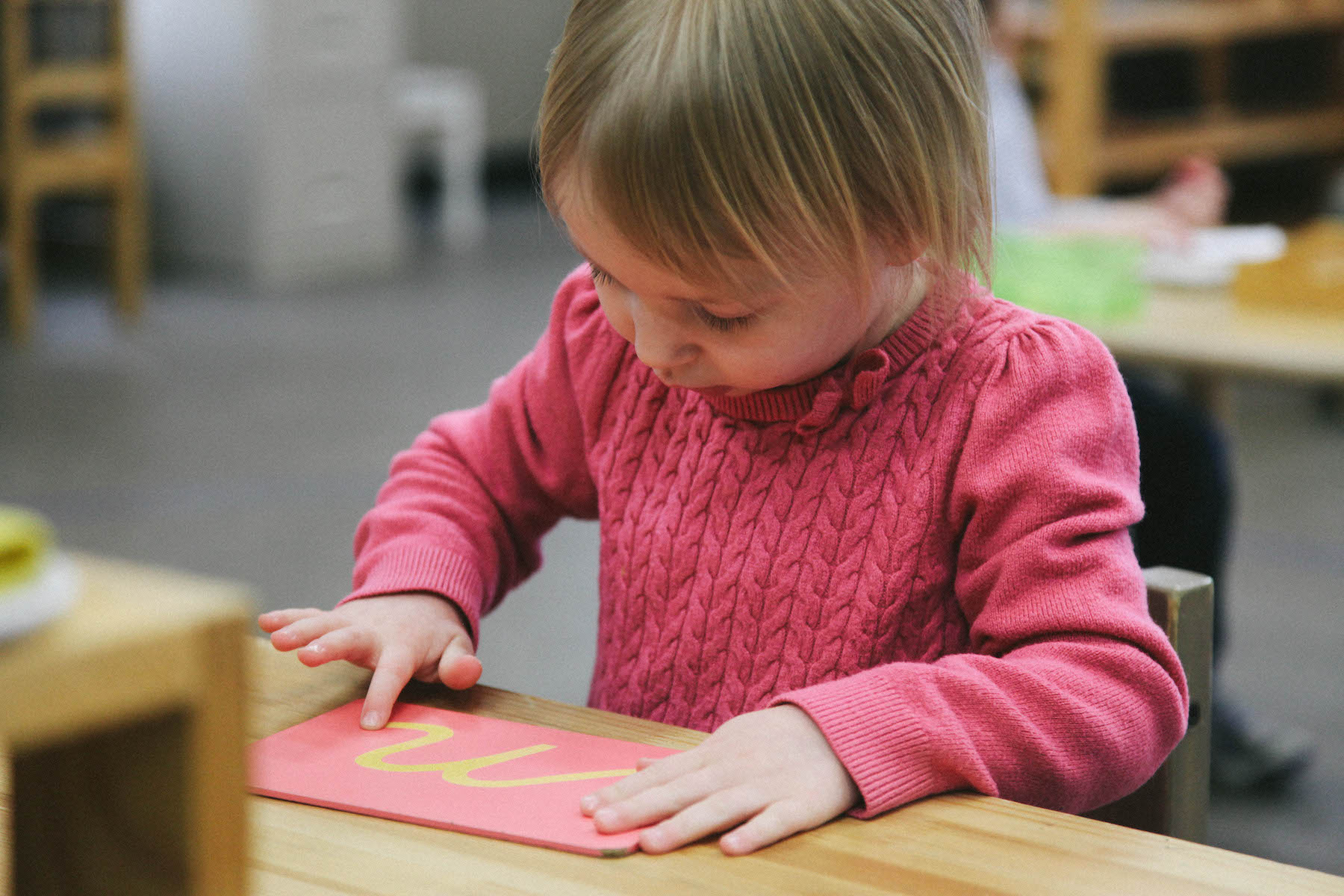

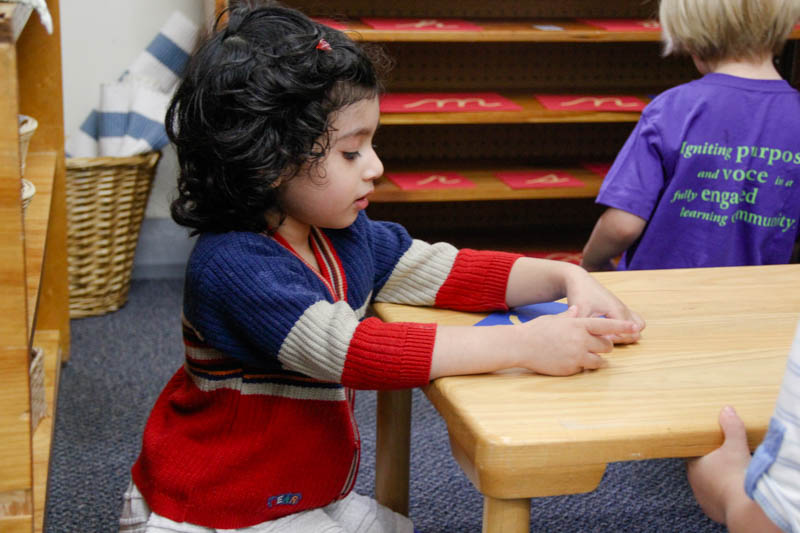
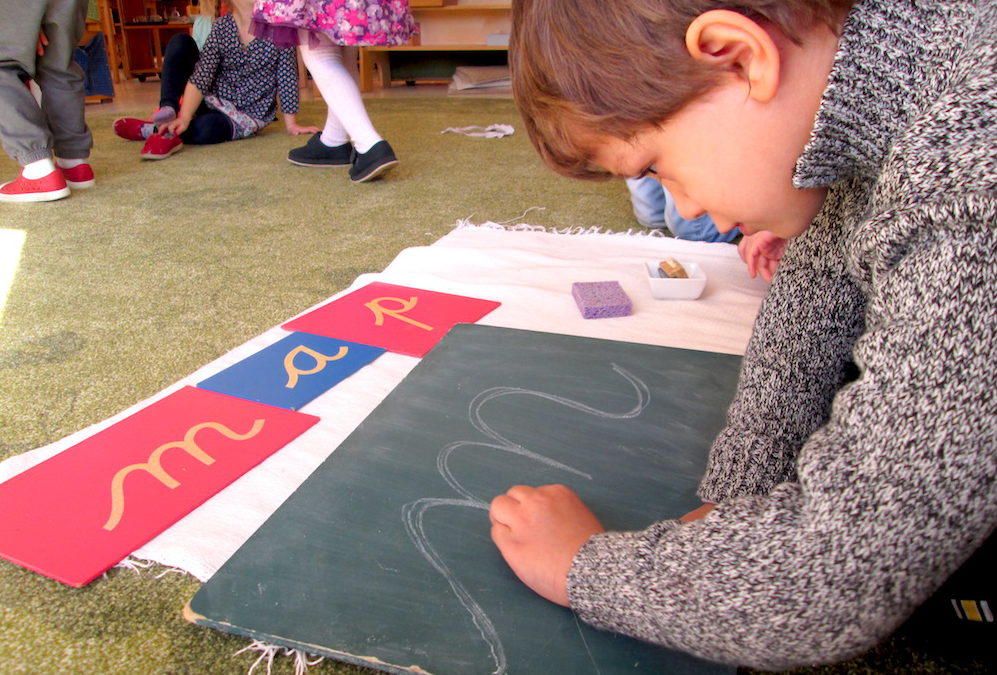
Children begin learning the letter sounds using sandpaper letters, which incorporate the sense of touch to further reinforce learning. They trace the letter with their fingers on a textured sandpaper inscription of the letter, learning the strokes used eventually to write that letter on paper.
Why do you present the letters out of (alphabetical) order?
When giving these lessons, Montessori guides present no more than three letter sounds at a time. There is no specified order of introduction, other than making sure that the letters don’t look and/or sound alike. One example of a presentation order is:
First set: c m a t
Second set: s r i p
Third set: b f o g
Fourth set: h j u l
Fifth set: d w e n
Sixth set: k q v x y z
Some Montessorians first introduce the first letter of the child’s name as a point of interest.
Why does writing precede reading?
The process and connection to writing will always precede that of reading. Cognitively, writing is just an analytical process that involves breaking down a word into its sounds. Reading is a more advanced mental process, requiring both analysis AND synthesis (putting the parts together).
Usually, children begins reading about six months after they start writing (composing words). Why? When you are writing, you are expressing your own thoughts. You are coupling sounds together to express your own intended meaning. Reading, on the other hand, involves putting sounds together and analyzing their meaning and order to comprehend an unknown meaning.
Why do you use hands-on materials to teach writing and reading?
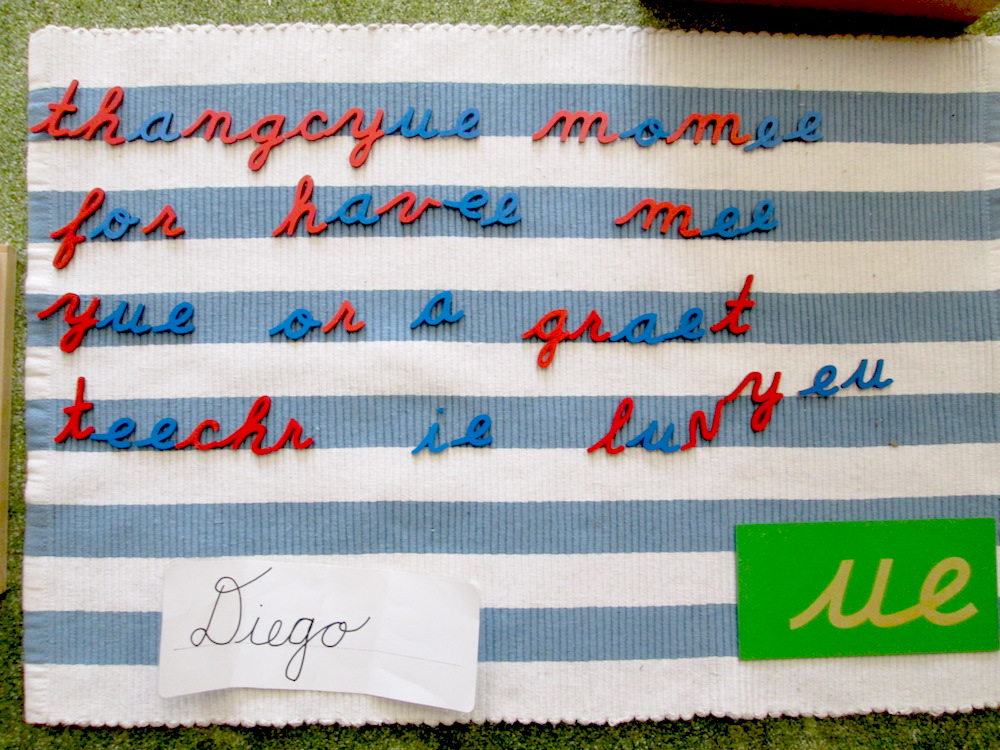
Separate handwriting from word-building. For a child to write a word, he needs to combine two separate skills: he needs to segment the word into sounds, represented by letters—and he needs to have the motor skills to write these letters on a piece of paper. Often, children can associate sounds with letters long before they can easily form the letters: their conceptual understanding of language is more advanced than their motor skills. That’s why in the Montessori program, children first “write” by building words with the Montessori Moveable Alphabet, a set of wooden letters that a child can arrange in different orders. They make words by placing the letters on a rug. This enables them to practice putting sounds together to make words—separated from the more challenging task of forming the letters with a pencil.

Children in Montessori classrooms also prepare the hand for writing with physical exercises, such as those found in our Practical Life and Sensorial areas. Children need to cut with scissors; they need to paint, to sew, to peel eggs, to wash tables; they need to build towers, hold puzzles by little knobs and carry big materials. These indirect preparatory materials strengthen shoulder, arm, wrist and finger muscles! The Montessori Metal Insets then help children joyfully master full pencil control: as they trace the inside and outside of the shapes, and color them in with careful, parallel lines, they have fun creating art and are imperceptibly and steadily improving their pencil control.
Why do you teach cursive first?
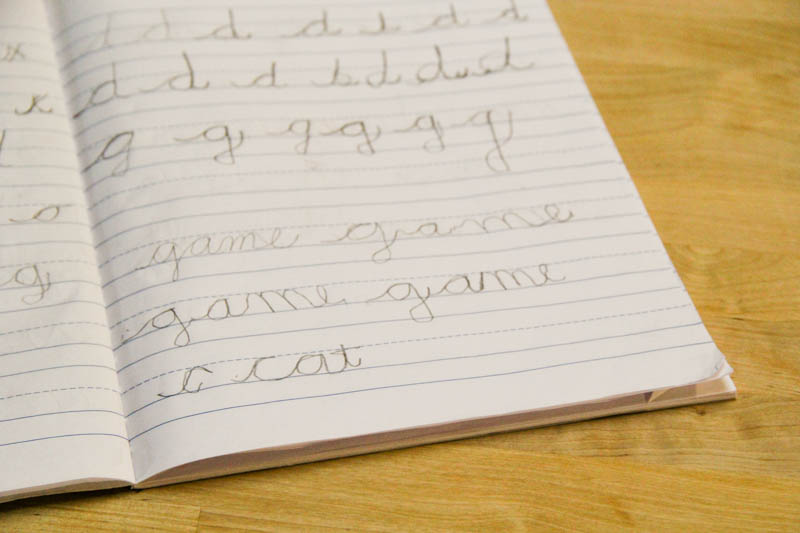
While cursive letters seem intimidating to most adults, they actually prove to be easier to learn than print letters: while writing in cursive, you don’t have to continuously lift the pencil off the page. This makes the act of writing fluid and continuous, without the extra stops and starts associated with print letters. In addition, letters that are easy to confuse in print are distinct in cursive, so children are less likely to reverse these letters.


Fascinating new research points out the benefits of cursive writing for cognitive development. A recent article in Psychology Today cited research which shows that:
- Students “wrote more words, faster, and expressed more ideas when writing essays by hand versus with a keyboard.” This study included second, fourth, and sixth graders.
- “Cursive writing helps train the brain to integrate visual (and) tactile information, and fine motor dexterity.”
- The regions of the brain that are activated during reading were “activated during handwriting, but not during typing.”
How can parents help at home?
You can help by:
- Articulating slowly and carefully
- Encouraging the children to speak and pronounce words
- Repeating new words
- Singing songs
- Reading books
- Reciting poetry
- Playing sound games like “I Spy” (see below)
- Please do not teach your child to memorize the names of the letters! Instead, emphasize the sound that each letter makes.
- Write in cursive when writing with your child
- Use lowercase letters when writing with your child
- Enjoy activities that build the muscles needed for writing (cutting, painting, etc.)
The “I Spy” Game
Here’s a great way to start on letter sounds, suitable for children of about 2 ½ years or older: Play a sound “I spy” game. Collect a few items with different beginning sounds (a fork, a cup, a napkin, for example). Place each item in your hand, and focus your child’s interest on the sound at the beginning of the word: “I spy something in my hand that starts with fffff: a f f f fork.” Once your child has mastered the sounds, you can advance to playing real “I spy”, asking them to look around and find items in their environment that start with the letter sound you mention. You can play this game at home, while on a walk, or in the car!


An important note: When making letter sounds with your child, be careful not to add the sound “uh” to the end. Letter sounds should be clipped to include only the consonant itself, such as “c” as in “cat” – and not “cuh.” You can download a list of Phonetic Letter Sounds here.