Though there still is nothing visible stirring on campus, children aside, the project is alive, active, and moving in the desired direction. To spend a little time with the intricacies of the site plan—the engineering design that documents and directs all construction activity related to changes to the campus lay of the land—one quickly comes to appreciate the complex, shared, and highly sensitive environmental responsibility that exists between the school and its watershed and neighbors downstream. In essence, the quality and quantity of every drop of water that falls upon and eventually runs off of the campus is under scrutiny and must be controlled so as to limit its impact on species, habitats, and communities beyond our sight. Ultimately, obtaining site plan approvals—the element of the state and county approvals process that assesses the proposed management and control of changes to the school’s precious seven acres of earth, and which rest between this update and groundbreaking—boils down to an agreement to do no harm when it comes to disturbance of soils, streams, and the balance of the local ecosystem in general all the way out to and including the natural and struggling wonder that is the Chesapeake Bay.
So, in many ways, the site design and the agreements made therein are at the very heart of developing a green campus, reducing the school’s eco-footprint, and being the good Montessori land steward we strive to be. When one considers the extensive site plan review process through this more holistic prism, while a tedious and often frustrating endeavor, it is non-negotiable necessity. Could it be a more streamlined yet equally diligent process on the county end? Probably. Could we be more patient with the county’s role as the designated protector of the area’s natural resources? Probably. In the end, is it worth the time, effort and expense on the part of all involved to get it right? Absolutely.
With this in mind here is where things stand in the approvals chain: There are four remaining, interlocking steps to obtaining the coveted building permits:
- Grading permit: In its last review for concept approval (fingers and shovels crossed); final approval typically is soon to follow.
- Storm Water Management permit: Same status as Grading.
- Erosion & Sediment Control permit: This is a state permit and the last to be navigated. The application was recently submitted, and we are working closely with the state to expedite the review period.
- Environmental Agreement: The final step in which the school provides the county with a form of financial security that ensures completion of the all of the site work exactly as approved. This process is underway.
How does this all translate into timing? In our last update we presented a best-case scenario of a November start and, even though that might be November 30, we are still striving to maintain that schedule. As always, the timetable is a goal, not a given.
A final note on a developing construction topic that is sure to be near and dear to your hearts: traffic management. To do everything possible to minimize inconvenience—and there will certainly be a degree of shared inconvenience, especially during Phase 1 that stretches throughout this school year—the project team has been working to develop as many traffic flow and coordination options as are practical to ease congestion during the morning drop off. Our construction management firm, Southway Builders, is doing all it can to accommodate the need to create ample and reliable access and egress patterns during critical times of the day. And while we will all need to be part of the solution in some small way on a day-to-day basis, solutions are surfacing. As soon as they are more set in stone, or gravel or dirt or asphalt, we will share these plans with you well in advance of any changes to the current campus routines. Promise.
As always, should there be any questions or concerns, please reach out to Shanie Nelson, Director of Advancement, at snelson@www.greenspringmontessori-b.dev. We will continue to keep you updated.

A student is developing fine motor skills by working with scissors, glue, and crayons.
Art in the Montessori Classroom
An Essential Part of the Child’s Work
Written by Michelle Dickson-Feeney, Art Enrichment Guide
www.michelledickson.com
Art is an essential component of learning in Montessori classrooms. In each classroom there are dedicated art shelves ensuring students always have access to art materials for creative expression. We are focused on providing our students with the skills, materials, and exposure to art that they need in order to express their creativity at their own pace and level. From Toddlers to Adolescents, you will see students naturally turning to art in response to what they are learning and studying in other lessons. For example, a student in Children’s House learning about the parts of a plant may want to make a painting about it, while a Lower Elementary student studying France may spend weeks in Open Studio building an intricate model of the Palace of Versailles.
In the Toddler and Children’s House classrooms, art plays an important role in developing fine motor skills, hand strength, and coordination. Cutting, gluing, modeling, crayoning, and painting are five foundational skills that prepare students for the next phase in their creative journeys. Once students master basic lessons in these areas they move on to activities which involve more steps, colors, and materials.

Children’s House students enjoy art and creativity in the classroom.
Supporting your child’s creative process
In these lessons, the process is about the focus, not the product. Toddlers and younger Children’s House students often won’t even want to keep their artwork. For them it is entirely about the process—the act of cutting, gluing, or painting. It’s our job as guides and parents to respect this and not force our feelings onto the child. Of course we’re proud of their accomplishments and want to say, “Good job!” but this creates a cycle where the child begins to make art to elicit that “approval” reaction from us, instead of satisfying herself.
A more appropriate guideline to go by is to match the child’s response to her work. If a toddler has made a painting and abandoned it on the table, resist the urge to bring it to her and praise it. That doesn’t mean you have to throw it away—you can keep it for yourself! Remember, we are working towards reflecting children’s feelings about their art, not our own.
If a child is excited about what she has made and brings it to you with the question ”Do you like it?” now is the perfect time to celebrate her accomplishment and engage in a discussion about the work. Match her excitement, but try to direct the conversation back to the art itself. Ask her to tell you about it, or ask what she likes about it, or make an observation about something you see. Be genuine and encouraging—never judgmental. Just telling a child that you like it is certainly easier, but it often ends the conversation and again, it makes it about us and our approval—not the child. Responding instead with real questions and observations shows the child that you see what they’ve made and you are interested.

Students work on art of their choice during open art studio.
Responding to a child’s disappointment
In the situation where a child comes to you with art she is not happy with, accept this as a valid emotion. Tell her that artists don’t like everything they make (as a working artist I can definitely vouch for that!) and maybe share an experience you have had. Resist the urge to reassure her that her artwork is good and that you like it. This often will frustrate the child further. Instead, ask them what they don’t like about it and brainstorm how to make it better if they’re interested. It’s also fine for them to throw it away. Is there a part they do like? Maybe they can cut it out and use it to start a new piece.

In preparation for Elementary Big Works Day, many students visited the Open Art Studio to work on their models.
When I began teaching at Greenspring Montessori School I was unfamiliar with this approach to art education. At first I was worried that my students wouldn’t develop art skills if I didn’t teach a project based lesson where everyone made different versions of the same thing. It was really hard (and still is at times!) for me to stop saying “Good job!” and “I like it!” But the more I read about it and observed in the classrooms, the more I came to believe that this is the best way to teach art. I see my students taking real ownership over their art, because it is truly theirs.
Students retain skills better because it’s something they care deeply about, rather than something they were told to do. At Greenspring Montessori, students become creative problem-solvers as they figure out what materials they need and how to use them to bring their ideas to life.
-
-
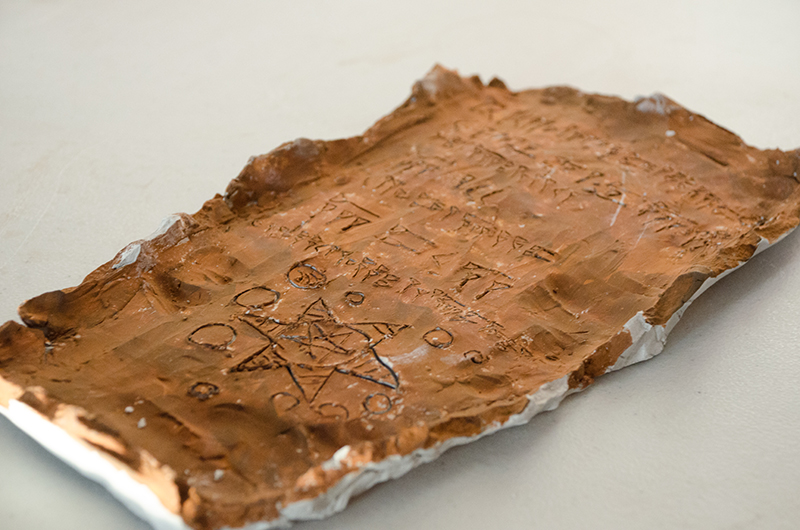
An Elementary student’s model representation of a clay tablet from ancient Sumer.
-
-
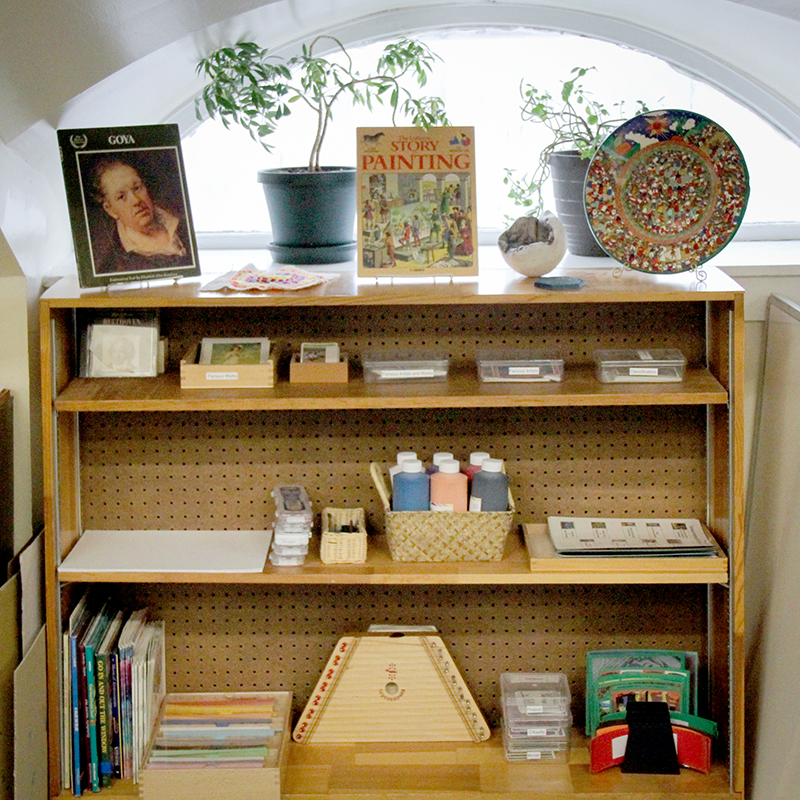
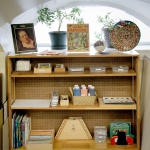
Art shelves in classrooms give students access to materials and art history resources.
-
-
Art shelves in classrooms give students access to materials and art history resources.
-
-
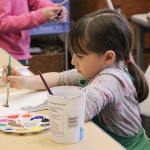
A student paints during Open Art Studio.
-
-
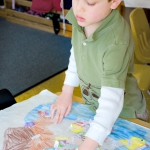
A Children’s House student painting a detailed map of Europe in his classroom.
-
-
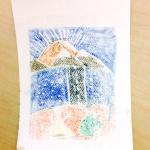
A Lower Elementary student’s styrofoam plate print.
Montessori As Preparation for the “Real World,” written by Lower Elementary Lead Guide, Cheri Gardner
In Montessori classrooms, we don’t insist that our students sit at desks all day, do the same work that everyone else does, or stop doing things they’re immersed in because a bell rings. Parents unfamiliar with Montessori often say, “That sounds great, but how does Montessori prepare children for the ‘real world?’”
We ask these parents to consider that traditional educational methods were developed during the industrial revolution when students were being trained for work in factories. Students needed to learn how to walk in lines, follow directions, memorize procedures, and start and stop work at the signal of a bell. This is clearly no longer the world in which we live or work.
So what skills are needed to succeed in the “real world” today? Success in the global economy comes from the ability to think, show ingenuity, and take purpose-driven action. Success comes from working cooperatively with others – as well as by oneself. Success comes from the ability to both define and solve the problem. Success results when we persevere in the face of difficulty, and keep trying even when our first (and second, and third!) attempts are failures. Success comes when we have the desire to make a significant contribution.
Daniel Pink, author of Drive and A Whole New Mind, said, “Human beings have an innate inner drive to be autonomous, self-determined, and connected to one another. And when that drive is liberated, people achieve more and richer lives. Maria Montessori figured this out a long time ago.”
The structured freedom of the Montessori environment fosters the development of inner discipline, responsibility, and intrinsic motivation. The collaborative nature of the Elementary Montessori classroom challenges students to both advocate and empathize, listen and lead, visualize and reflect – all real world skills that will serve them for a lifetime. With a strong foundation in methods supported by scientific research, Montessori education has a clear record of success in preparing students for high school, college, and adulthood.
Larry Page and Sergey Brin, the founders of Google, explicitly credit Montessori with their success. “We both went to Montessori school,” Mr. Page said, “and I think our success was part of that training of not following rules and orders, and being self-motivated, questioning what’s going on in the world, doing things a little bit differently.”
So we declare proudly, Montessori IS education for the real world!

The Friedburg Building is turning out beautifully! The pictures above and just below this text were taken just a couple days ago, to give you an idea of how close to completion we are.

Nearly every part of Friedburg has been updated this summer. To give you an idea, here’s some of what’s happened:
- Replaced!
- Windows
- Siding
- Lights
- Counters
- Most sinks
- Insulation
- Paint – yellow, white, and for the outside doors, green!
- Cupolas
- Floors
- Doors
- Outlets & Wiring
- Added!
- New kitchen layout, including a dishwasher, an adult sink, and counter space for students – which will help with our practical life curriculum!
- New Drywall over old wood paneling (a difficult choice, but we think you’ll agree: the results are beautiful, and will be much more energy efficient)
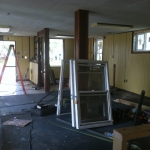
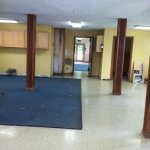
Here are some pictures from earlier on, so that you can see why we did this crucial work to update our campus:
-
-
Friedburg’s exterior, undergoing work.
-
-
Inside as windows were being replaced.
-
-
The old view from the front door.
This fall, we’ll have some very lucky Children’s House (Primary) students in this rejuvenated space!