A Lower Elementary student writes about the research she is doing.
In the Montessori Children’s House program, students learn letter sounds before the letter names. For example, they learn that the sound of “d” is “duh,” not “dee” and the sound of “b” is “buh,” not “bee.” (See our blog post about Language in the Children’s House for more information.) Spelling is not the focus during the Children’s House years because the focus is on children hearing and learning the letter sounds rather than recognizing the letter names.

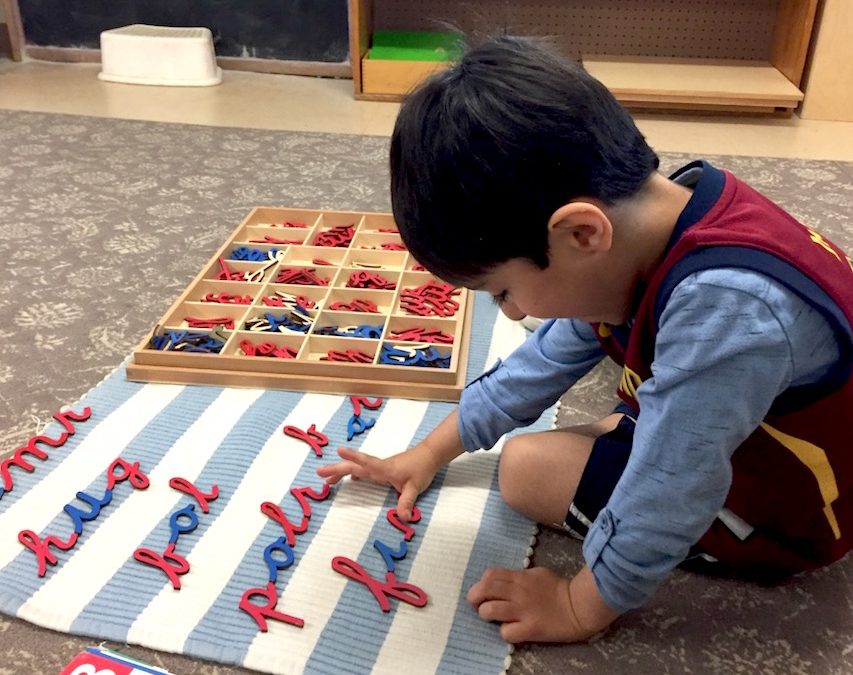
A Children’s House student uses the Moveable Alphabet to craft a message.
By using the Moveable Alphabet, children are able to put different letter sounds together to form a word (long before they have the hand strength necessary to hold a pencil). When a young child is asked to form the word “photo” with the Moveable Alphabet, she sounds out how she hears the word, letter by letter.
“Fuh”, “oh”, “tuh”, “oh”.
She would likely place out Moveable Alphabet letters like so:
f-o-t-o
While the word is spelled incorrectly, it is phonetically correct. This “spelling” is age-appropriate for a student in the Children’s House.
Later, once students have a firm grasp of letter sounds and have associated the letter names with these sounds, we work to introduce phonograms, which are when you put two sounds together to make a new sound (think, ee, ea, y, e-e all make the sound “ee”). With this work, which often begins during the Children’s House and continues into Lower Elementary, students become aware that there are options in spelling and become conscious of how to spell words when writing.


Once the child begins to internalize the phonograms, we can begin to explore the complexities of the English language. (Unlike Dr. Montessori’s native language of Italian, English is not a phonetic language; there are so many exceptions to every rule!) We practice reading “sight words” and finding “rule breakers.” This feeds the interest of the Lower Elementary student, who naturally begins to show an interest in how to correctly spell words.
Spelling is reinforced through extensive reading. The more a child reads, the more they will be exposed to spelling patterns. As a result, children are able to edit their work to identify words that don’t “look” right in context and begin to self-correct. In addition, children use a variety of strategies to determine the correct spelling of a work. Things like “have a go,” where the child will write a word that is misspelled, then write it again to see if it is correctly spelled, and if not try again until they get it right. Another strategy children may use to spell longer words is to “chunk” the word into single syllable pieces. As they move to Upper Elementary, children are exposed to Latin roots, which helps them understand the spellings of many English words.

Lower Elementary students write in English and Spanish to their pen pals at a Montessori school in Spain.
Keep in mind that even with more emphasis on spelling in Elementary, guides will not correct students’ spelling while writing rough drafts of reports or stories. We allow the children to focus on developing their skills of self-expression. The expression of the idea and the flow of creativity is more important than the limiting, halting prospect of getting every word right. Corrections are made during the editing stage of the writing process – whether individually, with a peer, or with the assistance of a guide. As children begin to create more polished work to share with others, such as the letters to pen pals shown above, they are more internally motivated to edit and correct their spelling.

A Lower Elementary student reads through his spelling dictionary.
Lower Elementary students keep their own personal spelling dictionaries, in which they can write words they want to remember how to spell. It allows the children to help themselves! It also teaches the very basic and beginning steps of learning how to use a dictionary. But most importantly, the words the student put into their personal dictionaries have meaning to them.
Just as with all other areas of the curriculum, the Montessori approach to spelling is rich, interdisciplinary, and meaningful.
For more on what you can do at home to support this work, take a look at this blog from How We Montessori.
To learn more about the Elementary Curriculum, please email us at learn@greenspringmontessori.org or visit the Elementary page of our website.

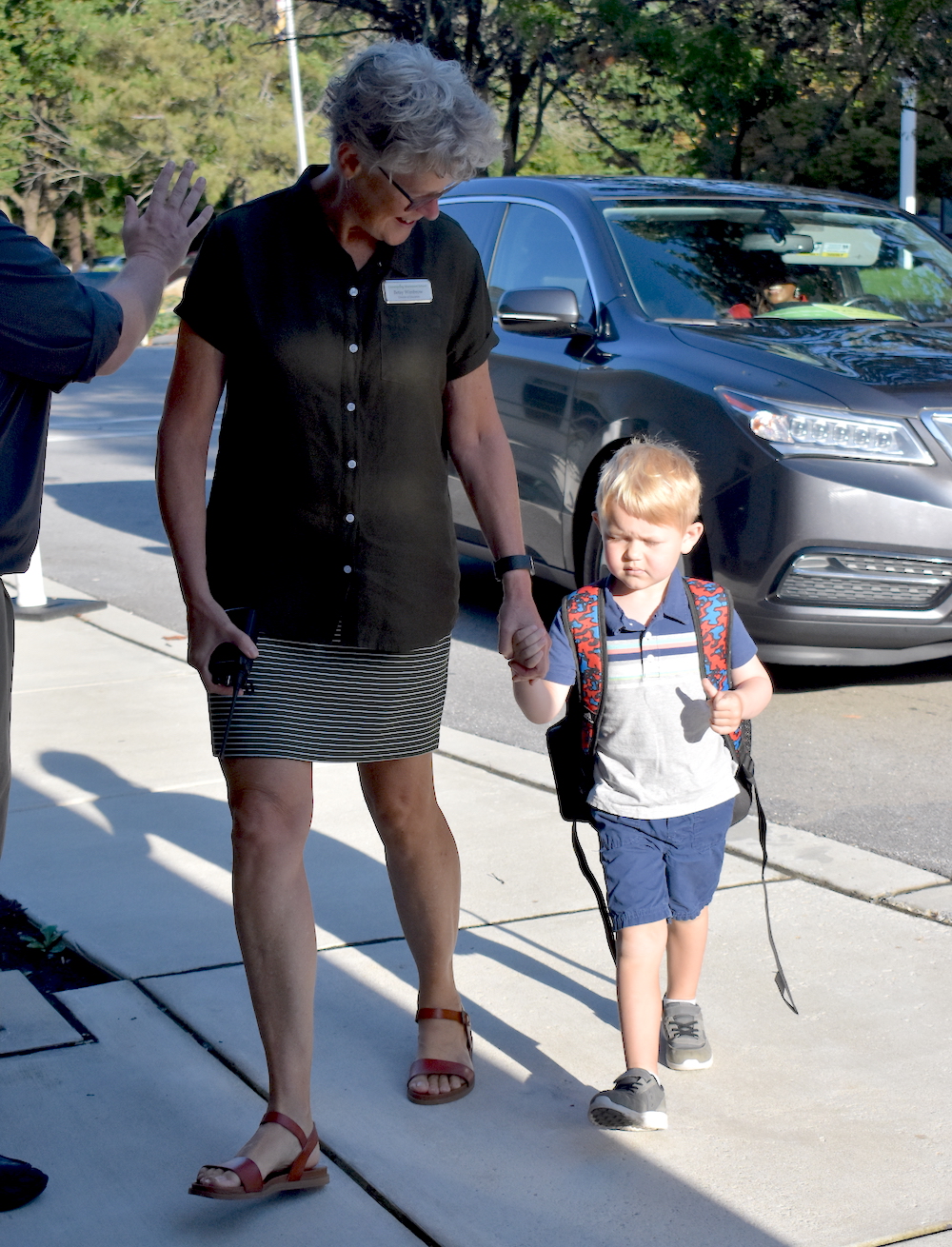
Beginning a new school year is a time of excitement and uncertainty for many new children. For some, it is their first time being away from home for a stretch of time. It is common for students (and parents) to experience feelings of anxiety; this is perfectly normal. These feelings are often caused by a fear of the unknown, as the child has no point of reference to draw upon when faced with a new environment or experience.
Separation anxiety can also be attributed to a child’s stage of development. Separation anxiety is a normal part of development, and most common for children aged eight months to two years; however, it can affect children of all ages. The first day of school, in a new room or level, can bring on a reoccurrence of separation anxiety in children who were previously settled. It takes time for young children to build relationships and establish a sense of trust with their new guides, so that they come to understand that their new environment is a safe and happy place. This is not uncommon, and is likely to settle once a new routine and relationships have been established.

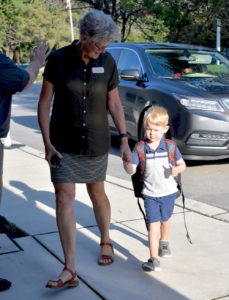

Below you will find a number of strategies published by the Montessori Academy to help Montessori parents settle their children into preschool. Remember separation anxiety is a phase, it is perfectly normal, and will pass in time.
Positive Behaviors and Attitudes
Modeling positive behaviors and attitudes plays an important role in the success of the first day of school, and the weeks thereafter. Keep discussions about school positive, and focus on things that your child is likely to enjoy. Children pick up on parent’s feelings, behaviors, and emotions, and are likely to emulate them if you are feeling upset or uncertain.
Morning Routines
Establish a positive and happy morning routine for preschool days. For children over two, this may include encouraging your child to pack their own school bag or sing a happy ‘school day’ themed song. Always give yourself plenty of time to get ready and arrive on time. Feeling late or rushed can cause children to feel additional anxiety.
Acknowledge your Child’s Feelings
It is important to accept that your child’s unhappiness at being separated from you is real, very normal, and temporary. Reinforce that you understand that leaving your child makes them unhappy, but that it is important that you leave, and they will have a good time. Avoid offering your child bribes for good behavior or not crying as this is only a temporary solution. Learning to cope with sadness is an important part of your child’s development and learning about emotions.
Positive and Prompt Goodbyes
When you drop your child off, don’t linger outside the classroom or stay for “just one more minute.” As a parent, the best thing you can do is give your child a hug and a kiss as they get out of the car, let them know you love them, and reassure them that you will be back soon. It is important for your child that you do not delay the inevitable.
Establish a Goodbye Routine
Montessori parents who establish a consistent goodbye routine typically have better luck with successful goodbyes. Take a special moment with your child to say goodbye, and do it the same way, every day. This may be as simple as a kiss and a cuddle, giving your child a thumbs up, or establishing a ‘secret’ hand shake. A special goodbye is a great way for your child to start their day feeling happy and reassured.
Encourage Friendships
Make a point of getting to know your child’s friends and classmates at school, and encourage friendships outside of school. These friendships will help make your child’s transition to the new Montessori environment easier.
Pick Up Routines
It is important to be punctual when picking up your child. It easy to lose track of time, but no matter who is picking your child up, always be on time. If you are late, it can cause your child to feel more anxiety, and makes drop off the next time much harder.
Positive Daily Reflections
On the way home, establish a routine where you talk to your child about their school day. Focus on the positive aspects of their day, such as their favorite activity, or playing with their best friend. By consistently reinforcing the positive aspects of their school day, your child will learn that their new environment is a fun and happy place, and their feelings of anxiety will decrease over time.

“A child who becomes a master of his acts through repeated exercises [of grace and courtesy]…is a child filled with health and joy and remarkable for his calmness and discipline.” – Dr. Maria Montessori
Have you ever entered a Montessori classroom and noticed that the children are naturally respectful of each other and often helpful? An older child may help a younger child zip his jacket zipper. A child might accidentally spill beans on the floor and two children stop what they are doing to help her clean up. Two students having a disagreement decide to go over to the peace table to work it out. These are manifestations of tGrace and Courtesy in the Montessori classroom, which is built upon 1) treating the child with respect, 2) teaching the child to respect herself, 3) teaching the child to treat others with respect, and 4) teaching the child to treat her environment with respect. Grace and Courtesy remains a focus at every level of Montessori education.
When we respect a young learner’s dignity by teaching the basic rules of etiquette, it fills a need in them. Dr. Montessori once taught a small group of children how to politely blow their noses; she explained every step in detail and showed them how to do it quietly and respectfully. After this presentation, the children erupted into spontaneous applause. They were delighted to know how to do something, that to adults would seem so basic. However, to these young learners, their teacher had shown them something they were longing to know how to do.
What does this look like in our classrooms? Treating the child with respect means that we speak to the children with soft voices and at eye level. We give the children freedom to choose their work and decide where they want to work. Yet the guidelines and limits of the environment are understood by all. For example, a lesson should be put back where it came from before moving on to something new. Children are free to choose their work, but are not free to disturb the work of others. We call this “freedom with responsibility.”
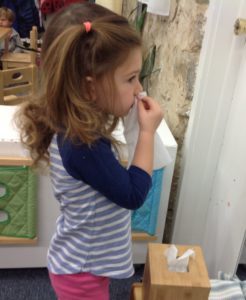
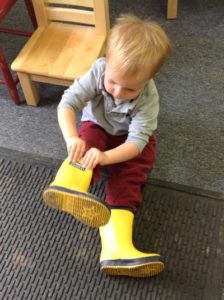

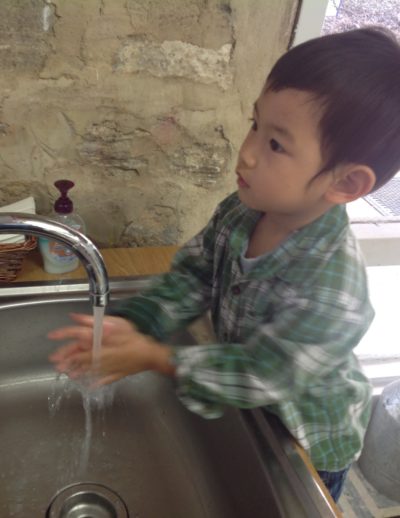
There are specific Grace and Courtesy lessons that demonstrate how to respect and care for oneself, such as blowing one’s nose, washing hands, getting in and out of a chair, putting on shoes, hanging up or putting on a jacket, etc.
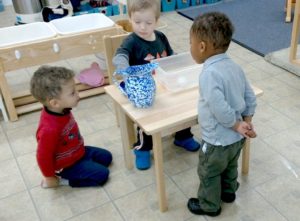

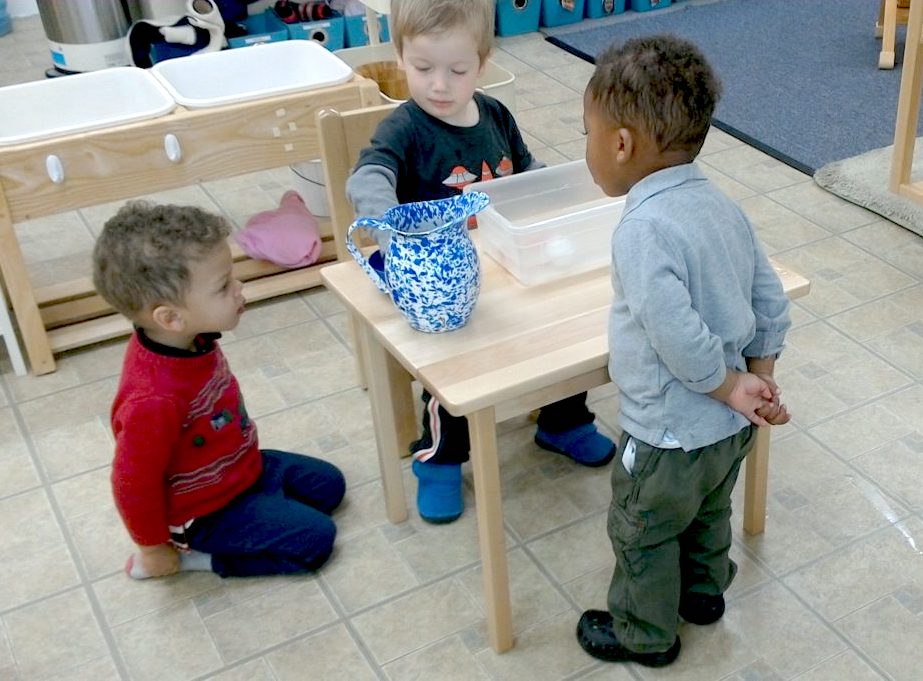
Lessons on respecting others include how to greet a visitor, walking around a rug, how to ask for help, using soft voices, inviting others to work, how to solve a conflict with a classmate, etc.


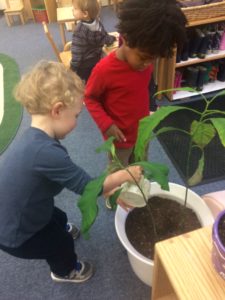
Lessons on respecting the environment include carrying and rolling up a rug, setting the table, how to take materials off of shelves, washing a plant, washing a table or mirror, etc. We are working daily on cultivating a sense of gratitude and nurturing wonder.
One of the main goals of a Montessori education is to prepare students to be contributing and valued members of society. This starts with lessons of Grace and Courtesy, which are key to modeling peace, learning how to act in social situations, showing respect for each other. These are tools our children will use their entire lives!
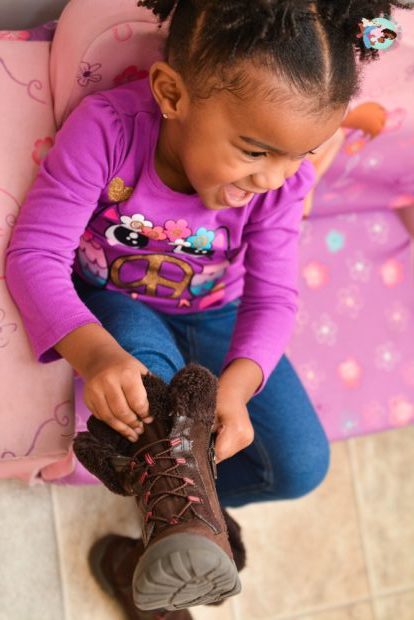
“Never help a child at a task which he feels can succeed.” -Dr. Maria Montessori
If you are lucky, your family members – especially those proud grandparents! – are excited and eager to learn more about your child’s Montessori journey. While we can’t expect our extended family to completely rearrange their homes or lifestyles, there are some simple ways that they can support your child in building independence.
Simple ways for family members to help your child’s growing independence
Allow the child to make decisions with limited choices
You can allow a child opportunities to make decisions without giving up all control. Consider offering two choices – both of which you are happy with. “Would you like a grilled cheese sandwich or chicken noodle soup for lunch?”
Allow the child to do things for herself
It is the natural instinct of a loving family member to make life “easier” for a child. But when we take away opportunities to overcome worthy challenges, we inhibit them from learning new skills and building self-esteem. For example, it may take much longer for a young child to zip up her own coat, but when time allows, give her the opportunity to try. If she begins to get frustrated, provide the minimal amount of help needed (such as holding the bottom of the coat to create tension, while the child pulls up the zipper).
Prepare the environment for independence
Allowing a child to do things for herself may require some support. Consider providing a stool at the bathroom sink so the child can reach the faucet to wash her hands. Consider putting out a small pitcher of water and a small glass so she can help herself when she is thirsty. If dishes, napkins, and silverware are placed in a lower cabinet, the child can help set the table for a meal.
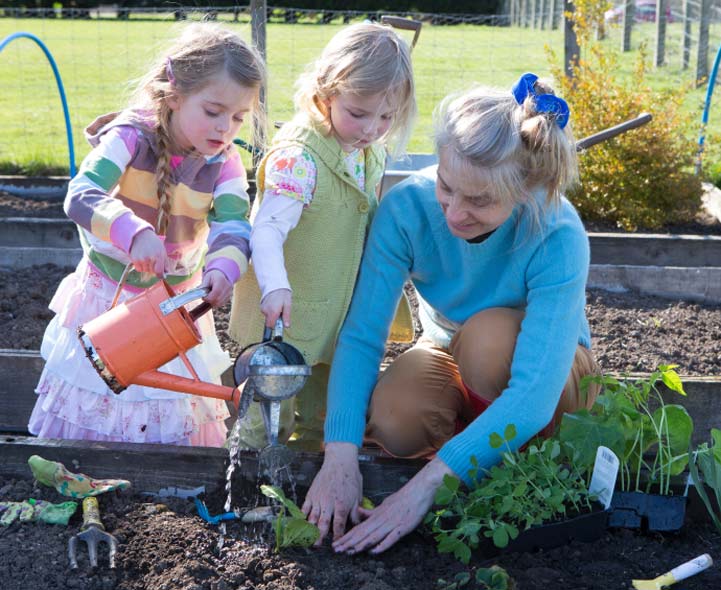
Involve the child in activities of daily life
Not every visit with Grandma and Grandpa needs to involve a trip to the zoo. Children want to do what you do! Invite them to join you peeling vegetables, feeding pets, watering the flowers, etc. You may need to provide child-size tools for some of these activities, such as a small watering can or acrylic knife, so that your child can participate fully.
Create order in the environment
Instead of piling toys in a basket, consider setting up a small open bookshelf where only a few toys are accessible. This helps the child make independent choices and give more focused attention to the chosen activity. (Toys can be rotated in and out to keep the child’s interest.) A minimal, organized toy area will also help the child clean up independently because there is a clear place for everything.
Be careful of praise
Dr. Montessori found that praise can inhibit children from gaining independence because they begin to rely on the judgement of others. As an alternative, encouragement can be empowering. So instead of “Good job!” “Good girl,” or “You are so smart,” you can try, “You did it!” “Thank you for your help,” or “I can tell you worked really hard on this.”
How to help family members get on board
Model rather than preach!
Most family members won’t appreciate being given a list of rules about how to behave around your child. But you can provide a powerful example by modeling these approaches in front of your family.
Gentle reminders
Feel free to give family members gentle reminders, such as “Please don’t help him; he can do it himself” You can also make it clear what the child is capable of, such as “Lila likes to choose her own clothing. She can get dressed herself but she might need help if her arms get stuck. Please don’t worry if she puts things on the wrong way.”
Provide resources
If a family member seems receptive, you might share an article with a brief introduction to Montessori at Home, such as this one. For those who wish to know more, a nice introductory book is How to Raise an Amazing Kid the Montessori Way by Tim Seldin. Though not all of it will apply to extended family, it’s a quick read with lots of beautiful photos that provides a nice overview of Montessori for families. If you would like to help family members find child-size tools or suggest gifts that would be appreciated, you can give them a copy of the For Small Hands catalog or share a link to their website. You may also consider creating an Amazon wish list.
“The greatest gifts we can give our children are the roots of responsibility and the wings of independence.” -Dr. Maria Montessori
With a little help from family, we can create even more consistency between school and home and provide more opportunities for the child to build independence.
Dr. Angeline Lillard, professor of psychology at the University of Virginia, has been studying Montessori’s methods for more than two decades. Dr. Lillard asserts that traditional American schooling is in constant crisis because it is based on two poor models for children’s learning: the school as a factory and the child as a blank slate. As an alternative, Dr. Maria Montessori, the first female physician in Italy, devised a very different method of educating children, based on her observations of how they naturally learn. Though Dr. Montessori developed her methodology over 100 years ago, Dr. Lillard shows that science has finally caught up with her groundbreaking work.

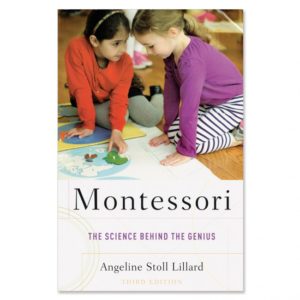
1st edition 3rd edition, now available
In her book Montessori: The Science behind the Genius, Dr. Lillard presents scientific studies that show how children learn best, makes clear why many traditional practices come up short, and explains why Montessori methods work. One such study is “Montessori Education Provides Better Outcomes Than Traditional Methods,” published in the September 29, 2006 issue of the journal Science. Among the findings were that 5-year-old Montessori students proved to be significantly better prepared for elementary school in reading and math skills than the non-Montessori children. They also tested better on “executive function,” the ability to adapt to changing and more complex problems, an indicator of future school and life success. Montessori children also displayed better abilities on the social and behavioral tests, demonstrating a greater sense of justice and fairness. And on the playground they were much more likely to engage in emotionally positive play with peers, and less likely to engage in rough play. You can read the full article reporting on this study here.
Dr. Lillard presents the research concerning eight insights that are foundational to Montessori education and describes how each of these insights is applied in the Montessori classroom. These insights are:
- Movement and Cognition – movement and cognition are closely entwined, and movement can enhance thinking and learning;
- Choice – learning and well-being are improved when people have a sense of control over their lives;
- Interest – people learn better when they are interested in what they are learning;
- Extrinsic Rewards are Avoided – tying extrinsic rewards to an activity, like gold starts for reading or money for high grades for tests, negatively impacts motivation to engage in that activity when the reward is withdrawn;
- Learning with and from Peers – collaborative arrangements can be very conductive to learning;
- Learning in Context – learning situated in meaningful contexts is often deeper and richer than learning in abstract contexts;
- Teacher Ways and Child Ways – particular forms of adult interaction (such as “freedom with responsibility”) are associated with more optimal child outcomes;
- Order in Environment and Mind – order in the environment helps children build internal order of the mind.
In reading this book, parents and teachers alike will develop a clear understanding of what happens in a Montessori classroom and, more importantly, why it happens and why it works. A third edition of this groundbreaking work is now available!