How do Montessori Materials Spark a Love of Mathematics?
“The hand is the pathway to the brain.” – Dr. Maria Montessori

It may be hard for some parents to believe, but all children have the ability to really enjoy learning math. In Montessori classrooms, mathematics are introduced to children at 3 to 6 years old, enabling the child to form positive associations with numbers to be carried on throughout life. Scientific research supports that the key to developing this positive relationship early is to provide the child with hands-on experiences [source – https://www.hand2mind.com/resources/why-teach-math-with-manipulatives]. Dr. Maria Montessori demonstrated that if a child has access to concrete mathematical materials in their early years, they can come to their own understanding of the concept much faster than if introduced in an abstract form at a later age.
Think back to your own experience as a young student. Most of us learned math in school by memorizing the steps required to solve a problem. For example, when learning to “borrow” in subtraction, we learned to slash through one number and write another number above it, add a tiny number one in front of the number to its right, and then continue with the problem. Many of us learned how to do this without ever really understanding why we were doing it or what it meant. Yet for Montessori students, those mathematical symbols represent very concrete ideas that they have physically manipulated; they fully understand what they mean, how they work, and why.
At a certain point in development, usually around the age of 4, the child enters the sensitive period for numbers, and the child’s mathematical nature awakens. She graduates from purely sensory explorations to interest in specific measuring and counting. Once begun, the child progresses through the math materials sequentially. Montessori materials are scientifically designed to meet the child where they are, allowing for independent exploration. The materials are made to be self-correcting, allowing the child to learn as they go.
So, what are some of the essential Montessori materials for learning math? Here are a few of our favorites:
The Pink Tower
 One of the first materials a child encounters in the Children’s House classroom at 3 years old is the Pink Tower. While this material may look like basic building blocks of conventional preschools, it is designed very specifically to introduce the child to the quantity of ten as well as basic experiences of order, sequence, coordination, and precision.
The smallest cube measures 1 centimeter cubed, and the largest is 10 centimeter cubed. In this way, the Pink Tower introduces the concept of base ten, which is also present in other sensorial materials such as the Brown Stair. When beginning the activity, the child carefully takes each cube, one by one, to their work mat. As the child builds the tower from biggest to smallest, they are able to work independently to determine the right order. If they place a cube out of order, they will quickly discover the tower doesn’t look quite right. This control of error is present in all Montessori materials and allows for the child’s self-discovery.
The Red Rods
 The Red Rods are comprised of 10 wooden rods differing in length. The smallest rod is 10 centimeters long, and the largest rod is 100 centimeters, with each rod increasing by increments of 10 centimeters in length. The shape, weight, and color of this material is alluring to the child, drawing them in to learn more.
The Red Rods are introduced to children at around 3 years of age after they have become familiar with the initial sensorial materials in the classroom, including the Pink Tower, Brown Stairs, and Knobbed Cylinders. Moving the Red Rods allows the child to perceive the differences in length and weight. The child also expands upon their basic language of mathematics by discussing length, size, and order.
The Number Rods
 Children are naturally drawn to the Number Rods after mastering the Red Rods. They are the same dimensions as the Red Rods, however, each 10 centimeters alternates between red and blue, showing the visual representation of each unit. The child is introduced to the number symbols and they learn to associate quantity and symbol.
With this work, the child is not simply memorizing 1-10 to recite back. They are learning that each quantity is a separate entity, known as one to one correspondence.

The Golden Beads
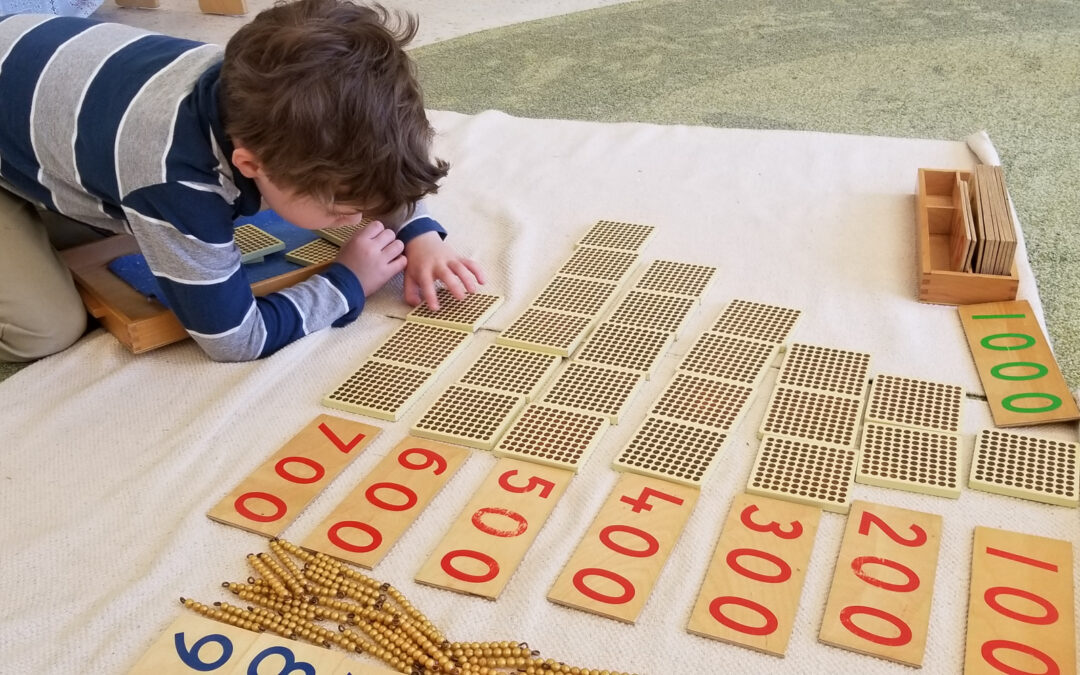
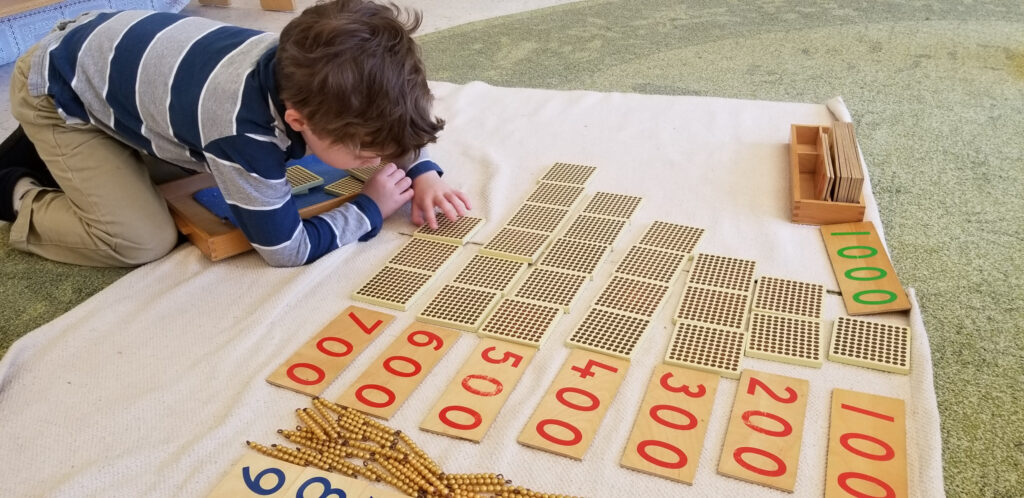
 The presentation of The Golden Beads gives a visual and a very concrete experience of the decimal system and place value. With this material, the child learns the terminology of units, then tens, hundreds, and thousands. The child can literally feel the heft of the thousand square and see visually the relationship between the unit bead and the thousand cube.
The use of tangible materials allows the child to tap into mathematical concepts much earlier than in a conventional education setting. By physically exchanging (ie, carrying ten ten bars to the shelf and trading it for a hundred square), students as young as four quickly learn that ten tens are equal to one hundred. Montessori students discover that the “square” of a number (10 squared = 100) is literally the shape of a square and the “cube” of a number (10 cubed = 1,000) is literally a cube.
The Bank Game
 Once a child is able to build a visual representation of a number, the Golden Beads are used to add, subtract, multiply, and divide numbers into the thousands. When students start using this material, one subtraction problem may take 20 minutes! But because it’s physical, social, and interactive, it doesn’t feel like work.
Children are given real-life examples of math problems, such as dividing a sum between their peers. This is a way to introduce them to solving increasingly complex problems while still maintaining a playful approach. A five year old may learn to divide 6,540 three ways to share with their peers.

The Stamp Game
When a student is ready to progress to a new challenge, either in Children’s House or during Lower Elementary, they are introduced to the Stamp Game. Instead of holding a large cube that actually shows the relative size of one thousand as they did with the Golden Beads, they use a representational material. These small square stamps are all the same size, but are differentiated only by their color and number label represent units, tens, hundreds, and thousands. Like the Golden Beads, the Stamp Game material is used to teach all four operations, with children adding, subtracting, multiplying, and dividing into the thousands. The Stamp Game is still hands-on, but slightly more abstract that the Golden Beads.
Since the elementary age child now craves variety more than repetition, other hands-on materials, such as the Bead Frame, Checkerboard, and Racks and Tubes are also introduced for computing all four operations.

The Trinomial Cube
The Binomial and Trinomial Cubes are three-dimensional puzzles that are introduced to children at age 3 or 4. The Trinomial Cube is made up of 27 color-coded blocks which fit together in a very specific way. Assembling the puzzle uses the child’s fine motor skills and requires the ability to observe the different characteristics of each block. Like other Montessori materials, the Cube is self-correcting. When it is assembled properly, it forms a cube that fits back into the wooden box. While the primary aim of the Trinomial Cube is to build a puzzle, children only later discover that it is a concrete representation of the algebraic formula, (a+b+c)³. You may recognize this formula from your own school days, but very few of us had the opportunity to interact with it in such a hands-on material. Through this process of discovery, children are able to grasp a deeper understanding of mathematical concepts.

Moving into Mathematical Abstraction
When the student is ready, they are shown how to record their work with the materials on paper. The paper is used to record the process completed with the concrete materials.
Having started with the Golden Beads, moved on to the Stamp Game, and then the Bead Frame, Checkerboard, and Racks and Tubes, at some point during this progression through the materials, the child experiences an “Aha!” moment and is able to “see” the answer without using the materials. The student understands the process so well, she can see the materials and can compute the answer in her mind. This moment is always thrilling to observe. The student feels pride and a sense of accomplishment that can not be matched by any lecture or quiz.
These are just a few of the many Montessori materials that are utilized daily in the classroom. By laying the foundation in the 3-6 year classrooms, Montessori students are able to understand mathematical concepts earlier and utilize problem-solving skills with more complicated math in high school and beyond.
To learn more about Mathematics materials in the Montessori classroom, take a look at this webinar from Greenspring Children’s House Guides, Lydia Farmer and Emily Shattuck – The Magic of Children’s House.