A Montessori Kitchen

A Montessori Kitchen

Greetings from Florida! For those of you who don’t know me, I was a Lower Elementary guide and then the Director of Admissions at Greenspring before moving to Florida. I have begun this series on Montessori in the Home to help parents find creative ways to implement Montessori practices into day-to-day activities at home. My daughter, Lila, is now three and a half and loves to work in the kitchen!

Getting Involved

Lila has been an active participant in the kitchen since she was very small. Early activities included stirring batter, washing and scrubbing fruits and vegetables, peeling clementines and bananas, pouring coffee beans into the grinder, and dipping bread into eggs for french toast.


These activities help build the essential skills of coordination, concentration, order, and independence. The work also exposes the child to tasting new foods. Lila was always more interested in eating something that she helped to prepare.


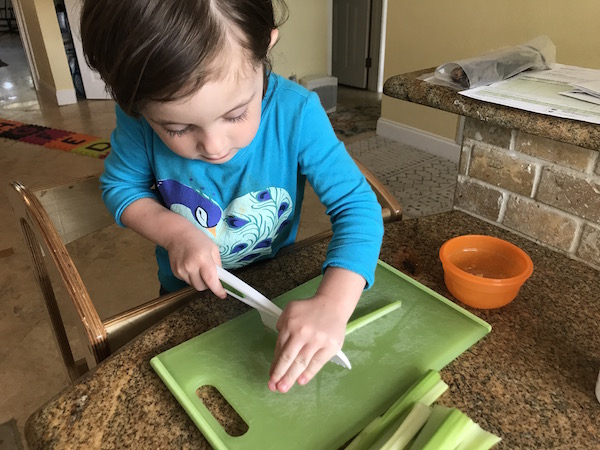
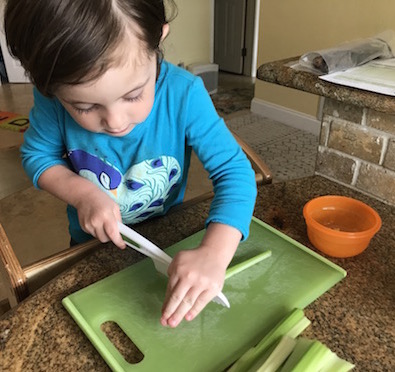
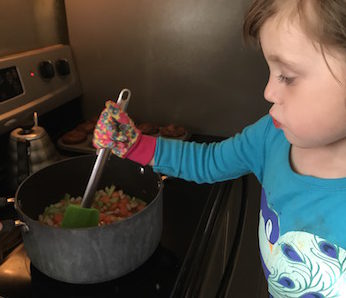
As her fine motor coordination increased, Lila started shucking corn, rolling dough, peeling and slicing eggs and bananas with special tools, and peeling carrots and cucumbers with a peeler and wavy chopper. Now Lila is also slicing vegetables with an acrylic knife, grating cheese, and juicing oranges. Child-size gardening gloves allow Lila to stir soup and flip pancakes without fear of touching the hot pan.


Involving a toddler at dinner time when everyone is tired can be challenging. If I have a few extra minutes earlier in the day, I will prepare part of the meal while Lila is still at school. This will allow me to focus more energy on her participation during the meal preparation. Sometimes I plan our joint projects for the weekends when I have more energy.


There are other ways besides cooking that children can help. Setting the table, sweeping up crumbs, and placing dirty dishes in the dishwasher are other ways that little ones can contribute. Montessorians know that children’s self-esteem comes from making meaningful contributions, rather than receiving compliments. So allowing children to be active participants in the family is a tremendous gift!

Learning Tower
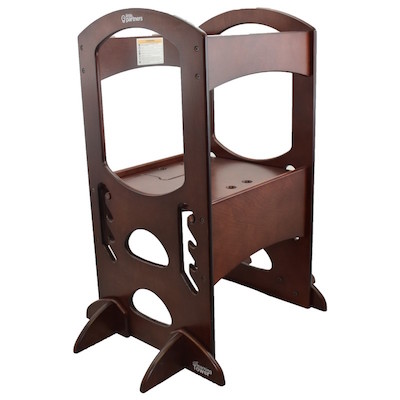
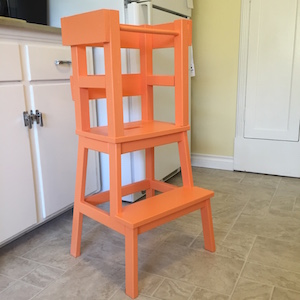
The single most important tool you will need to allow your child to participate in the kitchen is a safe stool. We put the “Learning Tower” on our baby gift registry before Lila was born. Three and a half years later, we are still using it every day. When Lila was very small, we wrapped the sides with saran wrap so she couldn’t fall out. Soon she was able to climb in and out independently. The adjustable height allows the stool to grow with her. And you don’t need to worry about her falling off a regular stool.

      

I have seen some great “hacks” on the internet for converting an Ikea stool into a learning tower, for a much lower cost. If you’re handy, this is definitely worth a try!

Eating Independently
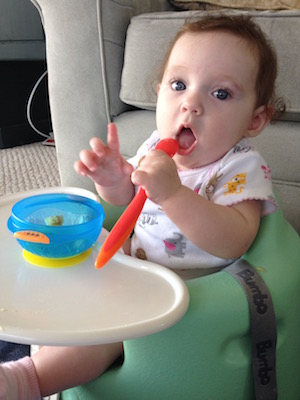
As much as your child will enjoy helping prepare food, she will also be highly motivated to eat independently. When Lila was very small, she sat in a Bumbo or high chair. As soon as she was able to sit in a chair without falling off, we moved her to a toddler-size table and chair. (The table was bought from Ikea with the legs chopped to make it shorter.)


While she still sat in a high chair for family dinner at the dining table, all other meals and snacks were eaten at her special table. Soon, Lila began rejecting the high chair. That’s when we switched to a booster seat in a regular dining chair.

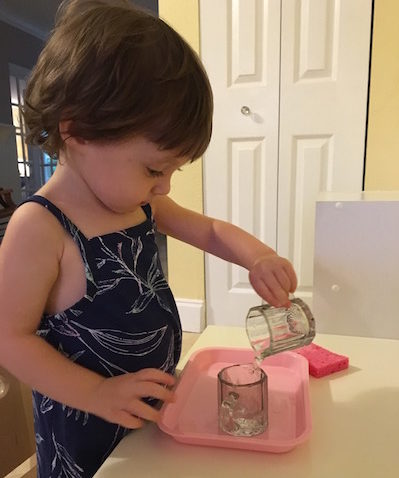
Montessori Services makes child-size glass dishes that are very sturdy. While I don’t like to replicate too many Montessori lessons in the home (as I like them to remain special at school and be presented by the experts!), I did invest in two small glass pitchers so that Lila could practice pouring. I have a full list of recommended supplies below.


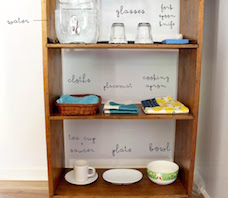
In order to further increase independence, you can make child-size dishes, utensils, kitchen tools, and cleaning supplies available at the child’s level. This can be a special shelf or just a lower kitchen cabinet that you dedicate for your child’s kitchen items.


You might consider creating a water and snack station on a low shelf or table. By having water and healthy snacks available at all times, your child can help herself to food when she is hungry. You can also dedicate a low shelf of the refrigerator for your child’s use and keep liquids in smaller containers that are easy to pour.

Don’t feel like you need to tackle all of this at once. Try picking just one new system to implement in your home and see how it works!

I have also written about setting up a Montessori bedroom and a Montessori bathroom. Next I will tackle the play area! Questions, comments, suggestions? Email me at mjarrell@greenspringmontessori.org.


Resources:

There are many wonderful tools to help young children work safely in the kitchen.

Some of my favorite resources include:

Montessori Services (child-size tools)
How We Montessori (blog)

Some of my favorite products include:

  • Learning tower or sturdy stool
  • Child-size apron
  • Wavy chopper
  • Banana slicer
  • Apple slicer
  • Egg and mushroom slicer
  • Citrus juicer/grater
  • Nylon knife
  • Peeler
  • Non-skid cutting board
  • Non-skid mixing bowl
  • Spatula, mixing spoon, scrapers, whisk
  • Child-size rolling pin
  • Child-size oven mitts
  • Child-size pitcher, glasses, plates, and utensils
  • Spreaders
  • Dishwashing station
  • Non-toxic cleaning supplies
A Montessori Bathroom

A Montessori Bathroom

Greetings from Florida! For those of you who don’t know me, I was a Lower Elementary guide at Greenspring and then the Director of Admissions before moving to Florida. My daughter, Lila, recently turned two and I would like to share a few thoughts on what it was like setting up a toddler-friendly bathroom.

img_1783         tub-stool


Care of Self

As Montessori parents, our goal is to prepare the home environment for toddlers to be as independent as possible. The bathroom provides a wonderful opportunity to empower our toddlers and begin teaching them important life skills. Toddlers are innately motivated to take care of themselves, so they will be eager for these opportunities!


Giving Introductory Lessons

Children will need to be introduced to each process, broken down into simple steps. All of the needed materials must be easily accessible and in child-size containers. After introducing and modeling each skill, your toddler will need many opportunities to practice. Important skills to learn include:


*Washing hands

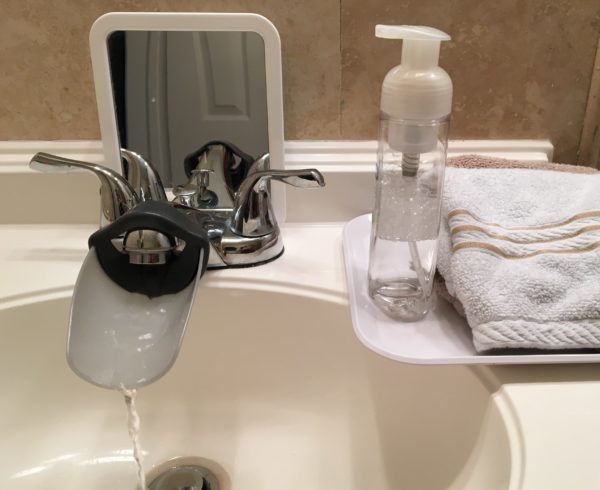
Provide a bottle of pump soap (my daughter loves the foaming kind) or a small bar of soap and a washcloth on the counter. You might consider using a faucet extender so your child can reach the water more easily. View a sample lesson here.

img_1807   img_1754


*Brushing teeth

Prepare a tray with the necessary supplies: toothbrush, toothpaste (which you may wish to portion out in individual containers at first rather than make the whole tube available), a timer, and a small water glass. View a sample lesson here.

   img_1781


*Brushing hair

Prepare a tray with a hairbrush and/or comb and place with (or near) a mirror. View a sample lesson here.

care-of-self-shelf   img_1815


*Blowing the nose

Have a box of tissues accessible. If you worry about your toddler enjoying this activity a bit too much and using the whole box (see photo below), you can place a few folded tissues in a small basket. View a sample lesson here.

img_1750   img_7997


*Washing with a washcloth & Washing hair

Toddler-size bottles will allow your child to pour her own soap without emptying the entire supply. You can use a small plastic basket, tray, or suction cup caddy to store supplies. A suction cup mirror will allow your child to see herself while washing. (You may still need to assist with the rinsing.)

img_1778   lila-bathtub-mirror


Necessary Items within Reach

Keep all necessary items within reach. If you have room in your bathroom, a shelf set up with supplies is ideal. Or you can empty the cupboard beneath your sink to store some of these items.

care-of-self-shelf-2   img_1755


Beginning Toileting

This is a weighty topic for another day, but just a few suggestions:

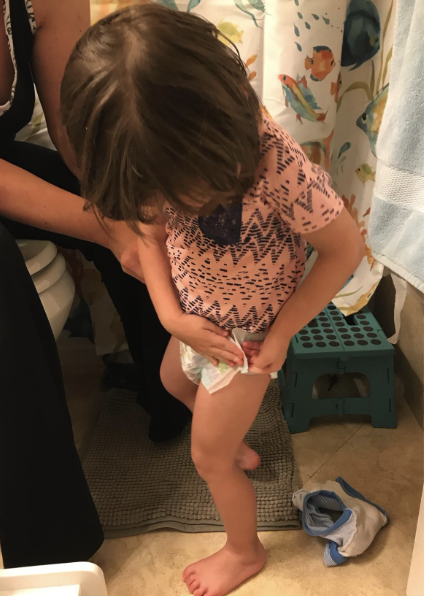
Start changing your child’s diapers (standing up) in the bathroom whenever possible. Allow your child to help with her own diapering as much as possible.

When your child starts to show an interest in the toilet, encourage this interest. Allow your child time to sit on the toilet, practice flushing, and washing hands.

If you are comfortable with it, allow your child to watch you using the toilet and assist with flushing and washing hands.

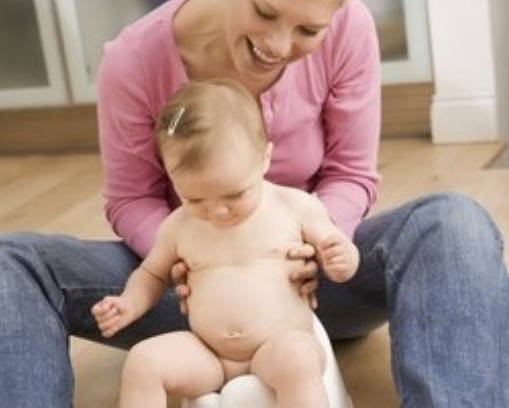
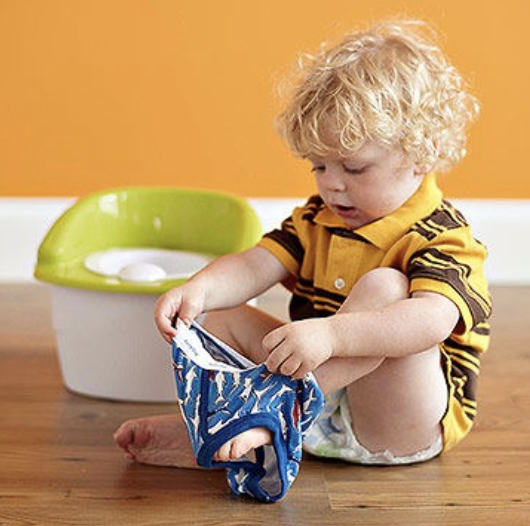
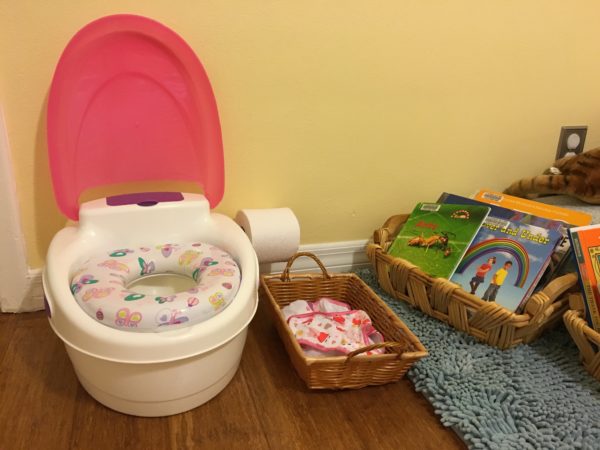
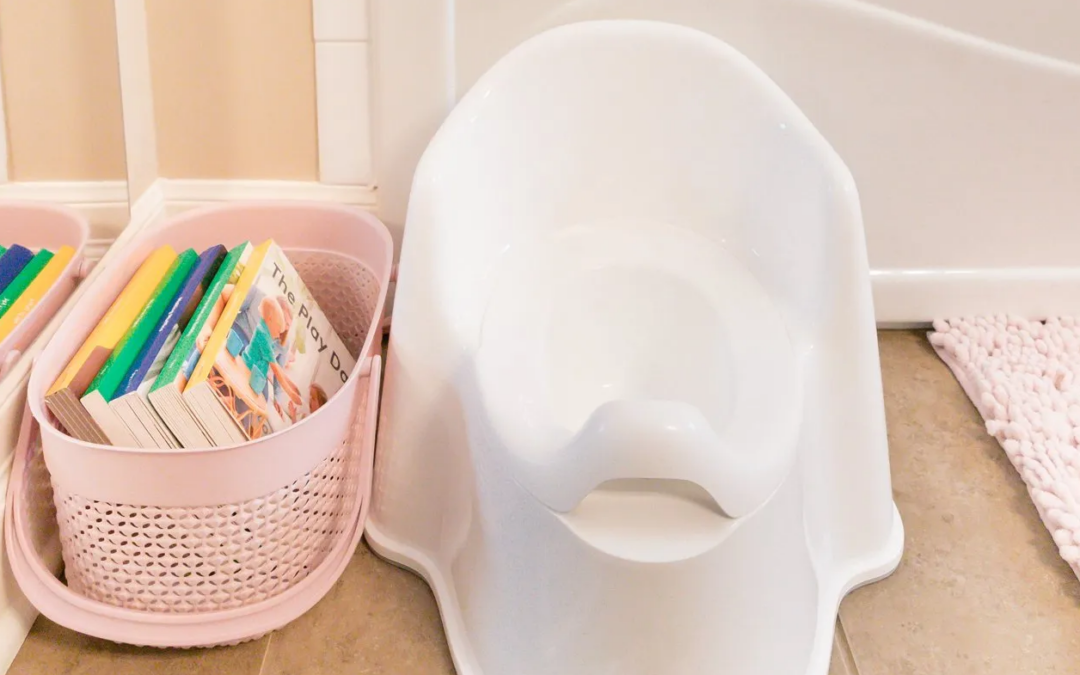
Have a floor potty available as well and allow your child to sit on it (clothed or unclothed) whenever she shows an interest. Keeping the floor potty in the bathroom is ideal if you have room – this reinforces the idea that toileting takes place in the bathroom. Now that Lila is fully engaged in the toilet-learning process, we keep a basket of underwear and books near her potty.

img_1804   whole-bathroom

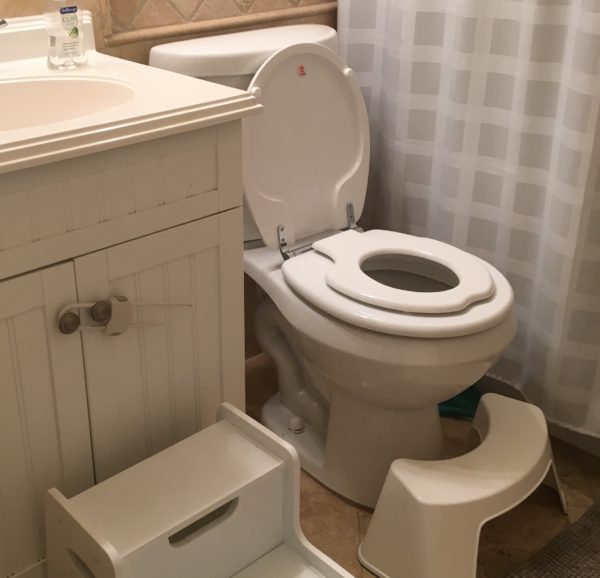
Have a child-size toilet seat and step stool for the adult toilet so that this is also an option. You can allow your child to choose which she wants to use.


Supplies

These are some of the items I recommend. (These are linked to Amazon.com.)

Sink faucet extender & Tub faucet cover

Stepping Stools: Kidcraft or Soft Grip

Two-in-one toilet seat (or Toilet seat with ladder) and a Potty chair with a soft seat


Articles & Resources:

Montessori Now (blog): Montessori Activities for Self Care

Montessori Teacher Collective: Montessori lessons plans for care of self

Michael Olaf: 1-3 Years Care of Self

Montessori Services has every basket, tray, and child-size dish you could ever want!

———————————–

In my next blog entry, I will discuss setting up a child-friendly kitchen. To view my previous blog entry about setting up a Montessori bedroom, click here.

lila-tub-silly    bathroom-break

A Montessori Bedroom

A Montessori Bedroom

Greetings from Florida! For those of you who don’t know me, I was a Lower Elementary Guide at Greenspring and then the Director of Admissions before moving to Florida in 2010. I am now the Director of the Greenspring Center for Lifelong Learning. I wrote this piece when my daughter, Lila, was one in order to share a few thoughts on what it was like creating a Montessori bedroom in the home.

IMG_0073

The Elements of a Montessori Bedroom:

Floor Mattress

A floor mattress allows your baby to crawl in and out of bed as soon as she is old enough to move around independently. When she wakes up, your baby can freely explore her bedroom rather than crying out for an adult to free her from “baby jail.” If the environment has been set-up with accessible toys and books, your baby can learn to entertain herself for increasing lengths of time.

Lila slept in a bassinet at the foot of our bed until she was four months old. We then lived in several short-term housing arrangements; this kept us from putting her on a floor mattress until she was six months old. But my friend and Montessori colleague, Nicole, used a floor mattress from the moment her son came home from the hospital! She placed her newborn in a Moses basket directly on the floor mattress until she felt he was ready for more space. The first time Lila crawled out of bed on her own (at my parents’ house), she was so pleased with herself!

IMG_4429 IMG_5909

I started with an organic crib-size mattress, but quickly found that Lila rolled off it almost immediately (as you can see above). I placed blankets all around the mattress for extra cushioning and often found her sleeping on the floor with her head on the mattress. (That was one expensive pillow!) Soon, I switched to a twin mattress. (If you have room, you may even prefer to use a futon or full-size mattress.) Placed in the corner and framed on the third side with a safety rail, Lila tends not to roll off accidentally, but can still get in and out freely. I placed non-skid bathmats around the perimeter of the mattress instead of blankets.

IMG_7639

I also fashioned a wall bumper out of foam core, batting, and an extra sheet to prevent her from rolling into the wall and bumping her head.

The idea of a floor mattress makes some parents nervous. But in actuality, many crib accidents occur every year when babies climb and fall out or get stuck in the slats. By setting up a completely baby-proofed Montessori bedroom, a floor mattress can actually be safer than a crib. You may also find that using a video monitor in the baby’s room helps you feel more secure. (One friend uses a Dropcam to view the entire room and even enables her to watch from her smartphone.)

Baby-Proofing

Because Lila can move about her room freely, we had to baby-proof the entire room. We covered outlets, hid wires behind furniture, and bolted shelving to the wall. By placing a safety gate in the doorway, the entire bedroom is safe and there is no need for a crib. (Fair warning: Lila is deeply insulted when the baby gate is closed, but we figure it is still friendlier than a closed door. I know that she is safe and I feel free to go to the bathroom in peace!)

Low Shelves

We placed toys and books on a low shelf so that Lila can access them independently. Lila was delighted when she first saw her new space; she seemed to know this room was designed just for her. In the morning, Lila often wakes up and starts playing with her toys.

IMG_5936    IMG_6786

We are trying to resist the urge to fill the room with toys and instead carefully select just a few toys, which can be displayed in baskets. I rotate toys from time to time to keep options limited and her interest high.

IMG_7643

We try to select toys made from natural materials whenever possible. It can be challenging to keep plastic and battery-operated toys out of the home, especially when given as gifts. A few of these toys have actually been very nice but most mysteriously “disappear” after a while. I subscribed close family and friends to several Montessori catalogs so they would have plenty of gift ideas. You can also keep an Amazon wish list for friends and family to reference when they wish to buy a gift for the baby.

Alternative Perspective: My friend, Nicole, found that her son had trouble falling asleep in a room filled with stimulating toys. She decided to place only a few stuffed animals and books in the bedroom, reserving it as a place for nursing and sleeping only. Instead, her son’s toys are in a separate play area in the family room.

Diapering area

Ideally, the diapering area would be in the bathroom so the child learns to connect toileting with the bathroom, but as our bathroom is very cramped, I keep a changing pad on the floor in one corner of Lila’s room.

IMG_7647

A few items – such as diaper ointment and wipes – are kept inaccessible on top of the dresser, but safe items are kept available so that Lila can learn to help with her own diapering. Lila actually prefers to be diapered standing up, which was challenging at first, but we encourage this as it is actually the first step toward toileting independence. Now Lila prefers to be diapered while walking, which is really challenging!

Darkening shades and white noise

The Florida sun is intense and it is often still bright as mid-day at Lila’s bedtime. As a consequence, we have installed black-out roller shades in her bedroom. We also use a white noise machine to help mask the sound of Lila’s daddy crashing around in the kitchen each morning. It’s a fine line – while I don’t want Lila to require pitch black or total silence to sleep, I also find that these measures ensure that she is well rested.

Décor

We have tried to keep Lila’s room functional without too much clutter. Montessori recommends decorating with beautiful artworks framed in plexiglass and posted at the child’s eye level. Confession: I have not yet implemented this. I still have framed artwork (that is special to me) at my eye level. When Lila is a little bit older, I promise to get with the program and add some lovely items behind plexiglass at her eye level.

IMG_7650 (1)

Many Montessorians mount a long, horizontal plexiglass mirror next to the baby’s bed. Taking Nicole’s advice, I decided not to place the mirror next to her bed so as not to overstimulate Lila as she is falling asleep. Now that she is one year old, I find that Lila gets very busy playing when she senses it’s bedtime. So I may be soon converting her room to a sleeping-only room and relocating the toys elsewhere…

IMG_5945

As a teacher, I was constantly tweaking the classroom environment based on observation of my students and how the space was serving their needs. It’s just the same when preparing the home environment! (For example, I recently moved the mirror to Lila’s diapering area in an attempt to keep her distracted during diapering, but it didn’t work.) I am trying not to get too attached to any one solution. As Lila’s needs change, so must her space.

In my next blog entry, I will discuss setting up other rooms of the home. Questions? Suggestions? Email me! My email address is mjarrell@www.greenspringmontessori-b.dev.

Recommended Reading:

Books & DVDs:

5109mY0BOLL._AA160_51on73J+qdL._AA160_    

How to Raise an Amazing Child The Montessori Way by Time Seldin (a great overview with beautiful photography)

Montessori From the Start: The Child at Home, from Birth to Age Three by Paula Polk Lillard (very in-depth)

Bringing out the Brilliance in Your Infant (DVD) by our very own Head of School, Tamara Sheesley Balis (please let us know if you would like to borrow or purchase a copy)

Articles:

To Crib or Not to Crib

A Montessori Home Tour

How We Montessori (navigate on left vertical column)

The Kavanaugh Report

Online Shopping Resources:

http://www.montessoriservices.com/preparing-the-environment

https://sprout-kids.com/

http://www.communityplaythings.com/products/shelving