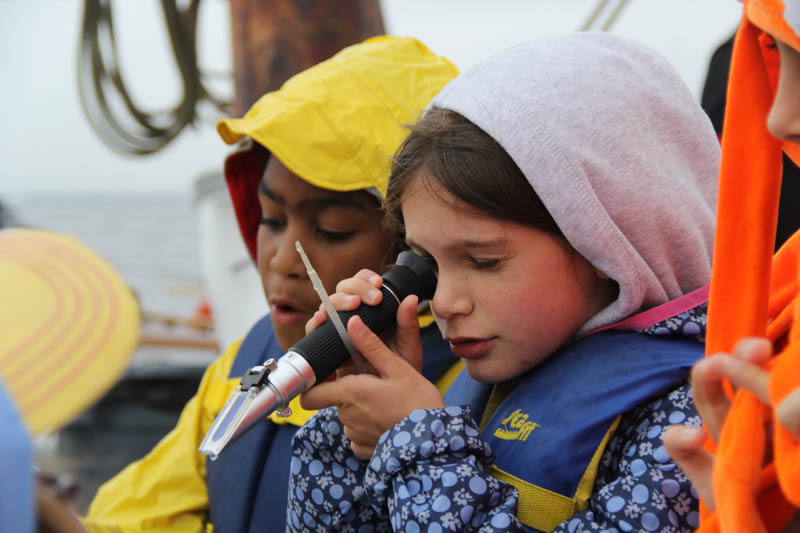
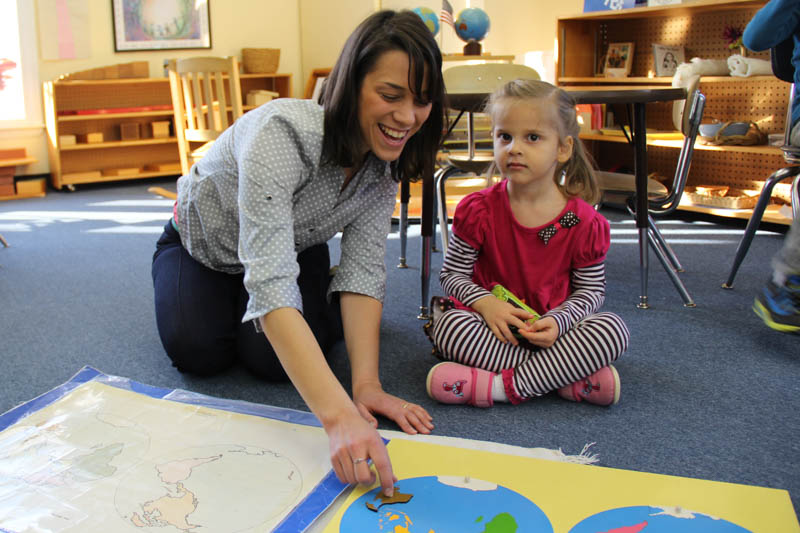
Montessori As Preparation for the “Real World,” written by Lower Elementary Lead Guide, Cheri Gardner
In Montessori classrooms, we don’t insist that our students sit at desks all day, do the same work that everyone else does, or stop doing things they’re immersed in because a bell rings. Parents unfamiliar with Montessori often say, “That sounds great, but how does Montessori prepare children for the ‘real world?’”
We ask these parents to consider that traditional educational methods were developed during the industrial revolution when students were being trained for work in factories. Students needed to learn how to walk in lines, follow directions, memorize procedures, and start and stop work at the signal of a bell. This is clearly no longer the world in which we live or work.
So what skills are needed to succeed in the “real world” today? Success in the global economy comes from the ability to think, show ingenuity, and take purpose-driven action. Success comes from working cooperatively with others – as well as by oneself. Success comes from the ability to both define and solve the problem. Success results when we persevere in the face of difficulty, and keep trying even when our first (and second, and third!) attempts are failures. Success comes when we have the desire to make a significant contribution.
Daniel Pink, author of Drive and A Whole New Mind, said, “Human beings have an innate inner drive to be autonomous, self-determined, and connected to one another. And when that drive is liberated, people achieve more and richer lives. Maria Montessori figured this out a long time ago.”
The structured freedom of the Montessori environment fosters the development of inner discipline, responsibility, and intrinsic motivation. The collaborative nature of the Elementary Montessori classroom challenges students to both advocate and empathize, listen and lead, visualize and reflect – all real world skills that will serve them for a lifetime. With a strong foundation in methods supported by scientific research, Montessori education has a clear record of success in preparing students for high school, college, and adulthood.
Larry Page and Sergey Brin, the founders of Google, explicitly credit Montessori with their success. “We both went to Montessori school,” Mr. Page said, “and I think our success was part of that training of not following rules and orders, and being self-motivated, questioning what’s going on in the world, doing things a little bit differently.”
So we declare proudly, Montessori IS education for the real world!
“Intelligence plus character – that is the goal of education.” – Dr. Martin Luther King, Jr.
During many of our parent education events, we talk quite a bit about fostering the development of soft skills in our children. Soft skills – also referred to as “people skills” – include a person’s social graces, habits, personality traits, and interpersonal skills.
When thinking about education for our children, parents often have high academic aspirations. But of course, we also want our children to be good. This goes without saying. We want them to be caring, compassionate individuals. We want them to be problem-solvers and leaders. It may seem obvious to parents, but how many schools are actually focusing on developing these skills?
At Greenspring Montessori School, we are constantly emphasizing these values in our children. We’ve also provided more resources below showing how essential these skills are in our adult lives, and how to focus on their development with your child.
In our modern world, it is so easy to get sucked in to conflict – online, on the news, with our family and friends. It is important that at a very young age, we begin to learn how to settle our differences and appropriately handle strong emotions.
Peace education is a major component of the Montessori classroom. Adults model peaceful and respectful behavior, and because Montessori classrooms are composed of mixed age groups, older students serve as role models for younger children.
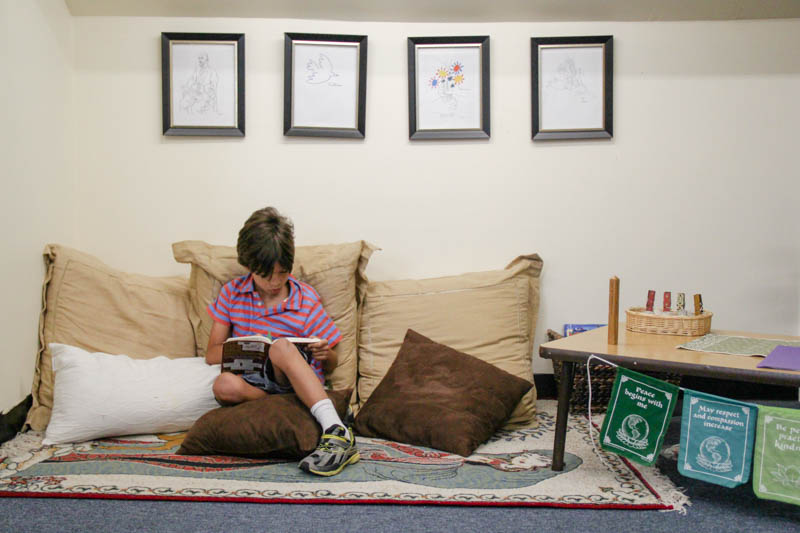
Most classrooms have a peace corner or peace table, at which two students can go to resolve a conflict or a single child can go to calm down and feel peaceful. One strategy is the use of a peace rose. Children learn to take turns holding the peace rose while speaking about how they feel. They stay at the peace table until they have heard each other and resolved their conflict. With very young children, adults model and coach the children with words they can use. Older students can do this independently. At the Elementary level, when the imagination takes off, students enjoy role playing and solving problems in small groups. Elementary and Middle School age students may participate in student-led community meetings, in which conflicts are discussed, brainstormed, and resolved as a group.
Going hand-in-hand with peace education is the Montessori Grace & Courtesy curriculum. Students practice simple lessons such as how to greet others, say please and thank you, tuck in chairs. At the core of these lessons is respect for others, self, and the environment. Montessori students engage in community service at every level – within the classroom for youngest students and outside the classroom and the school for older students.
Below are some additional resources related to Peace Education in the Montessori classroom. For more information on our programs at Greenspring Montessori School, please contact us at inform@www.greenspringmontessori-b.dev or give us a call at 410-321-8555.
Video: Educating for Peace: The Essence of Montessori
These are just a few of the many wonderful picture books about Peace for children! Current parents are always welcome to visit our library to check out books on peace education.
After the field trip to Rodgers’ Farm last week, a parent commented how amazed she was by the children’s discipline. When it was time to leave the farm to return back to school, the children immediately stopped climbing on hay bales, bouncing on hippity-hops, playing tag and lined up. She said it was as if I had a magic ‘dog-whistle’ and wondered how I achieved this. I am often asked how the Guide disciplines children in a Montessori classroom. My answer is: we don’t discipline the children; the children develop self-discipline themselves through purposeful movement with a determined goal. It is concentration with the Montessori materials that aids the child in creating self-discipline.
I realize that this sounds very mystical and vague. I will begin by stating methods that are NOT used to develop discipline in a Montessori environment. Commands, bribes, praise and threats are not viable methods to help the child develop self-discipline. Discipline is NOT adult-driven. In fact, in order for the child to develop self-discipline, the adult needs to get out of the child’s way! “Children decide on their actions under the prompting of natural laws. Adults do it by taking thought. If the child is to exercise this power, it is necessary that he be not directed by someone telling him what to do at every moment in his life. Inner forces affect his choice, and if someone usurps the function of this guide, the child is prevented from developing either his will or his concentration. So if we want him to acquire these traits, the first thing we must do is to make him independent of the adult.” (Dr. Maria Montessori, The Absorbent Mind, p.218)
By providing an environment with engaging materials, a three-hour work cycle, and minimal distractions, the Montessori Guide creates an opportunity for concentration that will lead to self-discipline. When a new student enters the Montessori environment for the first time, he can be disorderly, resistant to adults, and have a short attention span. The Guide respects the child and recognizes that he has an inner directive and must create his own personality. The Guide gives timely lessons to help the child engage with the materials. The child is given freedom to choose when to have snack, when to spend time with friends, when to work in the garden, when to sit quietly and look at a book, and when to work purposefully with the materials. When the child freely chooses work, he is following his inner directive. “By means of these exercises, children not only exercise their muscles but they also give order to, and enrich their minds. These activities strengthen the will and develop understanding. The child becomes ever more conscious of himself and his environment.” (Dr. Maria Montessori, The Discovery of the Child, p.306)
The child is never rushed, praised, or critiqued. She is given the time and space to develop herself. Even when an error is made, the child is then challenged to problem solve or practice to achieve perfection. For example, a few weeks ago, on Grandfriends’ Day, a child was not moving carefully while carrying a tray and dropped a glass vase on the floor. When the glass shattered, many grandparents rushed in to help the child. I intervened and asked them to step back and observe. The child calmly got a dustpan and brush and cleaned the broken shards of glass. If an adult had rushed in to help the child, she would have been robbed of her independence and the opportunity to problem solve and persevere! I did NOT say, “Now look what you have done! What a mess to clean up!” I knew that this child was capable of cleaning up broken glass because she previously had lessons cleaning up a spill. When something is dropped or broken in the classroom, I have faith that the children will take care of cleaning it up because they are not told to do it, but because it is their choice. When a child concentrates on his work, he develop self-discipline, self-awareness, and self-satisfaction. Discipline begins within the child.
There are occasions when a child is disruptive, disrespectful, or dangerous. When this occurs, the Guide must intervene to protect the concentration of the other children working in the classroom. Disrespectful or disruptive behavior also gives children the opportunity to practice their grace and courtesy skills. If a child is disruptive to another student, the classmate can politely ask that child to find her own work. The children thus develop peaceful conflict resolution skills which are practiced daily via lessons of grace and courtesy. It is also very valuable to have mixed-ages in the class to model peaceful behavior. The third-year students are well-versed in conflict resolution after two years of practice! Third-year children serve as models and help the younger children that have not yet developed self-discipline. Since the three year olds idolize the third-year students, their example is far more powerful than any words of an adult.
Although I do not possess a ‘magic dog whistle’ to beckon the children to do my bidding, I do have faith in the Montessori method and the wisdom of the child (plus lots and lots of patience). Time and time again, I observe the change in a child after she has been engaged with a material. After a child concentrates on a work and fully attends with body and mind, I know that she is on the path to discipline.
I also want to thank you, the parents, for helping us achieve concentration in our environments. By supporting us in our school policies such as arriving on time, adhering to the no-carton clothing guidelines, and leaving toys at home, you help minimize distractions so our children can concentrate on the important work of disciplining themselves.
If you would like to learn more about how Maria Montessori’s century-old observations about concentration are supported by current neuroscience, there are some great explanations in these videos:
Greetings from Florida! For those of you who don’t know me, I was a Lower Elementary Guide at Greenspring and then the Director of Admissions before moving to Florida in 2010. I am now the Director of the Greenspring Center for Lifelong Learning. I wrote this piece when my daughter, Lila, was one in order to share a few thoughts on what it was like creating a Montessori bedroom in the home.
The Elements of a Montessori Bedroom:
Floor Mattress
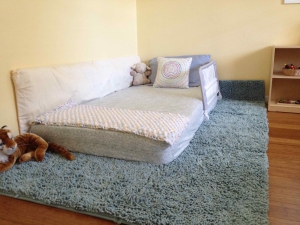
A floor mattress allows your baby to crawl in and out of bed as soon as she is old enough to move around independently. When she wakes up, your baby can freely explore her bedroom rather than crying out for an adult to free her from “baby jail.” If the environment has been set-up with accessible toys and books, your baby can learn to entertain herself for increasing lengths of time.
Lila slept in a bassinet at the foot of our bed until she was four months old. We then lived in several short-term housing arrangements; this kept us from putting her on a floor mattress until she was six months old. But my friend and Montessori colleague, Nicole, used a floor mattress from the moment her son came home from the hospital! She placed her newborn in a Moses basket directly on the floor mattress until she felt he was ready for more space. The first time Lila crawled out of bed on her own (at my parents’ house), she was so pleased with herself!
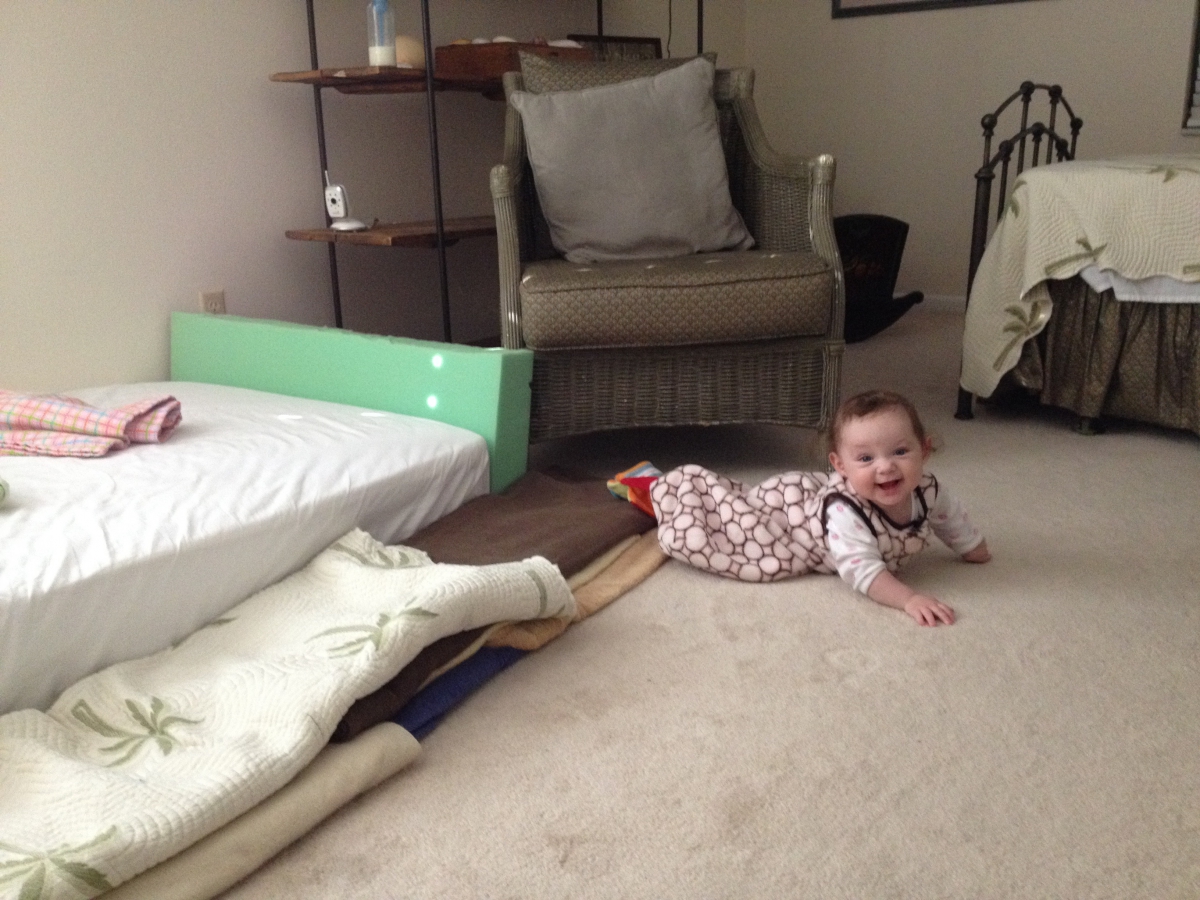
I started with an organic crib-size mattress, but quickly found that Lila rolled off it almost immediately (as you can see above). I placed blankets all around the mattress for extra cushioning and often found her sleeping on the floor with her head on the mattress. (That was one expensive pillow!) Soon, I switched to a twin mattress. (If you have room, you may even prefer to use a futon or full-size mattress.) Placed in the corner and framed on the third side with a safety rail, Lila tends not to roll off accidentally, but can still get in and out freely. I placed non-skid bathmats around the perimeter of the mattress instead of blankets.
I also fashioned a wall bumper out of foam core, batting, and an extra sheet to prevent her from rolling into the wall and bumping her head.
The idea of a floor mattress makes some parents nervous. But in actuality, many crib accidents occur every year when babies climb and fall out or get stuck in the slats. By setting up a completely baby-proofed Montessori bedroom, a floor mattress can actually be safer than a crib. You may also find that using a video monitor in the baby’s room helps you feel more secure. (One friend uses a Dropcam to view the entire room and even enables her to watch from her smartphone.)
Baby-Proofing
Because Lila can move about her room freely, we had to baby-proof the entire room. We covered outlets, hid wires behind furniture, and bolted shelving to the wall. By placing a safety gate in the doorway, the entire bedroom is safe and there is no need for a crib. (Fair warning: Lila is deeply insulted when the baby gate is closed, but we figure it is still friendlier than a closed door. I know that she is safe and I feel free to go to the bathroom in peace!)
Low Shelves
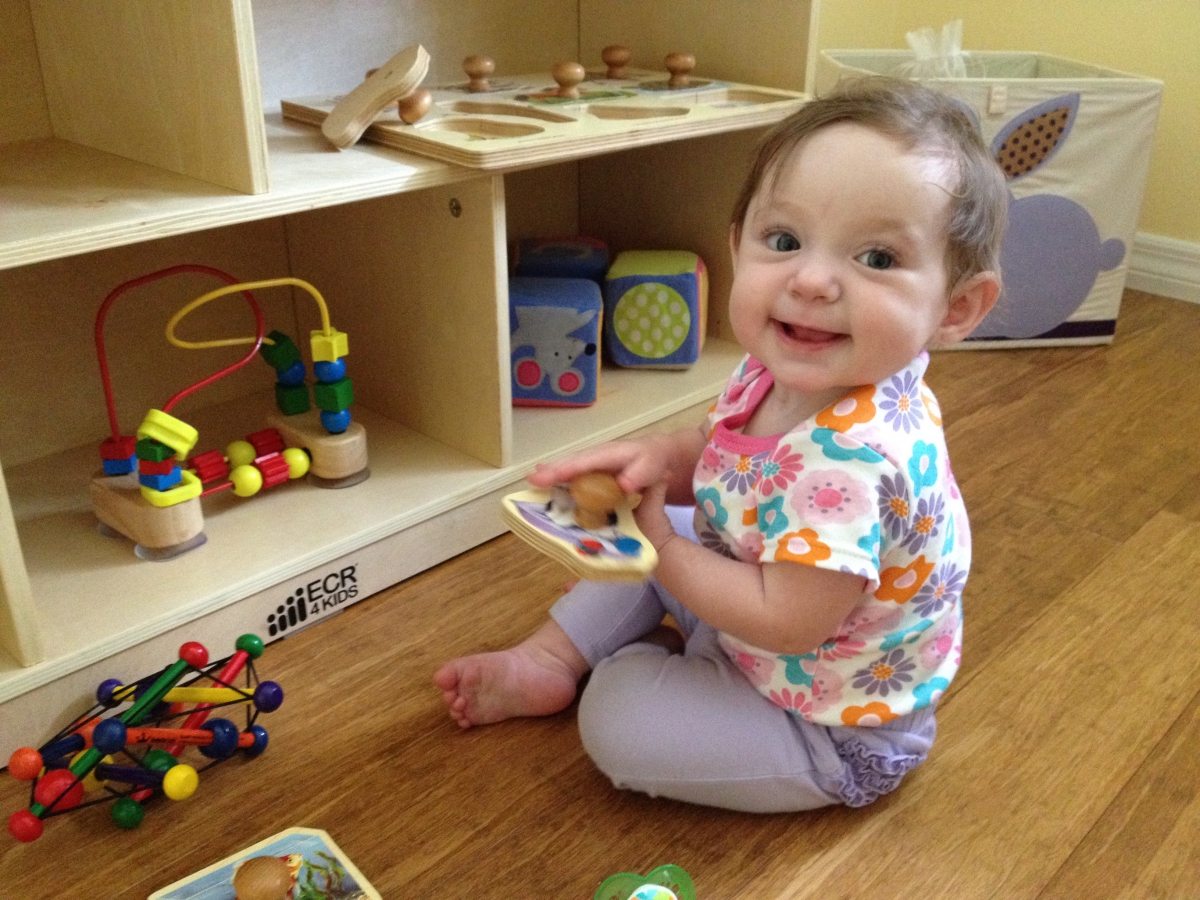
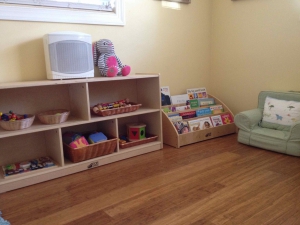
We placed toys and books on a low shelf so that Lila can access them independently. Lila was delighted when she first saw her new space; she seemed to know this room was designed just for her. In the morning, Lila often wakes up and starts playing with her toys.
We are trying to resist the urge to fill the room with toys and instead carefully select just a few toys, which can be displayed in baskets. I rotate toys from time to time to keep options limited and her interest high.
We try to select toys made from natural materials whenever possible. It can be challenging to keep plastic and battery-operated toys out of the home, especially when given as gifts. A few of these toys have actually been very nice but most mysteriously “disappear” after a while. I subscribed close family and friends to several Montessori catalogs so they would have plenty of gift ideas. You can also keep an Amazon wish list for friends and family to reference when they wish to buy a gift for the baby.
Alternative Perspective: My friend, Nicole, found that her son had trouble falling asleep in a room filled with stimulating toys. She decided to place only a few stuffed animals and books in the bedroom, reserving it as a place for nursing and sleeping only. Instead, her son’s toys are in a separate play area in the family room.
Diapering area
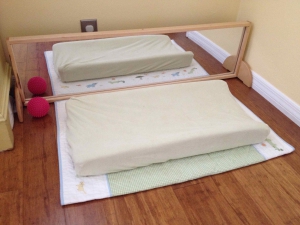
Ideally, the diapering area would be in the bathroom so the child learns to connect toileting with the bathroom, but as our bathroom is very cramped, I keep a changing pad on the floor in one corner of Lila’s room.
A few items – such as diaper ointment and wipes – are kept inaccessible on top of the dresser, but safe items are kept available so that Lila can learn to help with her own diapering. Lila actually prefers to be diapered standing up, which was challenging at first, but we encourage this as it is actually the first step toward toileting independence. Now Lila prefers to be diapered while walking, which is really challenging!
Darkening shades and white noise
The Florida sun is intense and it is often still bright as mid-day at Lila’s bedtime. As a consequence, we have installed black-out roller shades in her bedroom. We also use a white noise machine to help mask the sound of Lila’s daddy crashing around in the kitchen each morning. It’s a fine line – while I don’t want Lila to require pitch black or total silence to sleep, I also find that these measures ensure that she is well rested.
Décor
We have tried to keep Lila’s room functional without too much clutter. Montessori recommends decorating with beautiful artworks framed in plexiglass and posted at the child’s eye level. Confession: I have not yet implemented this. I still have framed artwork (that is special to me) at my eye level. When Lila is a little bit older, I promise to get with the program and add some lovely items behind plexiglass at her eye level.
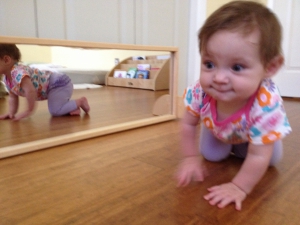
Many Montessorians mount a long, horizontal plexiglass mirror next to the baby’s bed. Taking Nicole’s advice, I decided not to place the mirror next to her bed so as not to overstimulate Lila as she is falling asleep. Now that she is one year old, I find that Lila gets very busy playing when she senses it’s bedtime. So I may be soon converting her room to a sleeping-only room and relocating the toys elsewhere…
As a teacher, I was constantly tweaking the classroom environment based on observation of my students and how the space was serving their needs. It’s just the same when preparing the home environment! (For example, I recently moved the mirror to Lila’s diapering area in an attempt to keep her distracted during diapering, but it didn’t work.) I am trying not to get too attached to any one solution. As Lila’s needs change, so must her space.
In my next blog entry, I will discuss setting up other rooms of the home. Questions? Suggestions? Email me! My email address is mjarrell@www.greenspringmontessori-b.dev.
Recommended Reading:
Books & DVDs:
How to Raise an Amazing Child The Montessori Way by Time Seldin (a great overview with beautiful photography)
Montessori From the Start: The Child at Home, from Birth to Age Three by Paula Polk Lillard (very in-depth)
Bringing out the Brilliance in Your Infant (DVD) by our very own Head of School, Tamara Sheesley Balis (please let us know if you would like to borrow or purchase a copy)