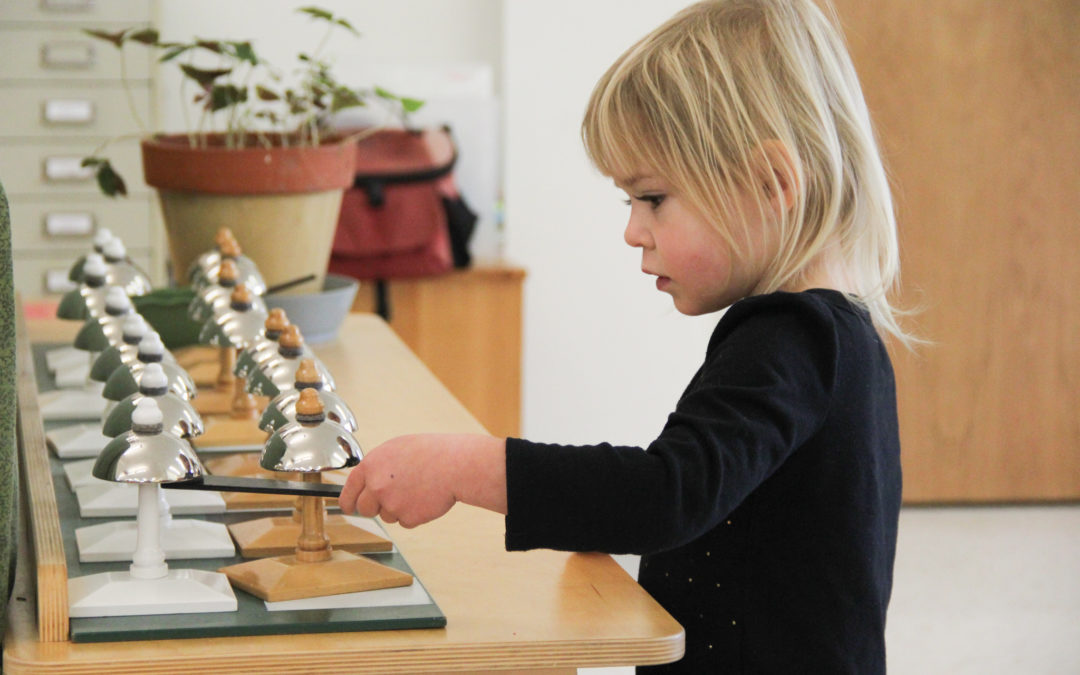
The ability to concentrate and focus is at the core of satisfying and successful experiences in many aspects of life. As adults we need to attend to what we’re doing, whether it be the details of a graph we’re explaining at a meeting, the particulars of a recipe, or the art of active listening to the people we engage with every day. This ability has many new challenges in times we live in. Children must be equipped with the ability to concentrate and Montessori education does so much to address this need.
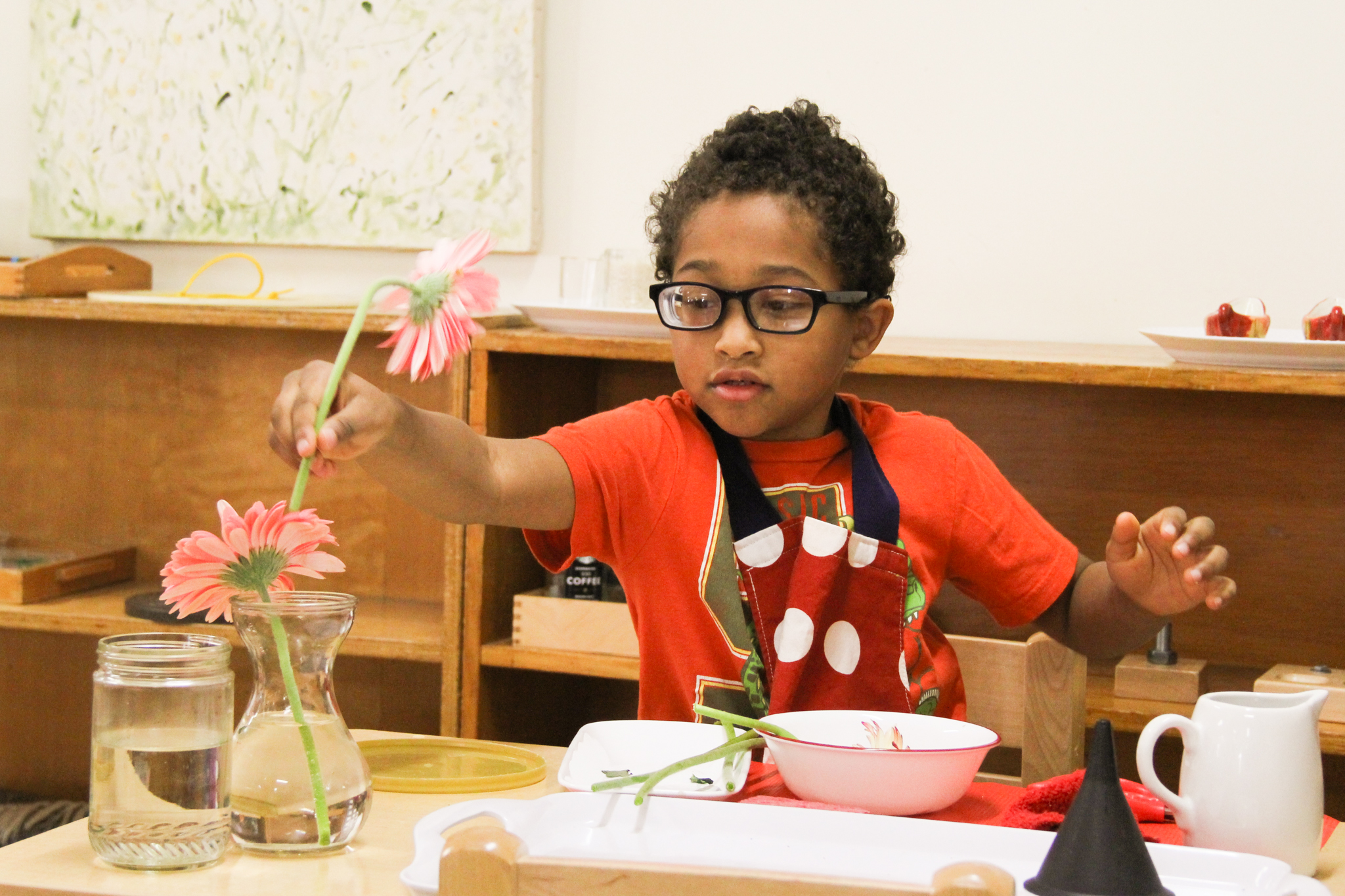
While concentration at the Children’s House level often looks like a student sitting alone with her work, engrossed in the task at hand, successful concentration looks a little different for the Elementary and Adolescent Community student. The Elementary child must learn to work collaboratively with others. This partner and group work means the child will be engrossed in their work, stop to talk to a friend for a few minutes, and then continue working. The ability to be interrupted and return to focused work is an incredible asset as an adult and the Montessori student practices this skill throughout the work cycle as he or she interacts with classmates during work and participates in lessons.
Similar to the Elementary student, the Adolescent Community student often works on projects in groups. Concentration for Elementary and Adolescent Community students means fully engaging in the projects and work. This is done when enough choice is given so that students can take ownership and invest in their work. In contrast, when everyone is given the same thing to do, some students will inevitably be more invested than others. However, students who are invited to choose within a particular assignment or project, tend to focus more because they are more engaged. Students are also focused when the work is challenging, but not so challenging that they give up.
The ability to focus on the present moment and attend to one’s work is challenging given the busy lives children lead, as well as the distraction of so many pinging and buzzing devices. At Greenspring, we support the students’ ability to concentrate with frequent opportunities for self-reflection that are built into the day. In Lower and Upper Elementary as well as Adolescent Community, students reflect on best practices after each work period, and often write in their work log about the work cycle. The process of reflection offers many insights into the child’s experience. Studies show that regular mindfulness-focused activities support concentration.

Home Challenge:
Challenge yourself to stand back and observe your child the next time he or she is focused on a project. This could be as simple as tying a shoe or as complex as building a Lego invention. See how long they are able to work independently to overcome the challenge and resist the overwhelming urge to swoop in and help. Be mindful of how often you are drawn to ask questions, fix the perceived problem, or otherwise distract from this process. A child’s ability to concentrate is a beautiful thing to observe!


We all know that young children thrive on consistency and routine. Dr. Montessori discovered that children from ages one to four are actually in a “sensitive period” for order. This means that not only do they crave consistency from their environment and schedule, but that toddlers are particularly attuned to developing an internal sense of order at this age, if given opportunities to develop this skill.
For this reason, Montessori environments – both at school and in the home – are carefully prepared so that every item has a place. (I have previously posted about setting up Montessori spaces in the home – the bedroom and the bathroom – and am currently working on a piece about the kitchen.) But while it’s fairly easy to create physical places for things, creating a sense of order throughout the day is far more difficult. Young children have a strong need to feel in control and yet so much of what happens during the day is determined by others. Plus, toddlers can’t yet grasp the concept of time – today, tomorrow and yesterday – because the part of the brain that is able to plan ahead and make predictions about the future is still developing.
Creating a few simple routines at home can help your toddler practice making simple predictions, as well as understand concepts such as “before and after.” A consistent routine can (sometimes) eliminate power struggles because your child feels more control over what is happening. A routine is especially helpful during difficult times of day, such as at bedtime or when getting ready for school in the morning.
I’ve collected a few tips good from the experts:
Include preparation for transitions in the routine. For example, say, “We have 10 minutes left before we start getting ready for bed. Since toddlers can’t read a clock, try setting a timer. When the timer goes off, it’s time to start the bedtime routine.
Include opportunities for (limited) choice. Toddlers like to feel in control. You can create the illusion of choice, such as “Are you going to wear the blue shirt or the red shirt?” By putting clothes where your child can access them, this also allows for greater control (aka, independence!) over the process.

Get silly! Even with consistent routines, toddlers will still test the limits. Recently, my daughter, Lila, started to resist getting dressed in the morning. Now my husband helps her “hop” into her clothes and then challenges her to see how high she can jump on the trampoline in her “jumping pants.” Hey, whatever works! And when this stops working, we’ll have to change it up again.
Try creating a picture schedule for your child. During her transition to a Montessori toddler program, Lila began to ask every morning, “Is there school today?” So we created a photo schedule that would show what was going to happen each day of the week. It allows us to discuss the next day’s schedule and Lila can refer to the schedule when she wants to know what is going to happen next. I have found several websites that offer free printables for daily routines, such as these on pricelessparenting.com. Older children may enjoy drawing pictures for their charts.
 Practice routines with activities that are fun, as well as chores. Routines aren’t only for things kids have to do. Lila enjoys making coffee with her daddy on Saturday mornings. She loves being the taskmaster: “Step 1: Grind the beans!”
Keep your daily schedule as predictable as possible. Your child will take comfort in knowing that she goes to school in the morning, comes home for lunch and a nap, and then has playtime in the afternoon. For this reason, we chose to enroll Lila in a Montessori toddler program five mornings a week. Her adjustment to school still included separation anxiety, but thanks to the consistent schedule, Lila quickly began to learn what to expect each day, and this knowledge provided some comfort. In a matter of a few weeks, Lila began to see school as a joyful place where she belonged; now she walks through that classroom door without looking back!
Stay flexible. Of course, children do need to learn how be flexible and deal with minor changes. But that’s why we offer children a predictable routine as a foundation–so they can rise to the occasion to handle big changes when they need to. If there is an interruption to the routine, you can tell your child, “I know we usually do ___, but today we are going to do ___ because (reason). Tomorrow we will go back to our usual schedule.”
It is never too late to start a routine. You can introduce a new routine by saying, “The way that we have been doing things has not been working. We are going to try something new. Here is our new schedule.” Give the new routine some time before making adjustments. Your toddler will resist at first; consistency is key!
To read more about the benefits of setting up routines for your toddler, check out this article by Aha! Parenting.
If you would like to learn more about our Toddler program, please click here.

Does this sound familiar?
“How was your day?” … “Fine.”
“What did you do at school?” … “Nothing.”
It can be hard to get children to open up about what’s going on in their world, especially after a long day at school. Here are a few different communication strategies you can try. Find ones that work best for your family and then practice until they become part of your daily routine. This process takes time but can lead to more satisfying conversations in the long run.
Strategies to Try:
Wait at least a half an hour
After a long day at school wait at least 30 minutes to trying to engage in a conversation. Give your child a chance to take off the backpack, relax, and have a snack.
Ask open-ended questions
“Do you have homework?” or “Did you give your speech?” are questions that only invite a yes or no response. So try to pose open ended questions. Get creative! (There is a list of examples below.)
Be present
The moment your child starts to engage in conversation, stop what you are doing, and give your full attention. It can be hard to tear yourself away from what you’re doing to focus on a child’s question or comment, but your response can either encourage or shut down the conversation. Don’t forget to look interested!
Listen! And stretch the conversation…
Don’t talk, listen! Try comments like “Really?” “Uh-huh?” “I don’t believe it!” “Wow!” to stretch the conversation. They are non-threatening and invite the child to open up. You can also reflect back what the child is saying so they know you understand, and then be quiet so they can talk more. Child: “I played on the swing.” You: “You played on the swing.” The trick is to repeat the tidbit in a matter-of-fact but interested way to get your child to open up and add more.
Try to listen without judgement
Pushing, prodding, demanding, coaxing, lecturing, and threatening are sure ways to end conversations. Questions that begin with “Why” often make kids defensive. “Why did you wear that?” won’t work nearly as well as, “What do you think most of the kids will be wearing to the theater?”
Resist the urge to jump in with solutions and advice
Your child needs a chance to vent and can’t hear advice until she does. Then she needs a chance to figure out her own solutions, which is how she develops confidence and competence. When we can reflect feelings and then help children brainstorm solutions, kids find us more useful to talk to — and they’re more likely to seek us out when they have problems.
Take advantage of indirect communication
Kids often open more in the car, on a walk, or in the dark — all times when eye contact is limited. Remember that these are great times to get kids talking. Another opportunity for indirect communication is when their friends are over or in your car. Just keep quiet and listen. Your child knows you’re there, of course, but often is more willing to talk than if you were speaking directly.

Questions a child might answer at the end of a long school day:
What made you laugh today?
Did anything silly happen?
Did anyone do anything super nice for you?
What is the nicest thing you did for someone else?
Was there an example of unkindness? How did you respond?
What games did you play at recess?
Does everyone have a friend at recess?
Who did you sit with at lunch?
Who do you want to make friends with but haven’t yet? Why not?
Did you help anyone today?
Did you tell anyone “thank you?”
Who inspired you today?
What is something that surprised you?
What is something that challenged you?
What made you feel proud?
How were you brave today?
Will you teach me a song you learned at school?
What was your least favorite part of the day?
Tell me something good (or three!) that happened today.
What are you looking forward to tomorrow?
Do you have a teenager? Huffington Post has some great ideas about starting the conversation with your teenage children. Take a look here – https://www.huffingtonpost.com/liz-evans/28-ways-to-ask-your-teens-how-was-school-today-without-asking-them-how-was-school-today_b_5751546.html
If you are interested in learning more about Greenspring Montessori School, please click here to request more information.

Written by Michelle Donohue, Toddler Guide
“The child’s development follows a path of successive stages of independence, and our knowledge of this must guide us in our behavior towards him. We have to help the child to act, will and think for himself. This is the art of serving the spirit, an art which can be practiced to perfection only when working among children.” – Dr. Maria Montessori, The Absorbent Mind, p. 257
This quotation from Maria Montessori in The Absorbent Mind is at the heart of the Montessori method and lays the foundation for all that we do in our Toddler environments. Preparing an environment for children’s independent growth applies to every area of our curriculum and the way we teach, making our art curriculum look drastically different from that of other schools. Our toddlers paint, glue, and mold with play dough…but in a new way that helps them to create themselves.

Art for Montessori toddlers is always child-selected and child-led, as with all activities in our classroom. Freedom of choice allows children to develop independence. Children build the ability to complete a work cycle, from start to finish, without adult intervention. We place only one of each work on the shelf to assist them in developing the capacity to wait patiently for a work that may be in use.
Each lesson in our art curriculum is focused on a skill, rather than on completing a project. The purpose of our toddler’s artwork is to master the process, and learning to finish a masterpiece happens later in the preschool years. To teach the ability to create lines, we supply chalk or crayon shaped like a sphere or an egg, in only one color, and a blank chalkboard or paper. To teach gluing, we provide blank paper in a basic shape, small pieces of paper or other materials, and glue and a spreader. To teach cutting, we provide child-safe scissors, with small strips of paper and bowl to collect the pieces.

After a lesson, each child is free to choose this activity whenever she wants, for as long as she wants. This freedom allows her to work on perfecting her gluing skill for an hour (or even longer!) if she chooses. Toddlers and preschoolers are intrinsically driven to repeat tasks that they are developmentally ready to master over and over for as long as the need is there, thus perfecting a skill and developing concentration. When she knows that she is finished, and the skill has formed enough for the moment, she completes her work cycle by returning her tray to the shelf and pushing in her chair. Developmentally, our toddlers are ready to focus on perfecting the process rather than on completing a product, and often the finished product is forgotten. They are content to simply bring home their newfound ability to glue with precision and accuracy.

This is also the age in which the child is developing her locus of motivation – the one that she will carry with her into adulthood! To develop strong internal, self-driven motivation, we allow the child to focus on process at a young age, and if she does present us with her work, we respond with non-evaluative comments, such as “You glued today!” or “I see that you glued blue squares on green paper.” This lets the child’s focus on her own hard work, rather than rely on our evaluation of her work.

Though process and independence are emphasized in Montessori toddler classrooms, our toddlers are creating brilliant masterpieces. These works are already forming, and are beginning to shine in all their glory. The Montessori toddler’s medium is herself, and the beautiful person she is artfully crafting will surely change the world.
Learn more about the Greenspring Montessori School Toddler Program.
Written by Emily Shattuck, Children’s House Lead Guide (and Mother of Two)
“Your job as a parent is to put yourself out of a job by raising your kid to independent adulthood (where independence equals not turning to you to handle/fix/resolve everything) and when you appreciate that every day offers a chance to build that independence, no matter what age and stage your kid’s at.”
~ Julie Lythcott-Haims author of How to Raise an Adult: Break Free of the Overparenting Trap
I agree with this quotation, but as a parent, I am also saddened by its truth. We all love our children and take great pride in caring for them: feeding them, dressing them, making sure they get enough rest, waking them in the morning, cleaning them, entertaining them, and educating them. As a parent of a 16 year-old high school junior and a 12 year-old seventh grader, I have fond memories of caring for my children as infants, toddlers, pre-schoolers, and through the elementary years. It is wonderful to feel needed and loved by our children. Being a parent is a very rewarding, fulfilling, and exhausting job and we would not trade it for the world!
While my children were young, however, I also was wary of the cultural norms to over-parent or “helicopter parent.” I know my children needed to develop skills to eventually leave the house at 18 and find their way in the world and it is my job to prepare them. With just two years remaining before my daughter’s 18th birthday, I decided to prepare myself for the craziness of the college application process and I picked up How to Raise an Adult, written in 2015 by Julie Lyhtcott-Haim, the former Stanford Freshman Dean of students. As a Montessori Children’s House guide, I was delighted when Montessori education was mentioned throughout the book. It states, “Despite the evidence that Montessori’s student-driven learning approach is a springboard to success in life, Montessori has yet to become a mainstream model for education in the in the United States.” (p. 158) It was both a relief and a validation that my children were Montessori students and had the benefit of a Montessori education.


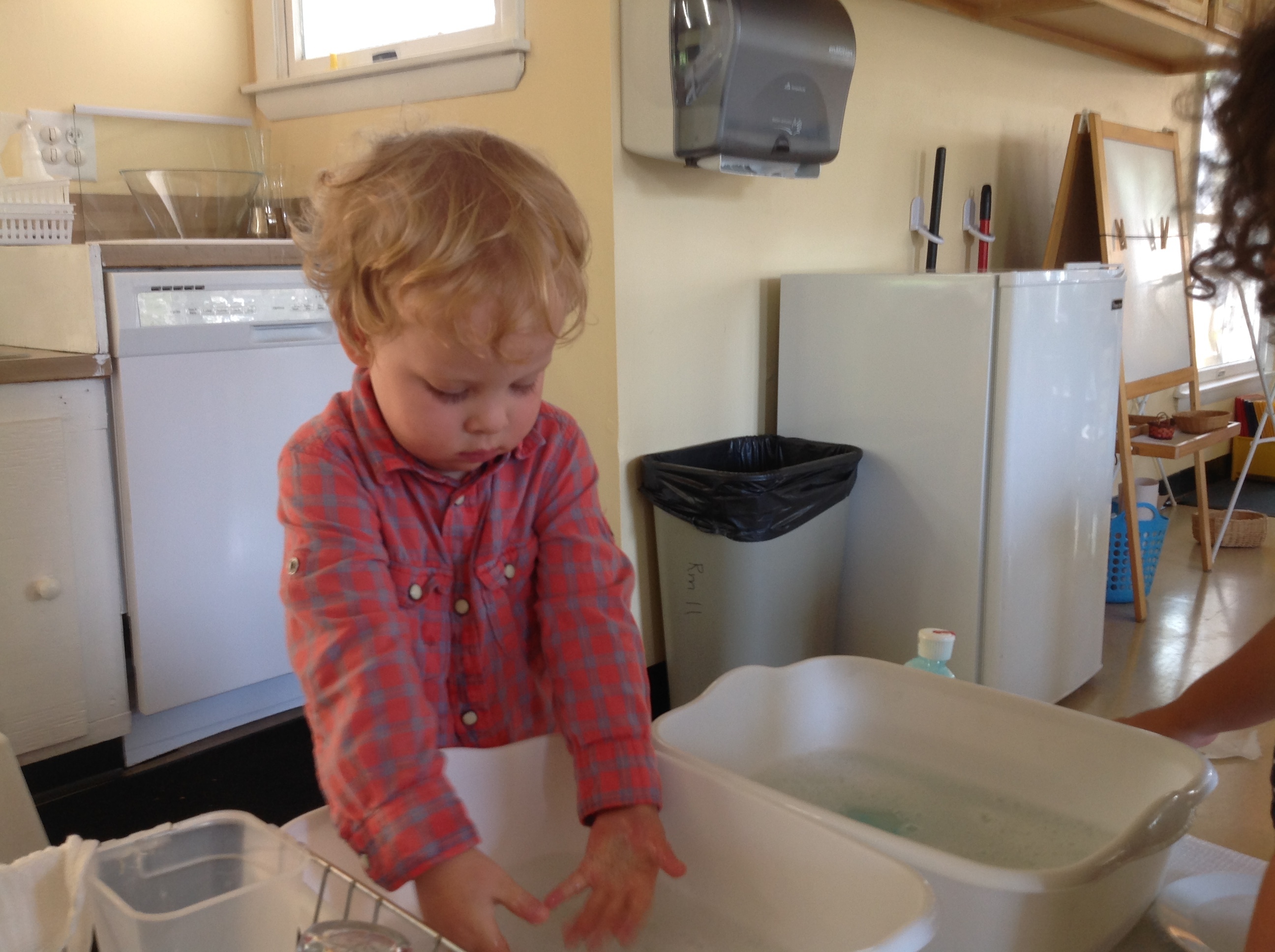
Although many aspects of the Montessori curriculum lends itself to creating resilient, creative, caring, responsible adults, the Practical Life lessons in the Children’s House build the strongest foundation for a path to independence. When developing her first school in Rome circa 1907, Maria Montessori observed that children between the ages of two and a half to six years delighted in helping to care for their classroom. Montessori created child-size tables, chairs, brooms, mops, and other materials so the children could practice sweeping, mopping, and cleaning. She noticed that children enjoyed helping prepare food, set the table, do laundry, garden, and clean as adults do. An entire curriculum was created to fulfill the child’s need to contribute to his community and the Exercises of Practical Life were born.
There are four components of the Practical Life curriculum: Preliminary Exercises, Applied Exercises, Lessons of Grace and Courtesy, and Control of Movement Exercises. The Preliminary Exercises are lessons to give the child the opportunity to practice movements that she will use on a daily basis to perform tasks such as pouring, using a spoon, spreading with a knife, cutting food, or folding laundry. In the Applied Exercises, the child utilizes these developing skills to care for herself and the classroom environment, such as with hand washing, dressing herself, washing a table, or mopping the floor. The lessons of Grace and Courtesy provide the child with the opportunity to learn and practice social graces. Grace and Courtesy lessons include blowing one’s nose, saying excuse me, greeting a guest, introducing oneself, and walking around a work rug. The Control of Movement Exercises help develop self-control and include walking on the line and the Silence Game. The aim of all the Practical Life lessons is to promote independence, responsibility, coordination, concentration, respect for one’s self and their environment, and provide the child the opportunity to develop their identity as a contributing citizen of the community.


As a parent, it is comforting to know that our children are exposed to the lessons of Practical Life and are establishing themselves as members of their Montessori community. But we can also help our children develop these skills by allowing them to play a contributing role in the home environment. “A longitudinal study conducted by Dr. Diana Baumrind concluded that those who were most successful began doing chores at age three or four years of age, whereas those who waited until their teen years to start doing chores were comparatively less successful.” (Lythcott-Haim p. 198) This is wonderful news to parents of current Children’s House children because your children are already accustomed to this role in the classroom. By bridging the gap between school and home, you can assist your child in developing resilience, responsibility, and independence.
Montessori guides have an advantage since they can design the entire environment to serve the construction of the child’s personality. At home the surroundings and pace of life are designed for adults. Our job, as parents, therefore, is to remove obstacles to our children’s independence in the home life. Parents can begin this process as the Montessori guide does – by observing the child. Observe what the child can do for himself already, his interests, what causes frustration, and which skills that he needs to work on. Once we have observed the child, we can begin to prepare lessons that will serve the child’s development. For instance, if we see that a child cannot put on his own shoes or pour his own drink for snack, we present simplified lessons so the child can practice these skills in order to gain mastery. This requires thoughtfulness and patience. We cannot rush the child when he is doing the hard work of self-construction. We should move slowly, carefully, and with precision. As adults, we do not realize how fast we are moving! Children at this age have not developed the visual acuteness to track fast movements, so we must remind ourselves to slow down when we are giving a child a lesson. The Practical Life Exercises are also given in silence. You can name the activity and the tools used for the work, but the movements are not accompanied by language. We are silent so that the children can process the steps and actions visually and are not confused or bogged down by auditory processing as well.


For instance, if you would like to give your child a lesson on washing his face you could introduce the lesson, “Today I will give you a lesson on washing your face.” You can name the tools used, “This is a wash cloth. This is soap. This is a towel.” Then you can demonstrate slowly how to turn on the faucet, wet the washcloth, rub it on the soap, rub it on your face, rinse the washcloth with water, rub your face again, turn off the faucet, hang up the washcloth to dry, and dry your hands and face. When preparing to give your child a lesson, practice yourself first and gather the necessary supplies. Make sure the supplies needed are suited to the child’s size and are accessible by the child independently. Practice the actions yourself, breaking them into steps, moving mindfully and slowly. When you are ready you can give a lesson to your child, finish the lesson by saying, “Now it’s your turn!” and give your child a turn to practice. You can end the lesson by saying, “You can wash your face whenever you like!” You do not praise the child, as the lesson it is not for your benefit, but a gift for your child.
Vicki Hoefle, author of Duct Tape Parenting, gives examples of skills and tasks children should learn and master at age four, including getting dressed on their own, making toast, brushing teeth, setting the table, taking dirty dishes to the dishwasher, making the bed, combing hair, packing own back pack, taking a bath, waking up with an alarm clock, wiping the table after meals, feeding pets, and cleaning the kitchen sink. (p. 143) Lythcott-Haims also includes tasks such as putting dirty clothes in the hamper, putting away toys, dusting, and washing one’s face (p. 167) as basic life-skills children age 3-5 should learn. “Children are innately interested and open to learning basic life skills, and if allowed and encouraged to do so, they grow into confident people who know that they matter within the family and within the community. This in turn affects how they develop socially. By the time they are teenagers, if they’ve mastered basic self and life skills, they can focus on developing their social skills.” (Hoefle p. 133)


Keep in mind that you must have patience, understanding, and self-restraint to actually make this work in your home. Your child is not going to perform these tasks perfectly the first time, or maybe even the 60th time. This is a process. It is our job to observe, give the lesson, and then move out of the way! Above all, do not follow behind them and do it for them if it is not done to your standards! That undermines their work and their self-worth. Also these tasks or chores should not be tied to an allowance, reward, or praise. They should be expectations as your child’s contribution to the household. (If you do want to introduce an allowance to help your child learn about financial responsibility, more guidance is given in Duct Tape Parenting.)
For more ideas on how to raise respectful, responsible, and resilient children, I highly recommend reading Duct Tape Parenting. If you are concerned that you may be one of those parents on the path to writing your child’s college essays, then I suggest How to Raise an Adult.
Your challenge this month:
Choose a time of day that you wish your child was more independent (for example, preparing for school, mealtime, or bedtime) and observe for fifteen minutes without stepping in. Then make a plan to determine what is going well and what your child needs to still work on. Develop a lesson to support your child with one skill. Then observe over the next few weeks to see how your child is progressing.
I hope you are as inspired as I am about current parenting books echoing what Maria Montessori knew over a century ago. “Children are the constructors of men whom they build. Childhood constructs with what it finds. If the materials are poor, the construction is also poor.” (Maria Montessori, letter to a government official,1947) And how fortunate to have your own child beginning the exciting work of creating the person he is to become!


Greetings from Florida! For those of you who don’t know me, I was a Lower Elementary guide at Greenspring and then the Director of Admissions before moving to Florida. My daughter, Lila, recently turned two and I would like to share a few thoughts on what it was like setting up a toddler-friendly bathroom.


Care of Self
As Montessori parents, our goal is to prepare the home environment for toddlers to be as independent as possible. The bathroom provides a wonderful opportunity to empower our toddlers and begin teaching them important life skills. Toddlers are innately motivated to take care of themselves, so they will be eager for these opportunities!
Giving Introductory Lessons
Children will need to be introduced to each process, broken down into simple steps. All of the needed materials must be easily accessible and in child-size containers. After introducing and modeling each skill, your toddler will need many opportunities to practice. Important skills to learn include:
*Washing hands
Provide a bottle of pump soap (my daughter loves the foaming kind) or a small bar of soap and a washcloth on the counter. You might consider using a faucet extender so your child can reach the water more easily. View a sample lesson here.


*Brushing teeth
Prepare a tray with the necessary supplies: toothbrush, toothpaste (which you may wish to portion out in individual containers at first rather than make the whole tube available), a timer, and a small water glass. View a sample lesson here.


*Brushing hair
Prepare a tray with a hairbrush and/or comb and place with (or near) a mirror. View a sample lesson here.


*Blowing the nose
Have a box of tissues accessible. If you worry about your toddler enjoying this activity a bit too much and using the whole box (see photo below), you can place a few folded tissues in a small basket. View a sample lesson here.


*Washing with a washcloth & Washing hair
Toddler-size bottles will allow your child to pour her own soap without emptying the entire supply. You can use a small plastic basket, tray, or suction cup caddy to store supplies. A suction cup mirror will allow your child to see herself while washing. (You may still need to assist with the rinsing.)


Necessary Items within Reach
Keep all necessary items within reach. If you have room in your bathroom, a shelf set up with supplies is ideal. Or you can empty the cupboard beneath your sink to store some of these items.


Beginning Toileting
This is a weighty topic for another day, but just a few suggestions:
Start changing your child’s diapers (standing up) in the bathroom whenever possible. Allow your child to help with her own diapering as much as possible.
When your child starts to show an interest in the toilet, encourage this interest. Allow your child time to sit on the toilet, practice flushing, and washing hands.
If you are comfortable with it, allow your child to watch you using the toilet and assist with flushing and washing hands.
Have a floor potty available as well and allow your child to sit on it (clothed or unclothed) whenever she shows an interest. Keeping the floor potty in the bathroom is ideal if you have room – this reinforces the idea that toileting takes place in the bathroom. Now that Lila is fully engaged in the toilet-learning process, we keep a basket of underwear and books near her potty.


Have a child-size toilet seat and step stool for the adult toilet so that this is also an option. You can allow your child to choose which she wants to use.
Supplies
These are some of the items I recommend. (These are linked to Amazon.com.)
Sink faucet extender & Tub faucet cover
Stepping Stools: Kidcraft or Soft Grip
Two-in-one toilet seat (or Toilet seat with ladder) and a Potty chair with a soft seat
Articles & Resources:
Montessori Now (blog): Montessori Activities for Self Care
Montessori Teacher Collective: Montessori lessons plans for care of self
Michael Olaf: 1-3 Years Care of Self
Montessori Services has every basket, tray, and child-size dish you could ever want!
———————————–
In my next blog entry, I will discuss setting up a child-friendly kitchen. To view my previous blog entry about setting up a Montessori bedroom, click here.