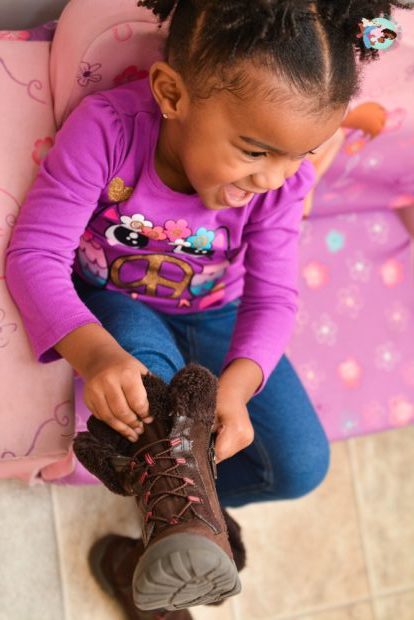
“Never help a child at a task which he feels can succeed.” -Dr. Maria Montessori
If you are lucky, your family members – especially those proud grandparents! – are excited and eager to learn more about your child’s Montessori journey. While we can’t expect our extended family to completely rearrange their homes or lifestyles, there are some simple ways that they can support your child in building independence.
Simple ways for family members to help your child’s growing independence
Allow the child to make decisions with limited choices
You can allow a child opportunities to make decisions without giving up all control. Consider offering two choices – both of which you are happy with. “Would you like a grilled cheese sandwich or chicken noodle soup for lunch?”
Allow the child to do things for herself
It is the natural instinct of a loving family member to make life “easier” for a child. But when we take away opportunities to overcome worthy challenges, we inhibit them from learning new skills and building self-esteem. For example, it may take much longer for a young child to zip up her own coat, but when time allows, give her the opportunity to try. If she begins to get frustrated, provide the minimal amount of help needed (such as holding the bottom of the coat to create tension, while the child pulls up the zipper).
Prepare the environment for independence
Allowing a child to do things for herself may require some support. Consider providing a stool at the bathroom sink so the child can reach the faucet to wash her hands. Consider putting out a small pitcher of water and a small glass so she can help herself when she is thirsty. If dishes, napkins, and silverware are placed in a lower cabinet, the child can help set the table for a meal.
Involve the child in activities of daily life
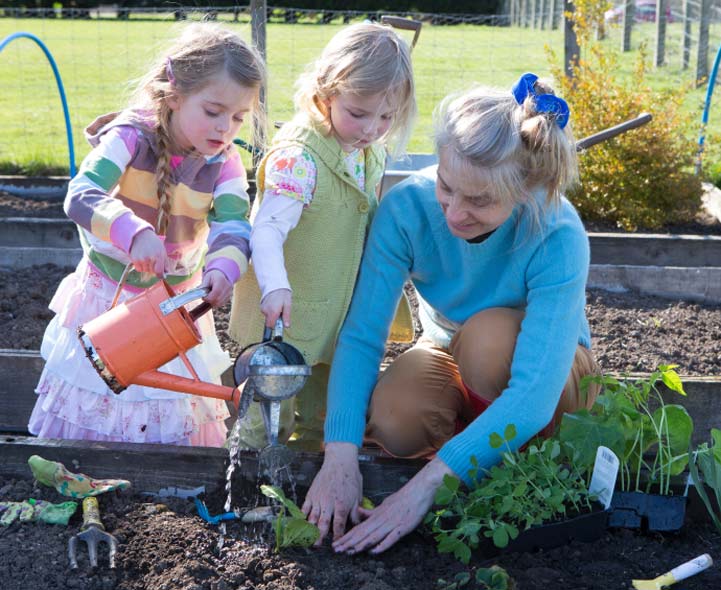
Not every visit with Grandma and Grandpa needs to involve a trip to the zoo. Children want to do what you do! Invite them to join you peeling vegetables, feeding pets, watering the flowers, etc. You may need to provide child-size tools for some of these activities, such as a small watering can or acrylic knife, so that your child can participate fully.
Create order in the environment
Instead of piling toys in a basket, consider setting up a small open bookshelf where only a few toys are accessible. This helps the child make independent choices and give more focused attention to the chosen activity. (Toys can be rotated in and out to keep the child’s interest.) A minimal, organized toy area will also help the child clean up independently because there is a clear place for everything.
Be careful of praise
Dr. Montessori found that praise can inhibit children from gaining independence because they begin to rely on the judgement of others. As an alternative, encouragement can be empowering. So instead of “Good job!” “Good girl,” or “You are so smart,” you can try, “You did it!” “Thank you for your help,” or “I can tell you worked really hard on this.”
How to help family members get on board
Model rather than preach!
Most family members won’t appreciate being given a list of rules about how to behave around your child. But you can provide a powerful example by modeling these approaches in front of your family.
Gentle reminders
Feel free to give family members gentle reminders, such as “Please don’t help him; he can do it himself” You can also make it clear what the child is capable of, such as “Lila likes to choose her own clothing. She can get dressed herself but she might need help if her arms get stuck. Please don’t worry if she puts things on the wrong way.”
Provide resources
If a family member seems receptive, you might share an article with a brief introduction to Montessori at Home, such as this one. For those who wish to know more, a nice introductory book is How to Raise an Amazing Kid the Montessori Way by Tim Seldin. Though not all of it will apply to extended family, it’s a quick read with lots of beautiful photos that provides a nice overview of Montessori for families. If you would like to help family members find child-size tools or suggest gifts that would be appreciated, you can give them a copy of the For Small Hands catalog or share a link to their website. You may also consider creating an Amazon wish list.
“The greatest gifts we can give our children are the roots of responsibility and the wings of independence.” -Dr. Maria Montessori
With a little help from family, we can create even more consistency between school and home and provide more opportunities for the child to build independence.

Written by Betsy Wimbrow, Director of Education

Ah, summertime! There is nothing like long, languid days that stretch slowly into the evening, running barefoot in the cool grass while chasing fireflies, and biting into cold crispy watermelon, the juice dripping down your chin. Summer is a time to relax, to play, to spend time with family and friends, to explore, daydream, and wonder.
There is a growing body of evidence that these same activities are key to developing important executive functioning skills. In the article “Why Free Play Is the Best Summer School“, Jessica Lahey states;
“Unscheduled, unsupervised, playtime is one of the most valuable educational opportunities we give our children. It is fertile ground; the place where children strengthen social bonds, build emotional maturity, develop cognitive skills, and shore up their physical health.”
This is great news for parents and children alike! No need to fill our children’s days with structured activities or for entertaining our children all summer long. The more unstructured “free” time we give our children the greater their chances of developing critical problem-solving skills, confidence in taking risks, and essential self-regulating skills. If you worry about loss of academic progress, relax! A recent study failed to prove such a slide exists for most children. You can read the details of the study, ”New Research Casts Doubt on the ‘Summer Slide’” Youki Terada at edutopia.org/article/new-research-casts-doubt-summer-slide.
So, sit back with a cold glass of lemonade and let yourself – and your children – just be. Dr. Montessori said it best,
“Let the children be free; encourage them; let them run outside when it is raining; let them remove their shoes when they find a puddle of water; and, when the grass of the meadows is damp with dew, let them run on it and trample it with their bare feet; let them rest peacefully when a tree invites them to sleep beneath its shade; let them shout and laugh when the sun wakes them in the morning as it wakes every living creature that divides its day between waking and sleeping.” (The Discovery of the Child)
I look forward to seeing you as the summer comes to a close, whether it be at an orientation for new parents or parents new to the next level, at one of our community picnics, or on your child’s first day of school. You needn’t wait until then to be in touch. I welcome your ideas, questions, and conversation at any time.

Reposted from NAMC Montessori Teacher Training Blog
 |
| Math and science work harmoniously in nature. |
Since the launch of Sputnik in 1957, the US has called for an increase in scientific and mathematical education. There is currently a movement underway to train and terrain 100,000 STEM (science, technology, engineering, and math) teachers. Across the country, there are new standards for STEM subjects, with educators being charged to be creative and engaging rather than just teaching from a textbook.
What does this mean for Montessorians?
STEM – Science, Technology, Engineering, and Math: Being Creative and Engaging in the Montessori Classroom
Montessori teachers have a jumpstart on their conventional counterparts. Since student engagement is at the forefront of the Montessori classroom, we are already actively engaging students in hands-on learning. Beginning in the Montessori preschool environment, students learn the fundamental rules of math and science through the discovery of natural laws through manipulation of didactic materials and problem-solving with peers. The work engages the senses and ensures the internalization of concepts, not just memorization of disjointed facts and figures. Through the Montessori concept of Cosmic Education, the curriculum reinforces that everything is interrelated; students see how math and science work harmoniously in nature, like in the Fibonacci sequence.
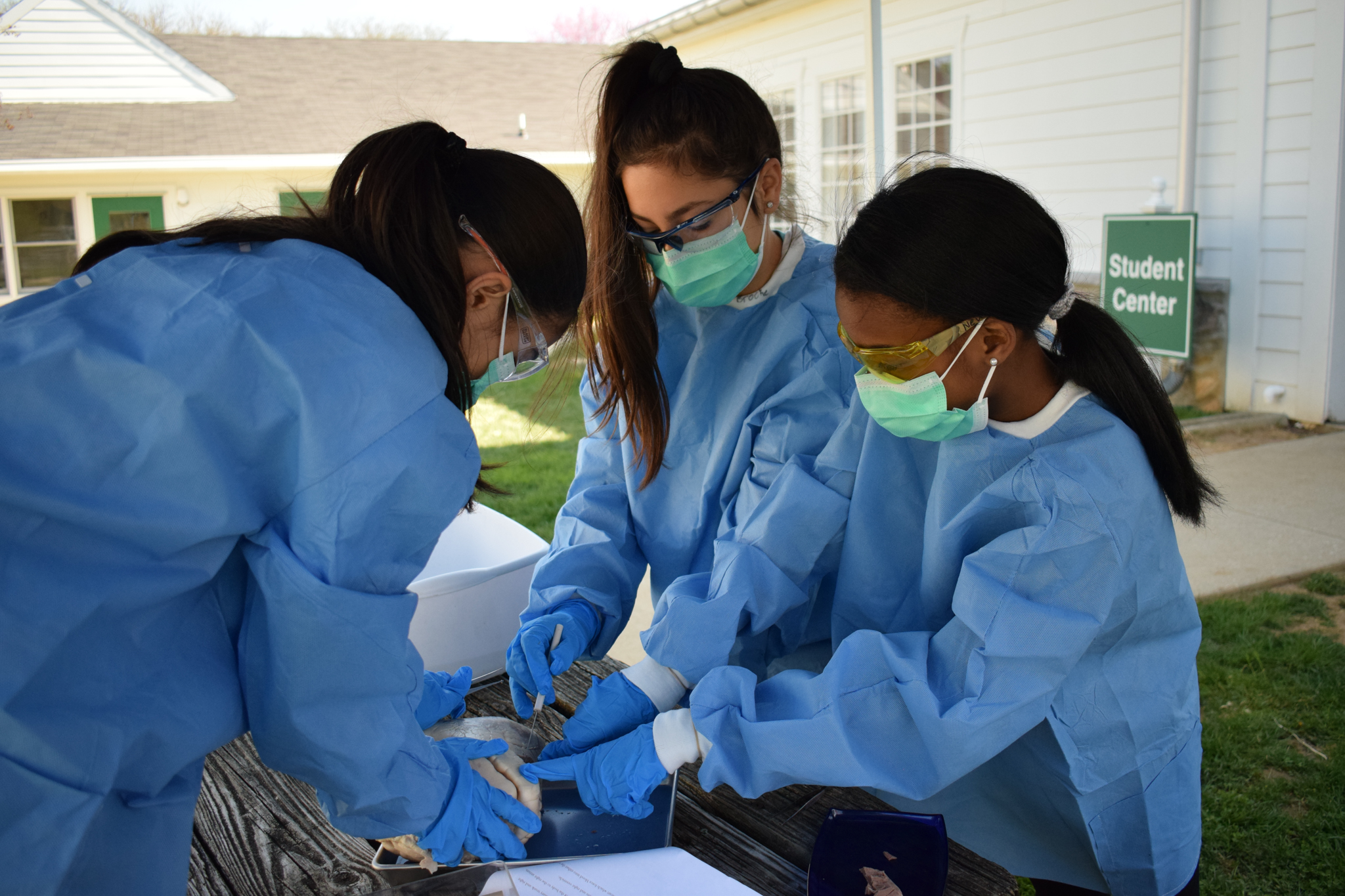
Upper Elementary students dissect a cow heart as part of their studies in anatomy.
On March 29, 2012, the National Governor’s Association issued a brief on “The Role of Informal Science in the State of Education Agenda”. It calls for an increase in hands-on discovery and practice of STEM concepts, something that is already happening across all levels in the Montessori community. It also calls for the use of outside resources such as museums, science centers, and other ‘real-life’ activities that engage and focus student’s attention in the areas of science, technology, engineering, and math. Again, Montessori teachers have been using “going-out” opportunities to pique student interest and foster real-life connections for over 100 years.

An Adolescent student shows one of their chicks to a Children’s House classroom, engaging in cross-level science work.
Larry Page and Sergey Brin, Co-founders of Google, have said that Montessori education allowed them to think for themselves. They credit Montessori with allowing them to question what was going on around them and to discover the answers for themselves. Former Montessori students, Jeff Bezos, founder of Amazon.com, and Will Wright, inventor of “The Sims” video game series, also credit Montessori for allowing them to ask questions, discover, and learn on their own terms.
The current STEM movement is calling for innovation, collaboration, and hands-on learning and problem-solving. To the Montessori community, this is nothing new. This is what we’ve been doing all along.

On any given day, you may smell an assortment of delicious aromas when you are walking the halls at Greenspring Montessori School. This is because students and faculty are often engaged in various cooking and baking activities as part of the Montessori curriculum. To support these efforts, we have a full kitchen in Emerson Village and we have kitchenettes complete with refrigerators, dishwashers, sinks, and prep space in each of the classrooms. Building practical life skills in areas of daily living is a cornerstone of the Montessori Method, and it is also proven to help students develop soft skills. These skills help children learn essential life tasks, such as working well with others, having empathy, and being trustworthy and respectful. To learn more about the importance of soft skills, please take a look at this new article.

Starting with our youngest students, guides and assistants work with toddlers to create snacks for their classroom. Whether they are carefully learning how to cut pieces of carrots using a crinkle cutter or making freshly squeezed orange juice, the children are actively involved in every step of the process. During the warmer months, many classrooms will also plant tomatoes, cucumbers, strawberries, and more in their outdoor environments, so they children will become familiar with where their food comes from.

At the Children’s House level, students will help to plan larger meals and snacks, and the guides introduce new flavors with the seasons. Instead of always baking comfort foods such as oatmeal cookies or muffins, our guides work to come up with recipes that include fresh and natural ingredients. During the fall, one of our Children’s House classrooms baked acorn squash. In addition to learning about how to use the oven with a classroom assistant, the children also talked about the color of the vegetable, the texture, and the new and interesting flavor!

Additionally, cooking is often a big part of Spanish language enrichment at all levels. Spanish Dual Language Children’s House students work with a parent volunteer each week to prepare mango salsa, pan de elote (a Mexican dish similar to cornbread pudding), and arroz rojo y friojoles de la olla (a Mexican style rice and beans). This is a great way to introduce new vocabulary and new tastes to our children while celebrating other cultures!

In Lower and Upper Elementary, students will often incorporate what they are learning in the classroom with a new recipe. Students in Ms. Sarah’s Spanish Dual Language classroom researched different cultures and shared meals with their entire classroom as part of their presentations. One group made yellow dal, a traditional Indian dish with lentils, while another group created Dulcis Coccora, an ancient Egyptian dessert (Cleopatra’s favorite!) made with honey.

At the Adolescent level, our students have come up with creative ways to grow their student-run business with their work in the kitchen! Several years ago, they started Pizza Fridays, selling pizza by the slice (along with hummus and veggies) every Friday to the students and the faculty. In addition to honing their cooking and prep skills, they also learn to work together, stay organized, and manage money. In addition, the students have built a chicken coop, compost bin, and they are starting a class garden. It is their hope to eventually sell eggs and vegetables to the school community, and even use some of these ingredients in their own cooking.
The joys of cooking with children can extend into your home too. Take a look at our blog on setting up your Montessori kitchen at home and consider trying some of the following this week:
- Take your child to the farmer’s market and pick out one new type of fruit or vegetable to try.
- Flip through a recipe book with your child and let them pick a meal for you to make together.
- Start giving your child a task during meal prep – this could be anything from rinsing the vegetables, to cutting, and eventually even cooking the ingredients.
- Give your child the opportunity to begin cooking, baking, or prepping one meal a day on their own (the younger ones may need some support) – this could be making scrambled eggs for breakfast, packing their own lunch, or preparing a snack when they get home from school.
- Make sure to include clean up in your routine together! – our children love setting the table with real plates and glassware, washing their dishes, and sweeping up crumbs
- Plant a garden – visit the store with your child and pick out seed packets or seedlings together! Children are more likely to try new things when they are involved in growing it themselves.
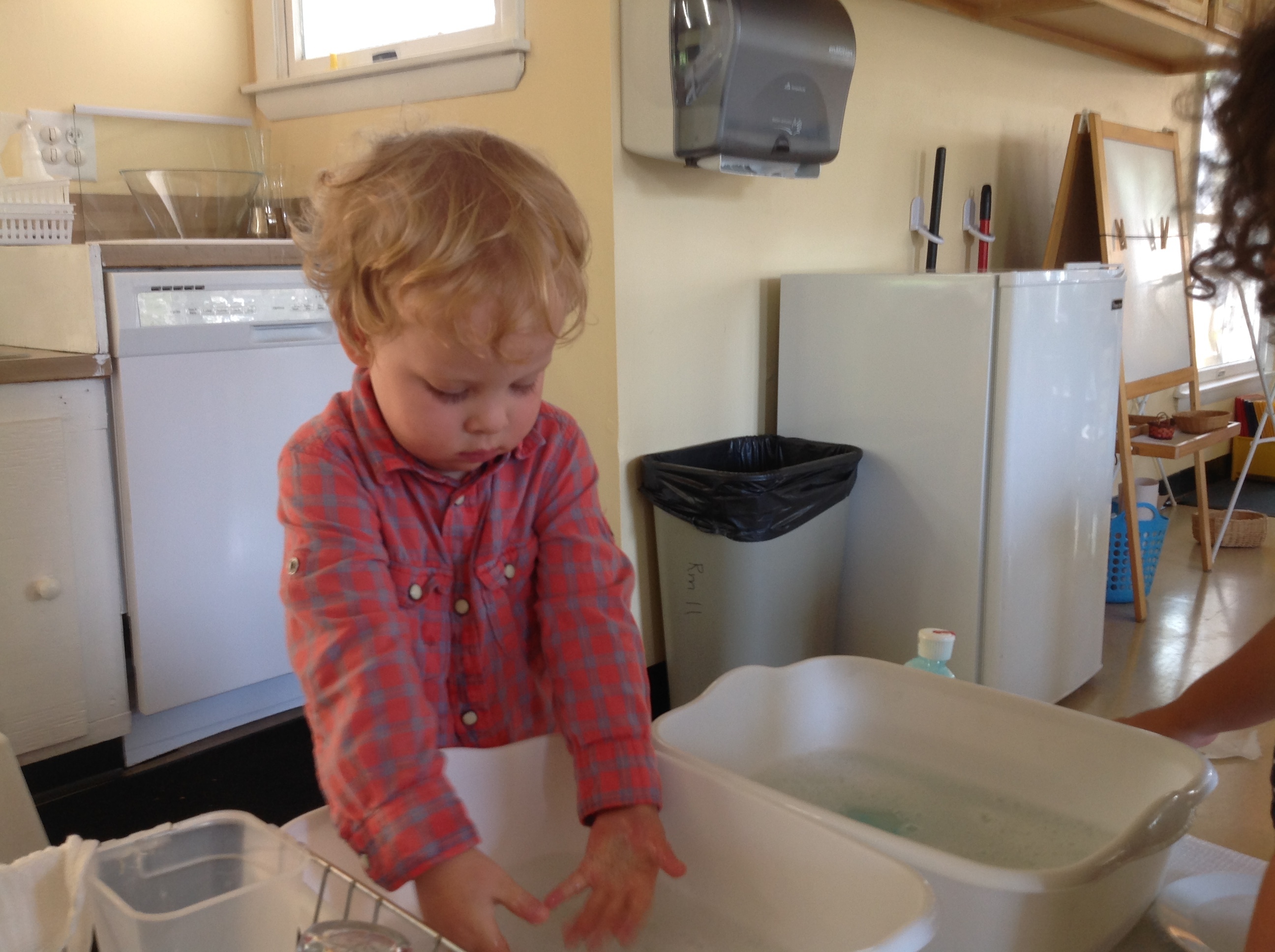
Written by Emily Shattuck, Children’s House Lead Guide (and Mother of Two)
“Your job as a parent is to put yourself out of a job by raising your kid to independent adulthood (where independence equals not turning to you to handle/fix/resolve everything) and when you appreciate that every day offers a chance to build that independence, no matter what age and stage your kid’s at.”
~ Julie Lythcott-Haims author of How to Raise an Adult: Break Free of the Overparenting Trap
I agree with this quotation, but as a parent, I am also saddened by its truth. We all love our children and take great pride in caring for them: feeding them, dressing them, making sure they get enough rest, waking them in the morning, cleaning them, entertaining them, and educating them. As a parent of a 16 year-old high school junior and a 12 year-old seventh grader, I have fond memories of caring for my children as infants, toddlers, pre-schoolers, and through the elementary years. It is wonderful to feel needed and loved by our children. Being a parent is a very rewarding, fulfilling, and exhausting job and we would not trade it for the world!
While my children were young, however, I also was wary of the cultural norms to over-parent or “helicopter parent.” I know my children needed to develop skills to eventually leave the house at 18 and find their way in the world and it is my job to prepare them. With just two years remaining before my daughter’s 18th birthday, I decided to prepare myself for the craziness of the college application process and I picked up How to Raise an Adult, written in 2015 by Julie Lyhtcott-Haim, the former Stanford Freshman Dean of students. As a Montessori Children’s House guide, I was delighted when Montessori education was mentioned throughout the book. It states, “Despite the evidence that Montessori’s student-driven learning approach is a springboard to success in life, Montessori has yet to become a mainstream model for education in the in the United States.” (p. 158) It was both a relief and a validation that my children were Montessori students and had the benefit of a Montessori education.


Although many aspects of the Montessori curriculum lends itself to creating resilient, creative, caring, responsible adults, the Practical Life lessons in the Children’s House build the strongest foundation for a path to independence. When developing her first school in Rome circa 1907, Maria Montessori observed that children between the ages of two and a half to six years delighted in helping to care for their classroom. Montessori created child-size tables, chairs, brooms, mops, and other materials so the children could practice sweeping, mopping, and cleaning. She noticed that children enjoyed helping prepare food, set the table, do laundry, garden, and clean as adults do. An entire curriculum was created to fulfill the child’s need to contribute to his community and the Exercises of Practical Life were born.
There are four components of the Practical Life curriculum: Preliminary Exercises, Applied Exercises, Lessons of Grace and Courtesy, and Control of Movement Exercises. The Preliminary Exercises are lessons to give the child the opportunity to practice movements that she will use on a daily basis to perform tasks such as pouring, using a spoon, spreading with a knife, cutting food, or folding laundry. In the Applied Exercises, the child utilizes these developing skills to care for herself and the classroom environment, such as with hand washing, dressing herself, washing a table, or mopping the floor. The lessons of Grace and Courtesy provide the child with the opportunity to learn and practice social graces. Grace and Courtesy lessons include blowing one’s nose, saying excuse me, greeting a guest, introducing oneself, and walking around a work rug. The Control of Movement Exercises help develop self-control and include walking on the line and the Silence Game. The aim of all the Practical Life lessons is to promote independence, responsibility, coordination, concentration, respect for one’s self and their environment, and provide the child the opportunity to develop their identity as a contributing citizen of the community.


As a parent, it is comforting to know that our children are exposed to the lessons of Practical Life and are establishing themselves as members of their Montessori community. But we can also help our children develop these skills by allowing them to play a contributing role in the home environment. “A longitudinal study conducted by Dr. Diana Baumrind concluded that those who were most successful began doing chores at age three or four years of age, whereas those who waited until their teen years to start doing chores were comparatively less successful.” (Lythcott-Haim p. 198) This is wonderful news to parents of current Children’s House children because your children are already accustomed to this role in the classroom. By bridging the gap between school and home, you can assist your child in developing resilience, responsibility, and independence.
Montessori guides have an advantage since they can design the entire environment to serve the construction of the child’s personality. At home the surroundings and pace of life are designed for adults. Our job, as parents, therefore, is to remove obstacles to our children’s independence in the home life. Parents can begin this process as the Montessori guide does – by observing the child. Observe what the child can do for himself already, his interests, what causes frustration, and which skills that he needs to work on. Once we have observed the child, we can begin to prepare lessons that will serve the child’s development. For instance, if we see that a child cannot put on his own shoes or pour his own drink for snack, we present simplified lessons so the child can practice these skills in order to gain mastery. This requires thoughtfulness and patience. We cannot rush the child when he is doing the hard work of self-construction. We should move slowly, carefully, and with precision. As adults, we do not realize how fast we are moving! Children at this age have not developed the visual acuteness to track fast movements, so we must remind ourselves to slow down when we are giving a child a lesson. The Practical Life Exercises are also given in silence. You can name the activity and the tools used for the work, but the movements are not accompanied by language. We are silent so that the children can process the steps and actions visually and are not confused or bogged down by auditory processing as well.


For instance, if you would like to give your child a lesson on washing his face you could introduce the lesson, “Today I will give you a lesson on washing your face.” You can name the tools used, “This is a wash cloth. This is soap. This is a towel.” Then you can demonstrate slowly how to turn on the faucet, wet the washcloth, rub it on the soap, rub it on your face, rinse the washcloth with water, rub your face again, turn off the faucet, hang up the washcloth to dry, and dry your hands and face. When preparing to give your child a lesson, practice yourself first and gather the necessary supplies. Make sure the supplies needed are suited to the child’s size and are accessible by the child independently. Practice the actions yourself, breaking them into steps, moving mindfully and slowly. When you are ready you can give a lesson to your child, finish the lesson by saying, “Now it’s your turn!” and give your child a turn to practice. You can end the lesson by saying, “You can wash your face whenever you like!” You do not praise the child, as the lesson it is not for your benefit, but a gift for your child.
Vicki Hoefle, author of Duct Tape Parenting, gives examples of skills and tasks children should learn and master at age four, including getting dressed on their own, making toast, brushing teeth, setting the table, taking dirty dishes to the dishwasher, making the bed, combing hair, packing own back pack, taking a bath, waking up with an alarm clock, wiping the table after meals, feeding pets, and cleaning the kitchen sink. (p. 143) Lythcott-Haims also includes tasks such as putting dirty clothes in the hamper, putting away toys, dusting, and washing one’s face (p. 167) as basic life-skills children age 3-5 should learn. “Children are innately interested and open to learning basic life skills, and if allowed and encouraged to do so, they grow into confident people who know that they matter within the family and within the community. This in turn affects how they develop socially. By the time they are teenagers, if they’ve mastered basic self and life skills, they can focus on developing their social skills.” (Hoefle p. 133)


Keep in mind that you must have patience, understanding, and self-restraint to actually make this work in your home. Your child is not going to perform these tasks perfectly the first time, or maybe even the 60th time. This is a process. It is our job to observe, give the lesson, and then move out of the way! Above all, do not follow behind them and do it for them if it is not done to your standards! That undermines their work and their self-worth. Also these tasks or chores should not be tied to an allowance, reward, or praise. They should be expectations as your child’s contribution to the household. (If you do want to introduce an allowance to help your child learn about financial responsibility, more guidance is given in Duct Tape Parenting.)
For more ideas on how to raise respectful, responsible, and resilient children, I highly recommend reading Duct Tape Parenting. If you are concerned that you may be one of those parents on the path to writing your child’s college essays, then I suggest How to Raise an Adult.
Your challenge this month:
Choose a time of day that you wish your child was more independent (for example, preparing for school, mealtime, or bedtime) and observe for fifteen minutes without stepping in. Then make a plan to determine what is going well and what your child needs to still work on. Develop a lesson to support your child with one skill. Then observe over the next few weeks to see how your child is progressing.
I hope you are as inspired as I am about current parenting books echoing what Maria Montessori knew over a century ago. “Children are the constructors of men whom they build. Childhood constructs with what it finds. If the materials are poor, the construction is also poor.” (Maria Montessori, letter to a government official,1947) And how fortunate to have your own child beginning the exciting work of creating the person he is to become!