
 Though the ample spring rains have been trying at times, the project found a much more productive rhythm in May. After spending April in a battle of wills with the vein of Cockeysville Marble running through the site, rock breaking yielded to a considerable amount of grading and foundation preparation. The new addition’s configuration has taken form as footings have been poured—their purpose is to support the foundation and prevent settling, and the site has been cleared of all remaining intrusive elements—electrical and internet cables and less difficult sections of rock.
On the interior, load bearing walls have been demolished and structural steel beams and columns await installation, the existing slab has been cut in various places for plumbing rough-ins, new plywood sheathing has been installed, and window and door openings cut throughout. With a little imagination – ok, maybe a lot – you can see the new classroom building taking shape. June’s efforts will bring far greater clarity to the image.

Written by Margaret Jarrell, former Greenspring Elementary Guide
“The child is capable of developing and giving us tangible proof of the possibility of a better humanity. He has shown us the true process of construction of the human being. We have seen children totally change as they acquire a love for things and as their sense of order, discipline, and self-control develops within them…. The child is both a hope and a promise for mankind.” – Dr. Maria Montessori
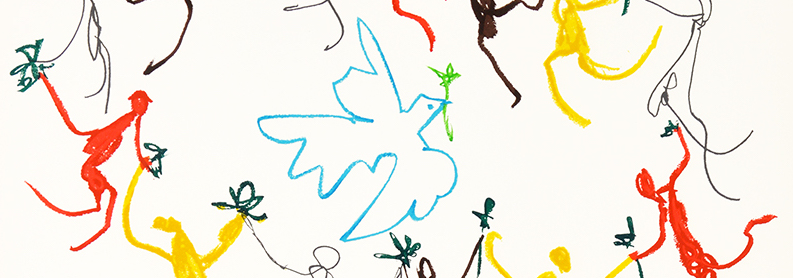
Peace education is a major component of the Montessori classroom. Maria Montessori saw the education of young children as the human race’s opportunity to recreate itself in a way that would eliminate war. As with most things, Dr. Montessori did not think that meant children needed to be lectured on the subject, but rather that they needed to be given an opportunity to discover peace for themselves. Adults model peaceful and respectful behavior, and because Montessori classrooms are composed of mixed age groups, older students serve as role models for younger children.

We start building conflict resolution skills with our youngest students. Most classrooms have a peace corner or peace table, at which two students can go to resolve a conflict or a single child can go to calm down and feel peaceful. One strategy is the use of a peace rose. Children learn to take turns holding the peace rose while speaking about how they feel. They stay at the peace table until they have heard each other and resolved their conflict. With very young children, adults model and coach the children with words they can use. Older students can do this independently.
At the Elementary level, “community time” is set aside to help establish a sense of responsibility and place within the group. Students encourage and acknowledge one another. They also help establish rules of conduct for the classroom and the playground. These meetings are student-led and a forum in which conflicts are discussed, brainstormed, and resolved as a group. Role-playing and discussion can be helpful in finding ways to handle challenging situations.

Once students enter our Adolescent Community, they begin exploring questions like, “Are all humans created equal?” and “What brings humans together into groups?” These questions are taken very seriously and are never assumed to have simple answers. We help adolescents seek insight by looking at world history, at the differing cultures of the world’s people, and at the interactions between humanity and the environment. Perhaps most importantly, we think about how future history might be written in a way more in keeping with the harmony that seems possible between people and the world, or between one group of people and the next.
Peace is also, essentially, a habit that Montessori students learn. Lessons in Grace and Courtesy teach our students the habit of viewing and treating others with respect, and then to continue to try to forge understandings where they encounter conflict. Young students practice simple lessons such as how to greet others, say please and thank you, tuck in chairs. Elementary students may practice introducing themselves or the etiquette for making a telephone call. And Adolescents may send thank you letters to experts who have helped them along the way. These lessons are present in Montessori classrooms from such an early age that the habits they create become as natural to our students as using a spoon, or putting on shoes.
At the core of these lessons is respect for others, self, and the environment. Montessori students engage in community service at every level – within the classroom for youngest students and outside the classroom and the school for older students. We encourage our students to be involved by asking, “How can we help others?” This can begin with caring for the environment, such as weeding and sweeping public areas. It can also take the form of volunteering to help others in our school. For example, Lower Elementary students may participate in a campus-wide recycling project. Upper Elementary students may tend community gardens and Adolescents are serving others lunch as a part of the micro-economy. It also involves thinking about the needs of others. Our students often remind each other, “We must be quieter. The toddlers are sleeping next door!”

The benefits of peace education are not just altruistic, but eminently practical. Most adults who have navigated the many changes to the world (or even just the job market) in the last several years have had reason to think about how much more connected everything seems to be getting – countries thousands of miles away can be regular business partners in ways that they might not have a decade or two ago, and people are truly mobile on a global scale for the first time in our planet’s history. Prejudice in favor of one’s own tribe – whether that tribe is formed by religion or geography or your school’s alumni association – has become more and more counterproductive to operating in a world where diversity cannot be avoided and is to be celebrated.
Peace is an amazing concept, a useful tool, and, through Montessori education, an attainable goal. Children are born with innate instincts toward compassion and the practice of compassion becomes ingrained when cultivated over time. Montessori students develop into involved citizens!
“Within the child lies the fate of the future.” -Dr. Maria Montessori
Written by Terriann Lane, Children’s House Guide
“A child is an eager observer and is particularly attracted by the actions of the adults and wants to imitate them. In this regard, an adult can have a kind of mission. He can be an inspiration for the child’s actions, a kind of open book, wherein a child can learn how to direct his own movements.” – Dr. Maria Montessori
Recently, I read an article titled, “Grace and Courtesy Beyond Please and Thank You.” The author shared an experience during a hotel stay that left her awestruck. An incident occurred that involved teenagers who chose to trash their hotel rooms, blast loud music, and run wild in the hallways, while unattended by their parents. The housekeeping staff was overwhelmed by the disaster created by the teens’ behaviors. The author wondered why and how the teenagers considered their actions to be appropriate behavior?
As a parent, I can presume that it is important to parents that their children learn to be kind, polite, considerate of others, and mindful of their actions. Consider the actions of the teenagers. What can we do as parents to instill appropriate social behaviors in our children? Society offers innumerable examples of antisocial and pro-social behaviors. Therefore, the onus is on us to model behaviors beyond please and thank you.

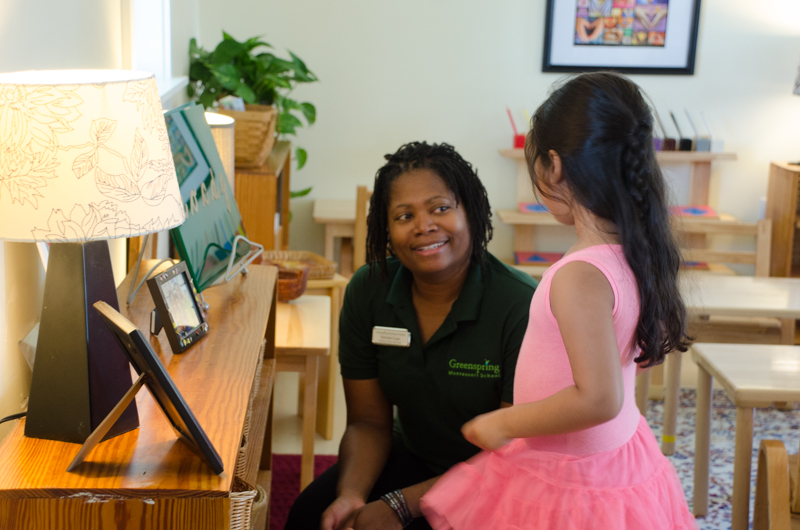
Children learn from those within their environments. Therefore, it is important to demonstrate grace and courtesy to children all of the time. Modeling behaviors in preparation for or in response to specific situations helps the children to practice new skills to use later when interacting with others and caring for environments. As adults, we must do what we expect the children to do and never model what we do not want them to do. Demonstrating grace and courtesy should be true, brief, and shown as many times as necessary until the child repeats the skill.
P. Donahue Shortridge wrote, “So if there is anything you want your child to know how to do, or a way you want him or her to behave, you should first model it, then show him or her how to do it, offer lots
of opportunities for practice, and finally, hold the child accountable. First, modeling: In the early years of life, we learn mostly by taking
in the sensorial impressions of the world around us. A series of neural connections helps us imprint that which we see. The child watches what other people do and attempts to do it, too. ” If we want our child to wait his or her turn to speak, stay seated at the dinner table, say thank you in response to being helped, say excuse me when interrupting, help someone who is need of assistance, and know how to conduct him/herself in a restaurant, grocery store, or at a hotel, we must set the example and model the behaviors.

There are many opportunities to provide examples. Modeling should be demonstrated daily, naturally, habitually, slowly, and simply. Parents can demonstrate how to push one’s chair under the table after being excused from the dinner table, return an object to its original location, hang a wet towel to dry after use or place a soiled towel in a clothes hamper, hold a door for someone carrying a load, etc.
Taking the time to model and practice social protocols and good manners, as well as holding children accountable, will empower them to respond appropriately to specific situations and encourage self-discipline.
Parent Challenge: Choose one behavior you would like to model for your child. (For example, placing a hand on a family member’s arm rather than interrupting.) First, invite your child to try something new. Your child will pick up on the excitement in your voice. With as few words as possible and moving slowly and carefully, demonstrate the way you wish your child to wait. Then invite your child to try it! Your child may wish to give a lesson to another family member. She may also enjoy role-playing scenarios of how to do this and how not to do this correctly. Switch roles and have fun!
Reference: Shortbridge, P. Donohue. “Grace and Courtesy Beyond Please and Thank You.” Montessori Life, Spring 2016.
Written by Margaret Jarrell, former Lower Elementary Guide
“The mind takes some time to develop interest, to be set in motion, to get warmed up into a subject, to attain a state of profitable work. If at this time there is interruption, not only is a period of profitable work lost, but the interruption, produces an unpleasant sensation which is identical to fatigue.” – Dr. Maria Montessori
In many traditional classrooms, students move through a series of subject periods, in which they must start and stop their work on a given subject according to a predetermined schedule. Can you imagine the frustration you would feel if fully immersed in a task, deep in concentration, and were suddenly jarred out of your thoughts by the ringing of a bell? You were just about to make a breakthrough? Too bad! It’s on to the next subject. This is not how the real world works and it is also not how children learn best.


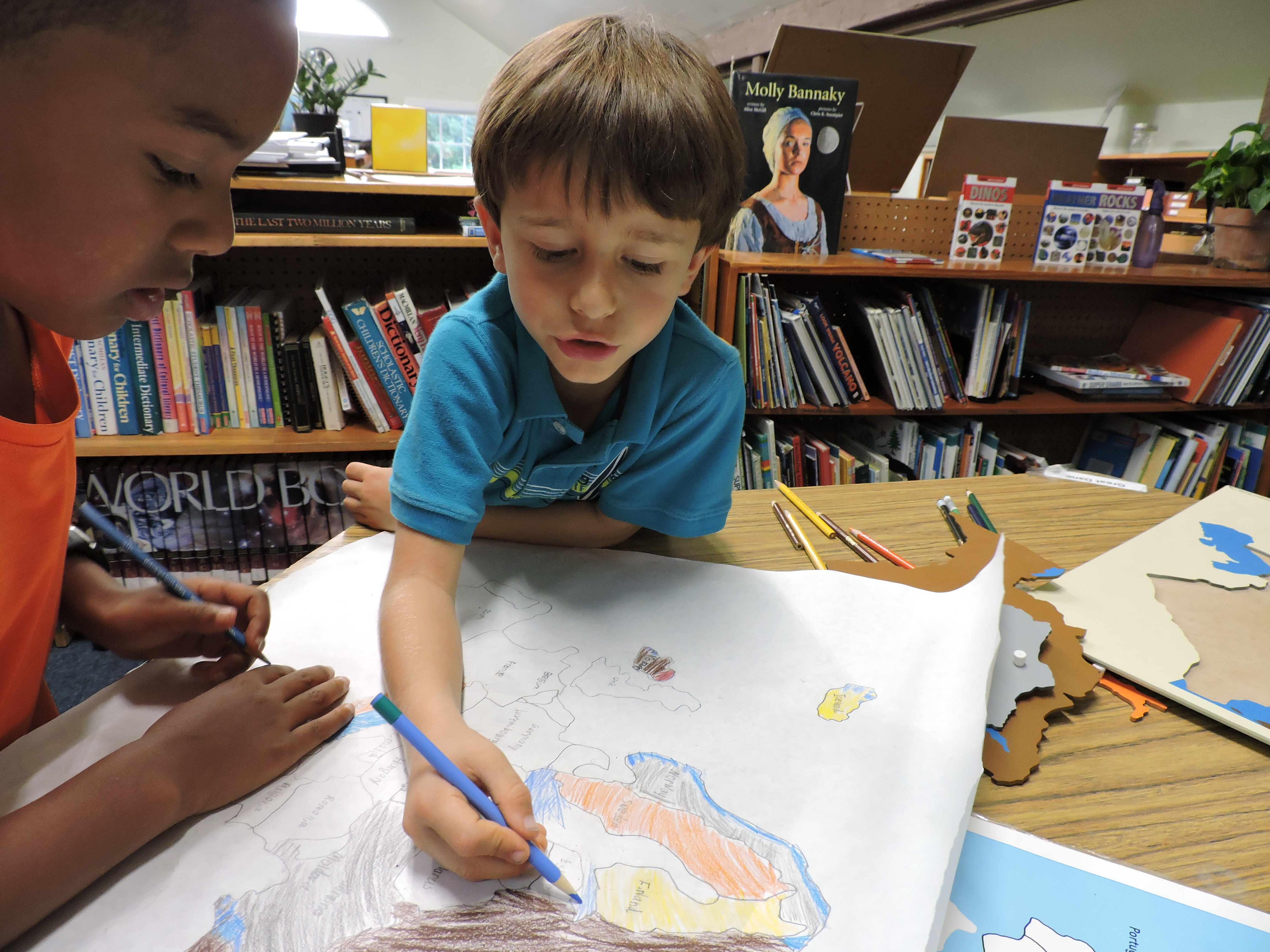
So what is the alternative? Dr. Montessori discovered that children as young as three are able to choose productive and challenging work, focus on the task at hand, finish a cycle of work, rest without interrupting those who are working, and repeat this sequence. The three-hour, uninterrupted work cycle allows students to freely choose work and engage in work more thoroughly. Based on her experiences observing children during an uninterrupted work period, Dr. Montessori wrote: “Each time a polarization of attention took place, the child began to be completely transformed, to become calmer, more intelligent, and more expansive.” In other words, children are able to develop better concentration skills and focus through undisturbed work.
Some parents might worry: “Won’t my child get tired of working? Doesn’t he need a break every 45 minutes or so?” In fact, Montessori students do take breaks – they are free to get a drink of water or use the bathroom as the need arises. They may choose to have a snack, stand up and stretch, or observe another student’s lesson. But regarding external interruptions of work, Dr. Montessori wrote, “A great variety of interesting research has been made into the question of change of work with identical results – namely, that frequent change of work causes greater fatigue than continuous work of one kind, and that a sudden interruption is more fatiguing than persistence.” Once the child’s concentration is broken, it is very difficult to try to engage them to the environment once again. Angeline Stoll Lillard, author of Montessori: The Science Behind the Genius, writes, “If we choose when to take breaks, then breaks work for us, but if the timing is externally imposed, breaks can be disruptive to concentration.”


Interestingly, there is a natural ebb and flow to children’s concentration during a three-hour period. Research on children in Montessori classrooms shows that after about 1.5 hours, there is a tendency for students begin to lose focus. Montessori educators call this “false fatigue.” Montessori guides don’t panic and send the students outside to run a few laps. We find instead that after ten to fifteen minutes of aimlessness, a student will redirect herself to a new activity in which she will become engaged at a heightened level of concentration, sometimes for as long as an hour. The student’s most meaningful work often takes place in the second half of the work cycle.
Lillard points out that, “Montessori teachers who adhere to three-hour work periods without interruption claim one can see the difference in the quality of the children’s concentration on days when children know they will be leaving the classroom in an hour for a field trip or doctor’s appointment or special music class.” Children who know they will soon be interrupted choose unchallenging “busywork” at best, and at worst become distracting to their peers. When children who don’t know an interruption is coming, they choose demanding work, become engrossed, and are understandably upset when the disruption takes place.
We want to give our children the opportunity to learn at their own pace, allowing them to concentrate and focus on the task at hand in an uninterrupted, peaceful environment. As Montessori guides, we follow the child’s schedule, not ours. One of the best gifts we can give our children is the opportunity to fully develop their concentration and independence, free from unnecessary adult interruptions.
Parent Challenge: Do an experiment. The next time you see your child deeply engaged in an activity, make a concerted effort not to interrupt your child’s concentration. Make a note of how long she persists with one task. The results may surprise you!


Learn more about the Greenspring Montessori School Elementary Program.

Greetings from Florida! For those of you who don’t know me, I was a Lower Elementary guide at Greenspring and then the Director of Admissions before moving to Florida. My daughter, Lila, recently turned two and I would like to share a few thoughts on what it was like setting up a toddler-friendly bathroom.


Care of Self
As Montessori parents, our goal is to prepare the home environment for toddlers to be as independent as possible. The bathroom provides a wonderful opportunity to empower our toddlers and begin teaching them important life skills. Toddlers are innately motivated to take care of themselves, so they will be eager for these opportunities!
Giving Introductory Lessons
Children will need to be introduced to each process, broken down into simple steps. All of the needed materials must be easily accessible and in child-size containers. After introducing and modeling each skill, your toddler will need many opportunities to practice. Important skills to learn include:
*Washing hands
Provide a bottle of pump soap (my daughter loves the foaming kind) or a small bar of soap and a washcloth on the counter. You might consider using a faucet extender so your child can reach the water more easily. View a sample lesson here.


*Brushing teeth
Prepare a tray with the necessary supplies: toothbrush, toothpaste (which you may wish to portion out in individual containers at first rather than make the whole tube available), a timer, and a small water glass. View a sample lesson here.


*Brushing hair
Prepare a tray with a hairbrush and/or comb and place with (or near) a mirror. View a sample lesson here.


*Blowing the nose
Have a box of tissues accessible. If you worry about your toddler enjoying this activity a bit too much and using the whole box (see photo below), you can place a few folded tissues in a small basket. View a sample lesson here.


*Washing with a washcloth & Washing hair
Toddler-size bottles will allow your child to pour her own soap without emptying the entire supply. You can use a small plastic basket, tray, or suction cup caddy to store supplies. A suction cup mirror will allow your child to see herself while washing. (You may still need to assist with the rinsing.)


Necessary Items within Reach
Keep all necessary items within reach. If you have room in your bathroom, a shelf set up with supplies is ideal. Or you can empty the cupboard beneath your sink to store some of these items.


Beginning Toileting
This is a weighty topic for another day, but just a few suggestions:
Start changing your child’s diapers (standing up) in the bathroom whenever possible. Allow your child to help with her own diapering as much as possible.
When your child starts to show an interest in the toilet, encourage this interest. Allow your child time to sit on the toilet, practice flushing, and washing hands.
If you are comfortable with it, allow your child to watch you using the toilet and assist with flushing and washing hands.
Have a floor potty available as well and allow your child to sit on it (clothed or unclothed) whenever she shows an interest. Keeping the floor potty in the bathroom is ideal if you have room – this reinforces the idea that toileting takes place in the bathroom. Now that Lila is fully engaged in the toilet-learning process, we keep a basket of underwear and books near her potty.


Have a child-size toilet seat and step stool for the adult toilet so that this is also an option. You can allow your child to choose which she wants to use.
Supplies
These are some of the items I recommend. (These are linked to Amazon.com.)
Sink faucet extender & Tub faucet cover
Stepping Stools: Kidcraft or Soft Grip
Two-in-one toilet seat (or Toilet seat with ladder) and a Potty chair with a soft seat
Articles & Resources:
Montessori Now (blog): Montessori Activities for Self Care
Montessori Teacher Collective: Montessori lessons plans for care of self
Michael Olaf: 1-3 Years Care of Self
Montessori Services has every basket, tray, and child-size dish you could ever want!
———————————–
In my next blog entry, I will discuss setting up a child-friendly kitchen. To view my previous blog entry about setting up a Montessori bedroom, click here.



 Though the ample spring rains have been trying at times, the project found a much more productive rhythm in May. After spending April in a battle of wills with the vein of Cockeysville Marble running through the site, rock breaking yielded to a considerable amount of grading and foundation preparation. The new addition’s configuration has taken form as footings have been poured—their purpose is to support the foundation and prevent settling, and the site has been cleared of all remaining intrusive elements—electrical and internet cables and less difficult sections of rock.


