The Tactile Appeal of Sandpaper Letters & Numbers

The Tactile Appeal of Sandpaper Letters & Numbers

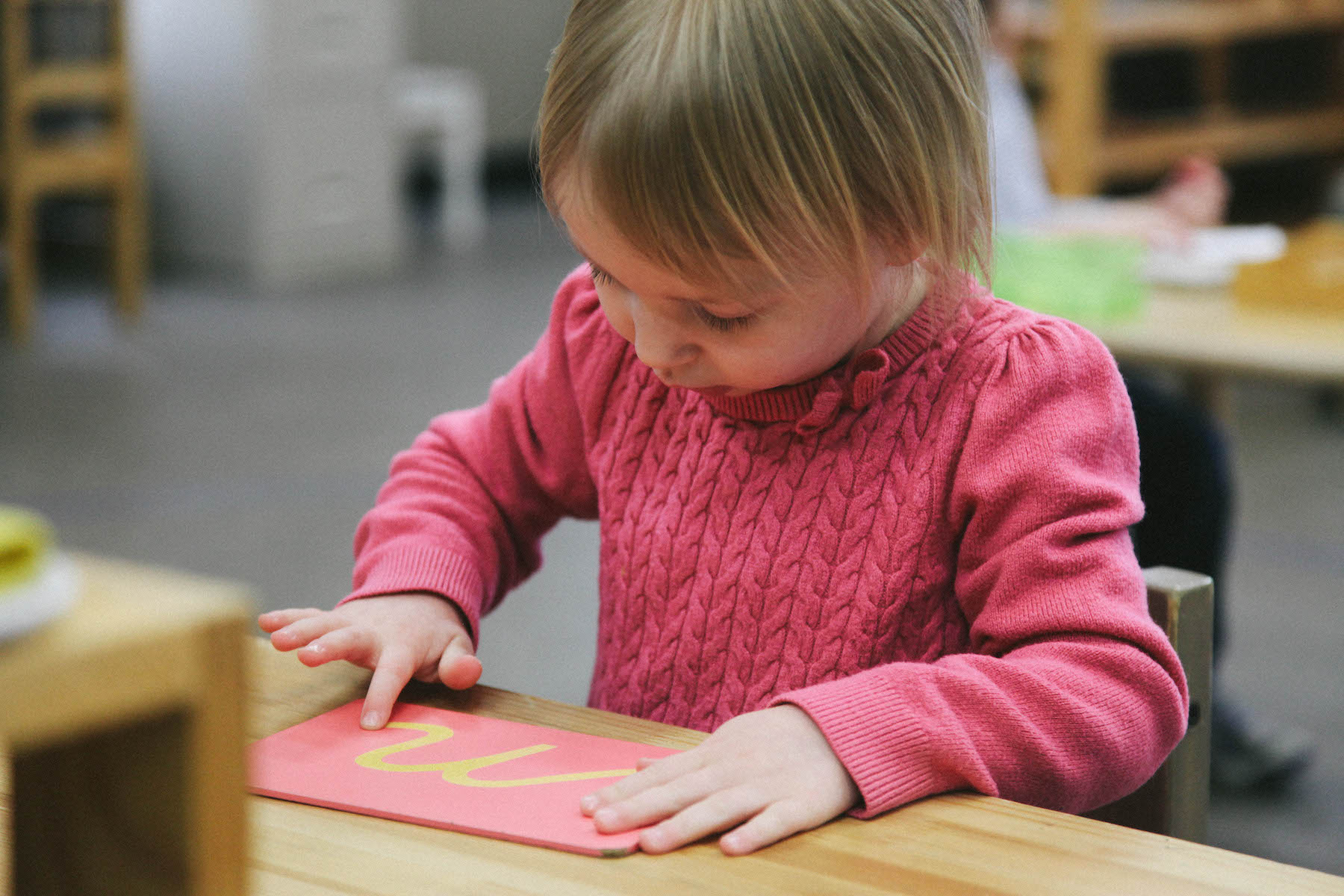
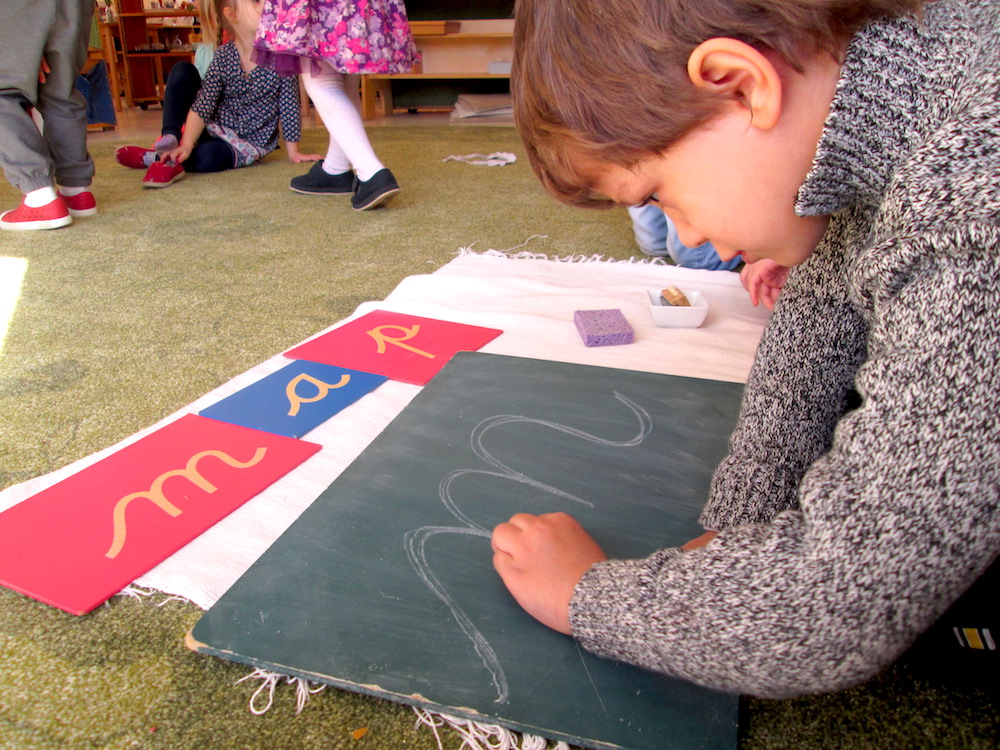
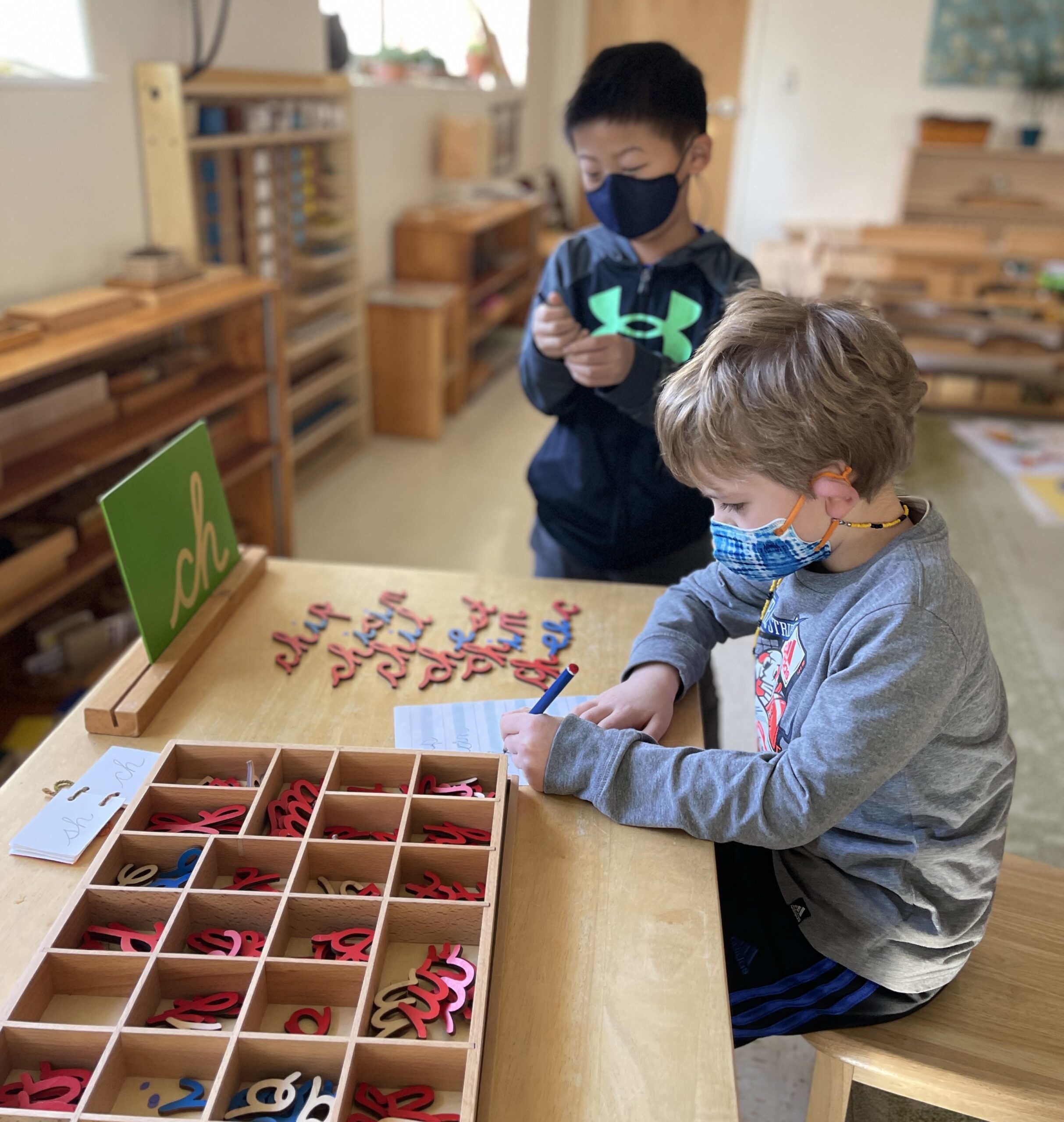
Children in Montessori classrooms learn to associate letter sounds with letter shapes using a material called the Sandpaper Letters. The shape of each letter is made with rough sandpaper, which incorporates the sense of touch to further reinforce learning. Children are encouraged to trace the symbol over and over again until the shape of the letter becomes a part of their muscle memory.

Similarly, children learn to associate numbers with their symbols using the Sandpaper Numbers. When each numeral is introduced, the Guide shows the child how the numeral is formed. Both the Sandpaper Letters and Sandpaper Numbers help prepare students for forming numbers and letters when writing with a pencil on paper.

Using the Sandpaper Letters and Sandpaper Numbers with the sand tray is another way to practice letter and number formation. For example, a child traces a sandpaper letter with their fingers and immediately writes that letter in the sand. Over time the child will associate the sound with the letter, and the proper formation of that letter becomes part of their muscle memory. The sand allows the child to write freely, without the pressure of holding a pencil. Mistakes are erased with a shake of the tray! 

When they are ready, children are ready to start forming letters and numbers on a chalkboard. Wall mounted chalkboards allow children to incorporate their gross motor skills, while smaller table-size chalkboards allow them to practice fine motor skills. When the time is right, children use the foundation they have built to make the exciting transition to pencil and paper!

For answers to your other language-related questions, please check out our blog post titled, Why do you teach letter sounds rather than letter names? (And other good questions about language acquisition…)

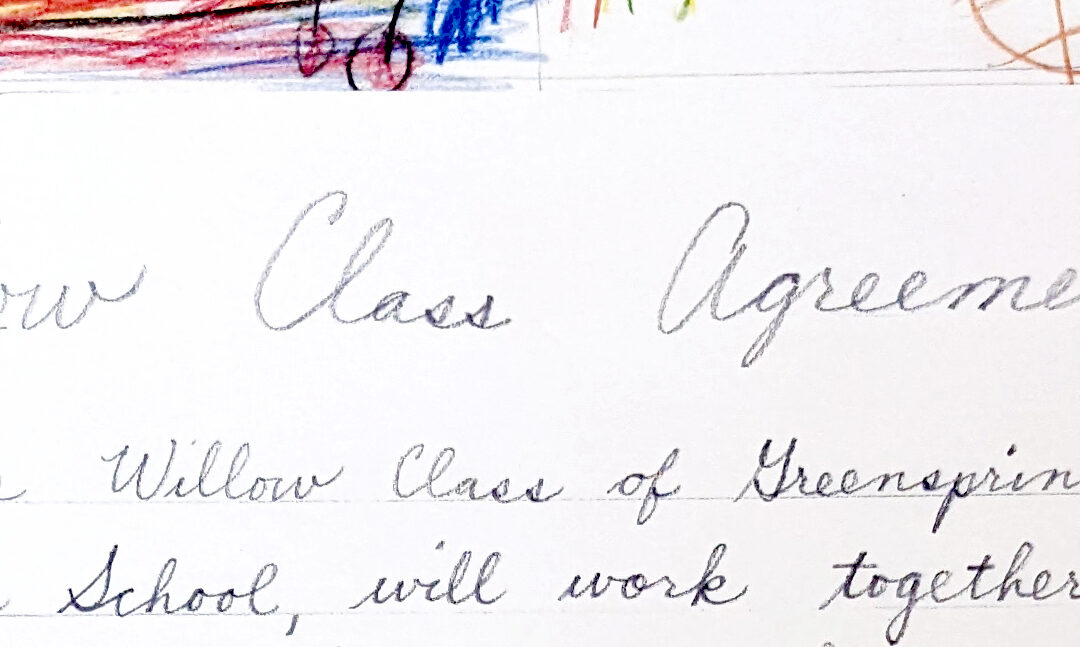
You might also enjoy this post titled “The Benefits of Learning Cursive Writing.”

The Power of Timelines in the Elementary Classroom

The Power of Timelines in the Elementary Classroom

Young children often have a hard time understanding the concept of time. In the Children’s House, children become comfortable with the days of the week and months of the year. They begin the study of measurement and telling time on a clock. And personal timelines that tell the story of the child’s life are used as a doorway into understanding the passage of time over years.

Illustrated as it must be by fascinating charts and diagrams, the creation of earth as we now know it unfolds before the child’s imagination.

Dr. Maria Montessori, To Educate the Human Potential

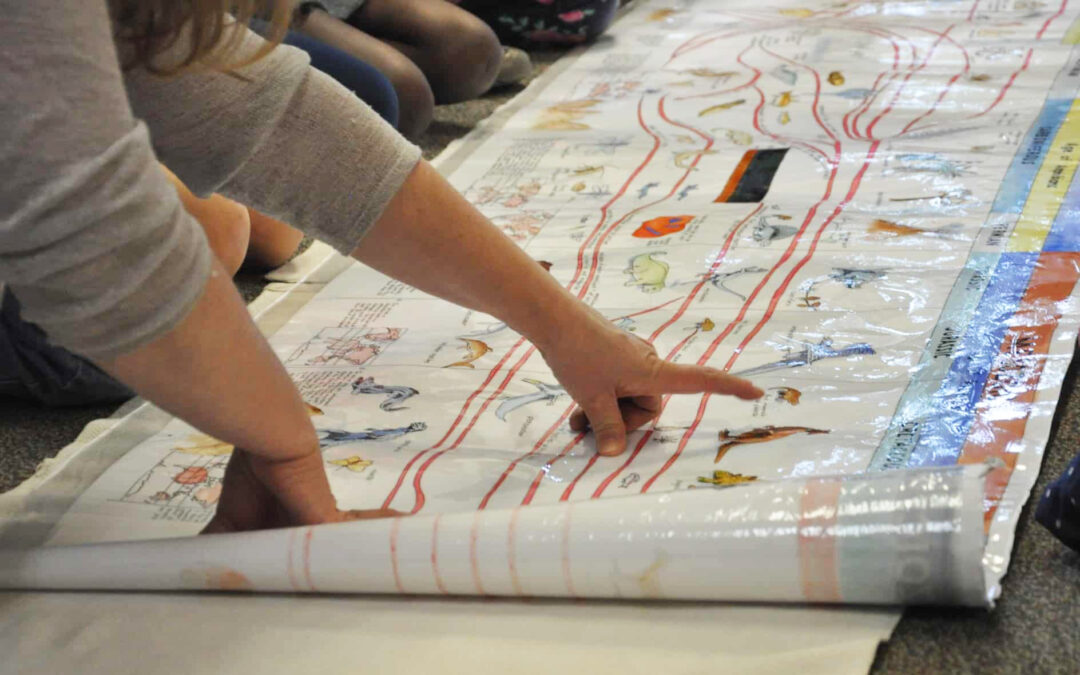
Children in the second plane of development, during the Elementary years, become fascinated by large numbers, including large measurements of time across generations or even eons. Elementary children are also emerging as social beings, seeking to understand their place in a greater context. For both of these reasons Elementary children are introduced to the structures of timelines, first as part of the Great Lessons and then in many other areas across the curriculum, including geology, geography, botany, zoology, anthropology and more. Here are a few examples of timelines used during the Great Lessons and corresponding key experiences:

The Clock of Eras

This chart represents the lifespan of planet Earth in terms of “cosmic hours,” so children have another way to grasp the concept of the relative amounts of time it took for Earth to form and for different types of life to develop.

The Long Black Strip

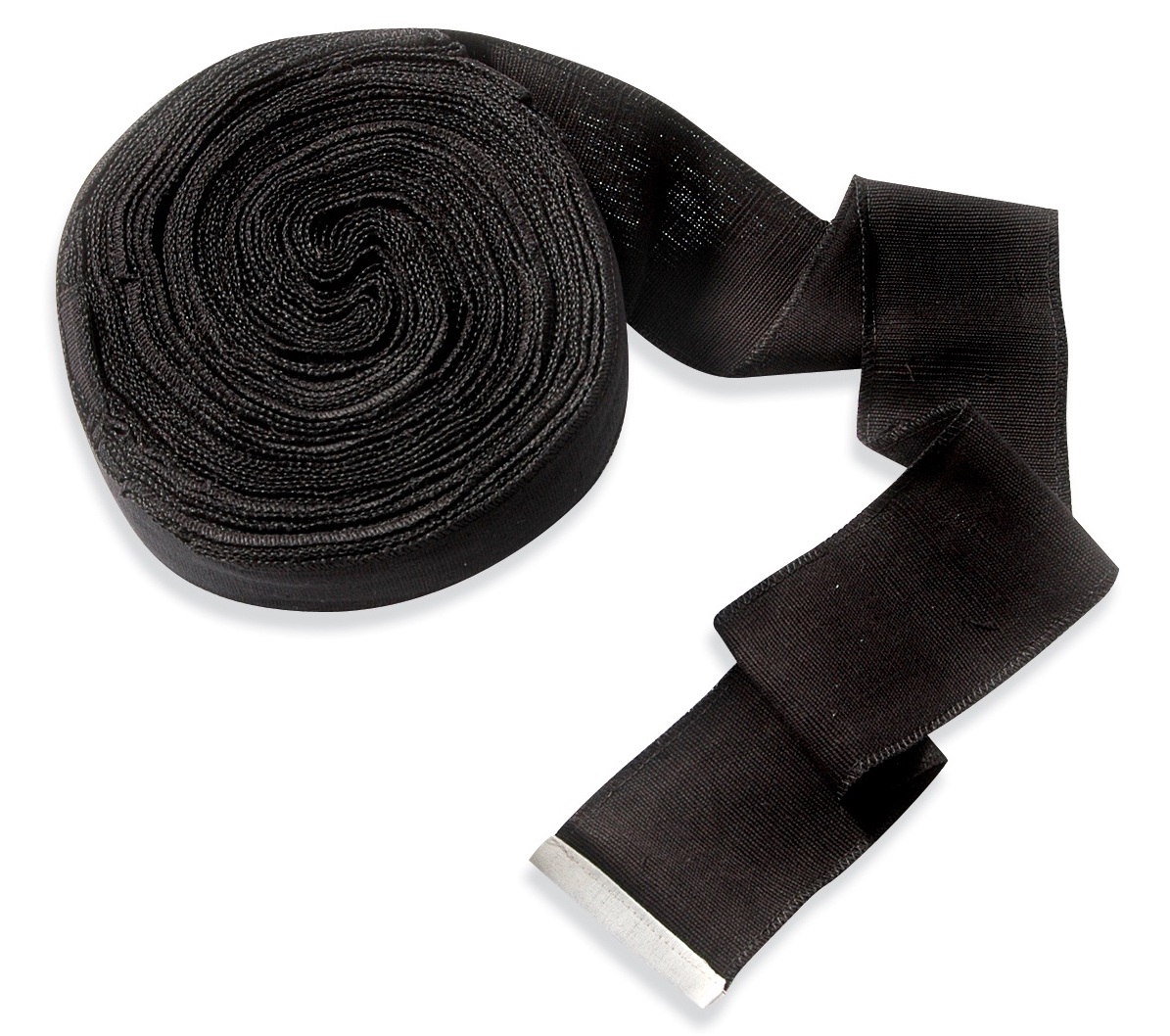
This black strip represents the age of Earth, from its very beginning. A 1cm strip of white represents the whole time that humans have been on Earth. This impressionistic lesson is designed to give children perspective on how recently, in Earth’s timeline, humans entered the scene. 

The Timeline of Humans

This timeline shows the story of the human journey from the end of the Pliocene (the emergence of our hominid ancestors) to the beginning of the Holocene, ending at the Bronze Age. Key events, such as the uses of fire and development of hand tools, are correlated with physiological development, such as the emergence of H. sapiens sapiens and the disappearance of H. neanderthalensis.

The Story of Language

This timeline introduces students to the development of communication over time and across civilizations. It covers the origin of human language: sounds, gestures, and pictograms of early humans, through the cuneiform of the Sumerians, the hieroglyphs of the Egyptians, and the first official alphabet of the Phoenicians. It explores derivatives of the first alphabet, which were created by the Greeks and Romans, and some additional ancient forms of writing, such as Chinese and Hebrew. 

The History of Numbers

This timeline introduces students to various forms and methods of counting and record-keeping, starting with the use of concrete materials, to the emergence of abstract writing systems, and eventually, more advanced number systems. 

BC/BCE Timeline 

The timeline begins from Prehistory and concludes to the Modern time period which is set off with a red background to represent the current time frame. 

Timeline of Civilizations

The timeline of Ancient Civilizations spans the period from 5000 BC to 300 AD. The timeline displays the empires that existed at that time as well as the factors that influenced their rise and decline.

Montessori timelines present just enough information to pique students’ interest. If too much information is included, the wonder of discovery is lost. When a student asks a question about something on a timeline, this becomes a springboard for further research.

Some students become inspired to make their own timelines. In doing so, they practice the precision of measurement. They also practice sorting and classification while deciding which information is most useful to include on a timeline. Students may notice examples of cause and effect and patterns that occur over time. They make connections between the content areas of the classroom, thus building a more integrated understanding of their world.

The Montessori Puzzle Maps

The Montessori Puzzle Maps

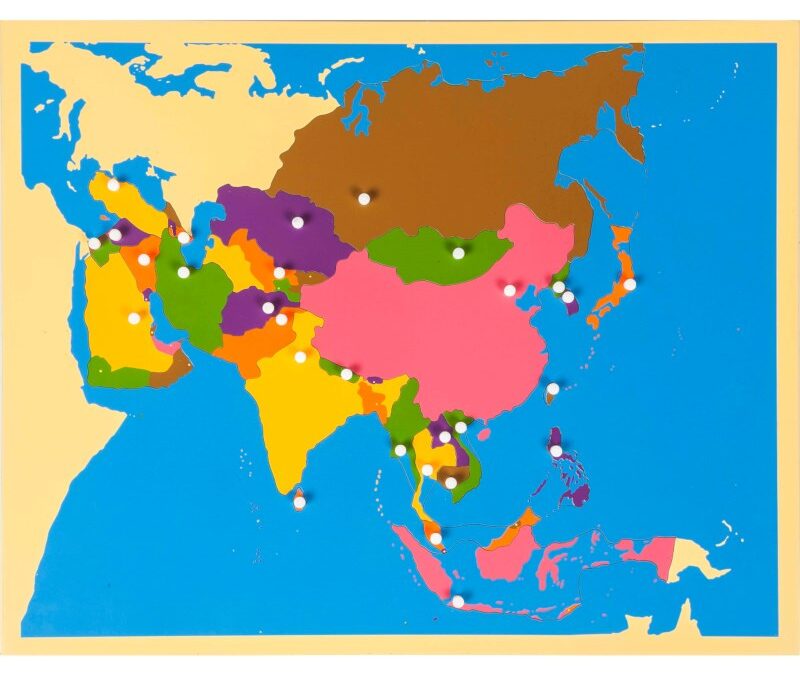
Creating globally minded citizens is a fundamental value of Montessori education. Puzzle Maps are a key component of the Cultural curriculum and are found in both the Children’s House and Lower Elementary classrooms. They are arranged intentionally, starting with the top shelf and working downward:

  • The planisphere: two blue circles with removable colored continents
  • A map of the child’s continent: puzzle pieces indicate countries
  • A map of the child’s country: puzzle pieces indicate states or provinces
  • Maps of the other continents of the world: pieces indicating countries

There is also a set of “control maps,” which are corresponding laminated paper maps that have the pieces drawn to scale and labeled.

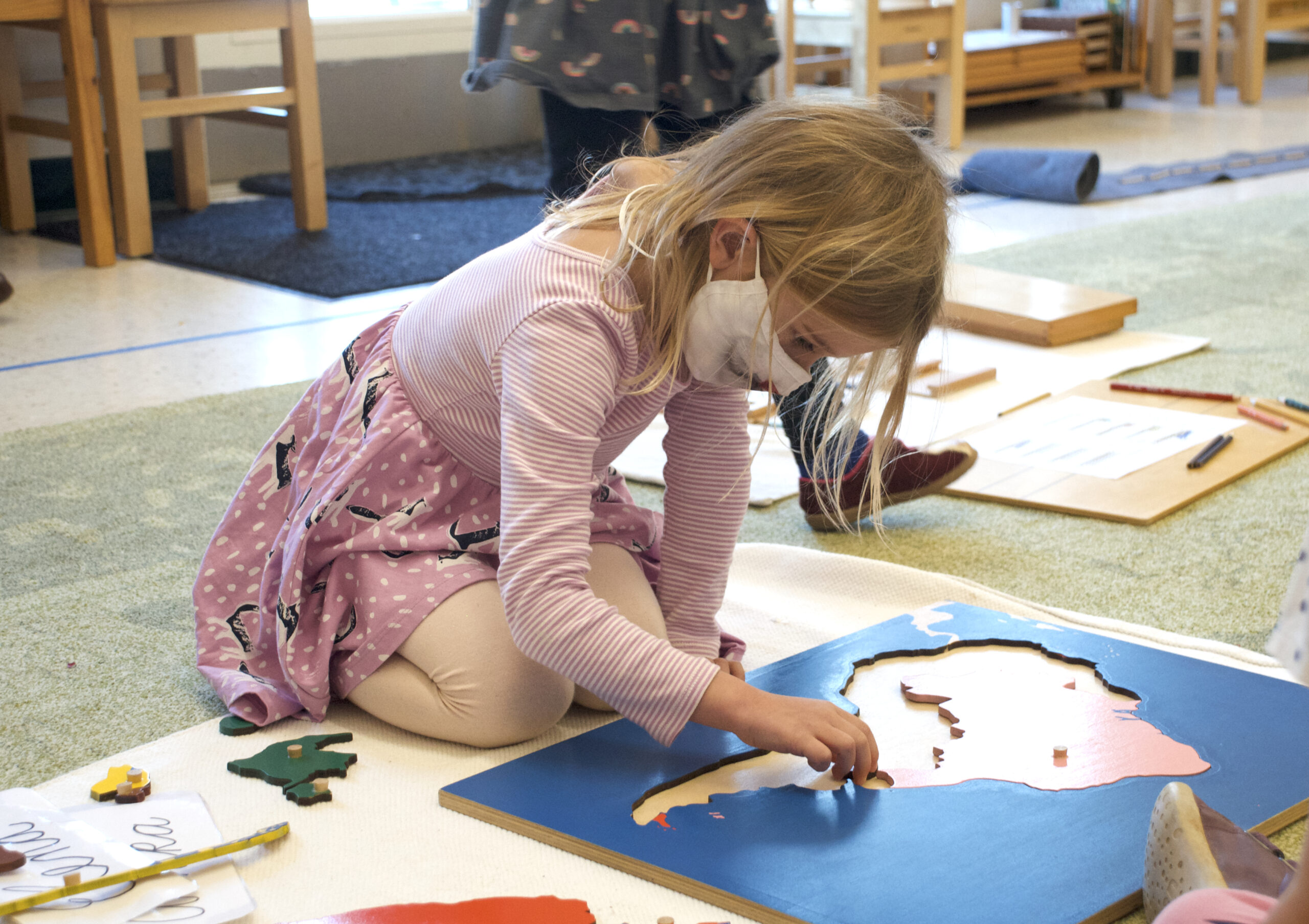
A Children’s House student works with the Puzzle Map of South America.

The initial introduction to the work in Children’s House is presented as a puzzle. Children become aware of the relative position, size, and shape of the continents of the world and the countries of those continents. Because the 3 to 6-year-old is learning with an absorbent mind, the names, locations, and orientation of the continents and countries are easily learned and remembered. When they are ready, students begin labeling the countries. Students also have the option of tracing and coloring a paper map of the world or country they are studying.

Sra. Emily works with a Children’s House student to learn more about the flag of China.

The Puzzle Maps help students memorize continents and countries, but memorization is only one benefit. Montessori students use these maps to gain a deeper, more rich understanding of how countries relate to one another. The pegged puzzle pieces have indirect purposes as well. The knob itself is placed at the location of the capital city, subtly reinforcing this concept. In addition, when a child grips the pegs, their hand muscles are strengthened and the pincer grip developed, preparing the hand to use a pencil. When a child later begins tracing and labeling the puzzle pieces, this work also builds dexterity and writing skills. Work with the Puzzle Maps often inspires children to read and write about various continents or countries, serving as a launching pad for exploration of biomes, animals, culture, and more.

In Elementary, the child moves to the reasoning mind and wants to understand why countries have these shapes and differences, as well as additional details about the areas. This leads to the knowledge that landforms often create borders, that there are political and cultural differences in adjacent countries, and an awareness of how the geography and resources of an area played a significant role in the settling of that region. We encourage Elementary students to use an atlas alongside the puzzle maps. They are now building the skills to find answers for themselves.

Science Experiments in the Elementary Classroom

Science Experiments in the Elementary Classroom

Science experiments are an integral part of Cosmic Education at the Elementary level, allowing the children to get “hands-on” with the scientific principles demonstrated in the Great Stories and Key Lessons. 

Levels of Understanding

When they are first presented, the experiments provide a visual image for a story or lesson. Paper pieces sprinkled on water, for example, enable the students to imagine how the elements born during the birth of the universe cooled and coalesced, joining together to create the stars and planets.

Above: Lower Elementary students demonstrate science experiments as part of the first Great Lesson, The Birth of the Universe.

From these explorations, the students can extend their studies further, engaging in deeper and more sophisticated studies of the fields of chemistry and physics. For example, the same experiment  with the pieces of paper sprinkled on water may be repeated in order to study the surface tension of water. Later, students can return to this experiment to explore the mechanism of surface tension, leading to the idea of hydrogen bonding.

Above: Upper Elementary students practice building models of elements on the periodic table using the Bohr Board.

The Scientific Method

When they are first presented, the experiments provide a vehicle for introducing the scientific method, including identifying a research question, proposing a hypothesis, conducting an experiment to test the hypothesis, making observations, recording data, analyzing results, drawing conclusions, and presenting findings. Elementary students also explore the work of groundbreaking scientists across time periods and cultures, discovering along the way how many scientific discoveries came about from incorrect hypotheses, a wonderful opportunity to discuss “mistakes as teachers” and the importance of a growth mindset.

Above: A Lower Elementary student tests the properties of a solid.

The science experiments offered in the Montessori classroom bring Cosmic Education to life. They enable students to develop scientific skills and delve more deeply into scientific concepts. And most of all, they offer students opportunities to pursue their interests and develop concentration on the path towards their self-construction.

Above: Lower Elementary students explore the movement of sound waves through water.

Montessori Brings Grammar to Life in the Classroom

Montessori Brings Grammar to Life in the Classroom

Many of us do not have fond memories of our grammar studies. But Montessori grammar is different. Instead of being presented as a boring set of rules, Montessori students are first introduced to “The Story of Language,” which tells the story of the evolution of language from its earliest beginnings to modern day. And instead of waiting until middle school, grammar is introduced to children at the age when children are fascinated by words – between the ages of 5 and 7. Best of all, Montessori grammar is hands-on, colorful, and active!

In Montessori grammar, each part of speech is represented by a shape and color with a special meaning. For example, the Noun is represented by a black pyramid. The pyramid, one of the first human structures, is solid and does not move. It is black to represent carbon, believed to be the first mineral discovered by humans. We can imagine nouns (naming words) being among the first words spoken by early humans. The Verb, on the other hand, is a red sphere, to represent the shape and energy of the sun which gives life. The verb gives life and movement to objects, just as the sun gives life to all living things.

Dr. Montessori designed a series of Grammar materials that bring this work to life.

“The study of grammar is to language what the study of anatomy is to science. By studying grammar, we become better writers and readers.”

– Lori Bourne, Montessori for Everyone

Key Experiences

Each part of speech is introduced in an interactive story or game that leaves a lasting impression. For example, when introducing the adjective, the guide will gather a group of children and ask the children to get something for her: a book. When the children return with various books, the guide responds, “No, not that one! Sorry, I was thinking of another.” The children continue fetching different books until they realize that they need more information. The guide then explains that when there are many of something, we must use more specific language. “I want the small book with the green spine.”

The Farm

Early introductions to grammar can begin in the Children’s House classroom. One Children’s House material, called The Farm, usually consists of a wooden farm set, including a barn and miniature farm animals. It also comes with cards on which are written different nouns, verbs, adjectives, and other parts of speech.

A child who has been introduced to the function of the noun can practice this new skill by putting out labels naming the nouns they find on the farm, such as sheep, goat, farmer. A child who has had a lesson on the article and the adjective can practice differentiating between items or using more descriptive language, such as the brown cow vs. the black cow or a fluffy, white sheep. And a child who is working with the verb might add some action by placing out cards that say, The farmer plants tiny seeds.

This material allows the child to practice reading isolated words in context, to understand the function of words, and is preparation for reading and creative writing. After children have been introduced to grammar on a sensorial level, they are ready to understand it in a deeper way.

Grammar Commands & Grammar Boxes

In the Lower Elementary classroom, students begin working with the Grammar Boxes. There are eight grammar boxes, each isolating a new part of speech to be studied. After the key experience introducing a new part of speech, the children first work with the grammar commands. These involve student acting out the new part of speech. “Throw the eraser out the door” is a favorite!

Then the child will work with the grammar box corresponding to the new part of speech. The child will select a sentence and then form this sentence by placing the word cards out in the correct order. They can experiment with syntax by exchanging the order of words in a phrase or sentence. Next the child will select the correct grammar symbols and place them above each word.

Extensions & Classification

There are many grammar extension activities. One large, exciting one is the Detective Triangle Game. The child spreads out all the triangles on a rug or table. Then must sort them by type, matching the labels to each triangle – for example, “the small, red, isosceles, right triangle.” The child can clearly see how using adjectives gives us the information we need to distinguish one thing from another.

Students dive deeper into their grammar studies through classification. As they continue with the adjective, for example, children will have the experience of classifying the degree of adjectives, such as soft, softer, softest. Next, they will use the Classification Chart for Adjectives to practice identifying adjectives as either proper (e.g., Canadian), descriptive (e.g., rectangular), numerical (e.g., third), or pronominal (e.g., that), and make even finer distinctions within those categories.

Symbolizing

When students have worked through all the grammar boxes, they are ready to apply their knowledge to “real world” writing. Students can select a sentence from their own writing to symbolize or select a passage from a favorite piece of literature or poem. Students can also select a grammar pattern and create their own sentences that fit the pattern. These more abstract applications of grammar allow students to demonstrate a deep knowledge and understanding of the function of words.

In Montessori, grammar is tactile, active, and fun! It goes hand and hand with Montessori sentence analysis, which both provide a foundation for agile writers with a solid understanding of the function of words.