
The Five Great Lessons of Montessori
Above, Montessori Guide, Brad Choate, discusses the Great Lessons in a Montessori classroom.
In Montessori Elementary classrooms, we begin the first few weeks of the year with the five Great Lessons. Dr. Maria Montessori created a curriculum that focused on helping each child discover the joy of learning. The crux of this learning is contained in the Five Great Lessons—a way of introducing enormous topics, such as the big bang, the evolution of life on earth, and the origin of writing and mathematics, to children as young as six through storytelling. These stories are a cornerstone of the Montessori Elementary curriculum and they spark students’ research in topics from the solar system to dinosaurs to the invention of the internet. Learn more about these stories on our blog.
Below is a breakdown of the five lessons.
The First Great Lesson: Coming of the Universe and Earth
The first story that the children receive is the Coming of the Universe, where Elementary Guides factually demonstrate how the universe and earth were formed. Guides and older students create experiments that help transform one big lesson into many smaller lessons.
Via 80 large visual charts and corresponding lessons, the Guide focuses on each child’s curiosity and enthusiasm to present new topics like astronomy, chemistry, physics, geology, and geography. As students thumb through each chart, they see what they want to learn more about.
Then, they proceed at their own pace to learn more about that topic while watching what other kids do.
It’s this process of building curiosity, enthusiasm, and inspiration that gives students a better understanding of the universe, the earth, and its interlocking scientific components. And when your child discovers something on his or her own, it stays with them and becomes imprinted into a more thorough understanding.
It’s this sense of self-discovery that is the most important part of the Montessori Method’s lifelong learning strategy. When knowledge becomes imprinted or embedded, it has more impact.

The Second Great Lesson: Coming of Life
Every living thing has a job to do to contribute to life on Earth. From a visual timeline of life that breaks down eras, evolution, and extinction, we learn about dinosaurs, animals, plants, and microorganisms—and how they all connect via topics and experiments. The goal of the Second Great Lesson: teaching the diversity of life via biology, botany, and habitats.
The key to The Montessori Method is the individual child—a child who can work at his or her chosen speed under a highly experienced teacher who knows a little bit about everything and a lot of ways to inspire a child.
The Third Great Lesson: Humans Come to Earth
What makes man special? How did we evolve from living in caves and creating fire to fashioning tools and machines? What does man possess that animals don’t and what makes us different? Montessori Guides focus on these age-old questions as a way to unlock the creativity in each child’s mind.
It is our minds, hands, and emotions that have helped separate us from all others. Through discovery and invention, human beings have become the dominant species on the planet. Man has built a vibrant history from tools, farming and food preparation/storage to shelter, transportation, medicine, art, and spirituality. Most importantly, children learn to understand their existence, their place in the world, and their personal responsibility in bettering society and the universe.
The Fourth Great Lesson: Communication and Writing
Human beings have long used language, pictures, and symbols to communicate with each other. From grunts and hand gestures to the advent of the written alphabet and ultimately, the printing press, man has always sought ways to communicate what he sees and how he feels.
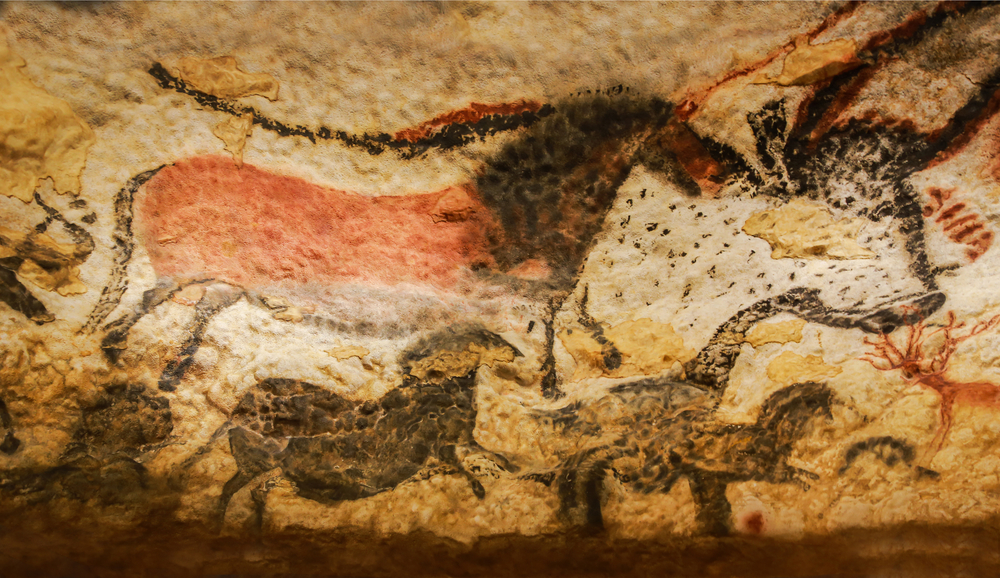
It is here in the Fourth Lesson that Montessori Guides begin to discuss the study of folk stories, mythology, language, alphabets, grammar, sentence structure and word study. From cave paintings to Egyptian hieroglyphics to Greek and Latin letters, the lesson allows children to focus on reading, writing, and language. The extended lesson: we can understand the similarities and differences of human beings by our history, stories, literature, poetry, and music.
Watch the video below to see the Story of Language, presented by Brad Choate, Upper Elementary Guide at Greenspring Montessori School.
The Fifth Great Lesson: Numbers
 The common language of the human race is mathematics. Over our 30,000-year history, man has built a system of numbers that has evolved from concepts of zero and one to arithmetic to geometry and ‘to infinity and beyond.’
The story of numbers helps students branch out to learning about the applications of these numbers in such arenas as the invention of the calendar, systems, and units of measurement and economic geography.
Summary of the Five Great Lessons
In the Montessori setting, lessons arouse enthusiasm. Via demonstrative overviews, our Guides seek to engage excitement and curiosity so children can explore on their own. This is the foundation of the Montessori elementary school philosophy—children working at their own speed with highly experienced, specialized Guides who give them the freedom to succeed at their own level. These lessons seek to inspire children to be curious about the world around them and to grow into life-long learners with an understanding of the interconnectedness of the world.
The information above is adapted from Lifetime Montessori School in San Diego, California.