
Our children are back on campus and classes are in full stride! The month of August brought many exciting updates, along with some hiccups. Our entire community has worked together to overcome these challenges with grace and strength.
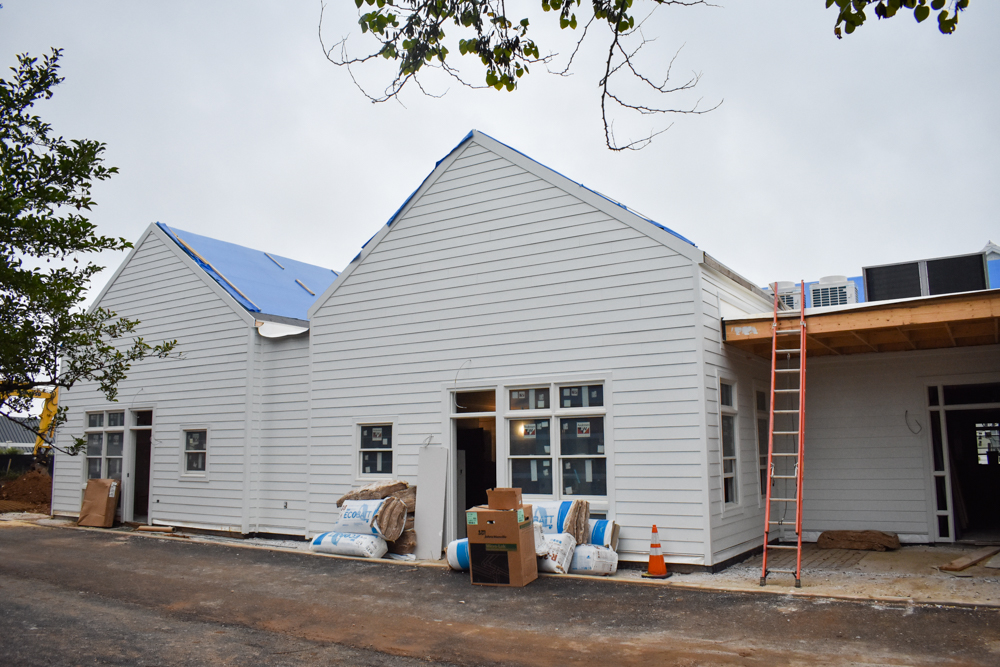
The Toddler and Children’s House Village East looks very different from our last update – there is now a roof, walls, windows, and doors! Inside, the HVAC, plumbing, and electrical have all been set and the workers are finishing up with the drywall. In addition, the road that runs in front of the Main Building has been torn up to make way for new utilities and a new road has been paved in its place.


Our entire school community had the opportunity to experience the unpredictable nature of renovations when the power was lost on the first day of school. Our children were excited to learn about the ins and outs of construction and it was a beautiful day to be outside, so it was a harmless inconvenience. Since then, things have been running smoothly!
We are all looking forward to moving into the new building in November.
The Faculty and Staff of Greenspring Montessori School have had quite a busy summer. Guides and assistants traveled as far as Ohio, Connecticut, and even Prague to learn from seasoned Montessorians. Learn more about their exciting experiences below.
Elliot Dickson, Adolescent Guide, traveled to Hershey, Ohio, to attend the North American Montessori Teachers’ Association Orientation. He writes:
“I attended Hershey Montessori School, a farm school that was the first school to implement Maria Montessori’s full vision for an adolescent community. At Hershe, I attended lectures given by veteran Montessori guides and got to experience the life of an adolescent as I balanced academic work with chores on the farm and in community spaces. The training gave me a holistic view of human development and how Montessori’s vision for community learning can best support the developmental needs and characteristics of children and adolescents at each stage of life. I also came to better understand how our own adolescent community at Greenspring can fully meet the needs of the adolescents while also preparing them for the young adults they want to grow to be. After two years at Greenspring and thirteen years in education, the learning and time for reflection was a true gift. ”
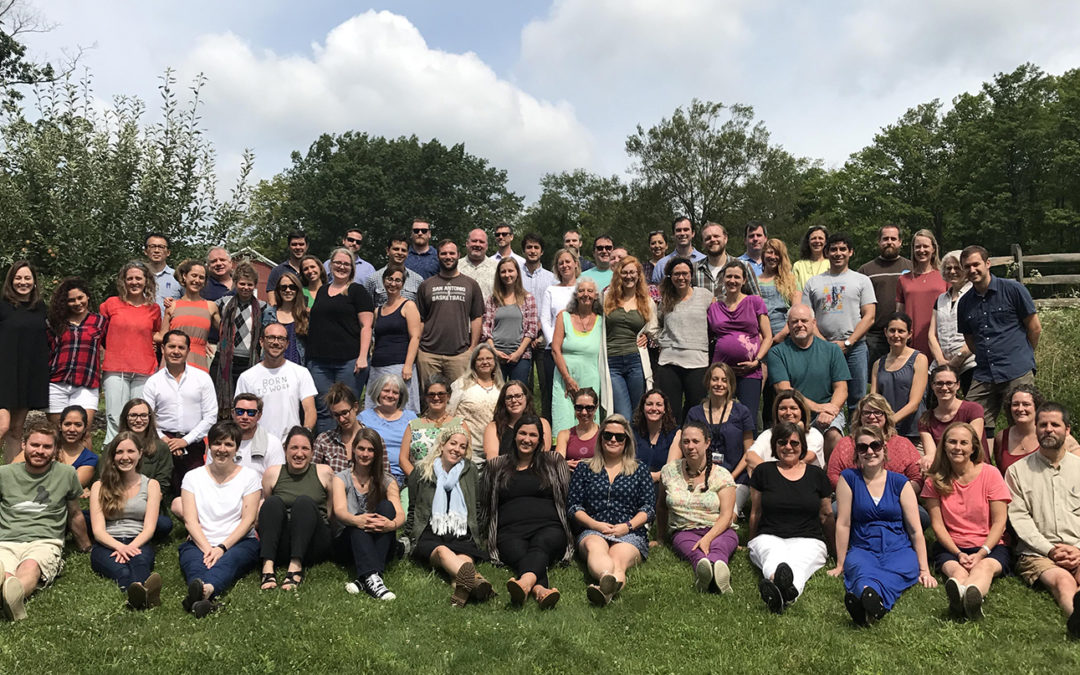
The picture is of all 60+ attendees (from the U.S., Australia, Sweden, Mexico, Romania, China, and Germany) and faculty.
Marketa Traband, Children’s House Guide, ventured to Prague to attend the International Montessori Conference. The topic for this year’s conference is
Pathway to Peace: Montessori Education for Social Change. She was so inspired by her trip and the international community of Montessorians, and she is excited to utilize her new understanding in the classroom this year.
Lee Lanou, Director of Children’s House and Director of Training at the Maryland Center for Montessori Studies, continued her AMI Primary training at Greenville Montessori Institute in South Carolina.
Already AMS certified, Lee is deepening her Montessori practice and gaining a better understanding of the unique teachings of the AMI curriculum. She said, “Training is a wonderfully intense, fulfilling, and filling experience. By the end of 8 weeks, my brain was completely full! Having had the AMS Primary training in 1989, this training has served as a wonderful refresher, rich in Montessori theory and practice.”
Marcela Daley, Spanish Enrichment Guide, attended the Summer Assistants Course at Washington Montessori Institute in Columbia, Maryland. She was enthusiastic to share, “The
training provided great information helping me with a better understanding, not just about the
Montessori philosophy, but about the needs and expectations of the child from 6-12. I am excited to put in practice all the learning and use it during the Spanish time with the students.”
“I greatly enjoyed my time training at Mid-America Montessori Teacher Training Institute in Omaha, NE for three intense weeks this past July. I had the opportunity to study both infants and toddlers. During my training, we made materials, practiced lessons and created practical yet thorough albums. I brainstormed new ideas with both my teachers and my classmates. Overall it was a wonderful experience that gave me a more complete understanding of the importance and beauty of a Montessori education.”
Two new staff members, Monique Crabb, Dual Language Children’s House Assistant, and Shweta Santosh, Floating Assistant, began
their AMS Early Childhood training at our very own Maryland Center for Montessori Studies. Both are looking forward to pairing their knowledge from training with real-world implementation in the classroom.
11 other team members – including Lead Guides, Assistants, and Administrators – attended conferences and trainings, bringing back a wealth of knowledge on Montessori practice. We are looking forward to a fantastic year of continued growth!


In June, our building project hit full stride – we have seen walls literally pop up overnight! Although many of our families and staff are off for the summer, our construction continues on and it is great to see the amazing progress.

The half of the Multipurpose Building that is being renovated was stripped down to the bones, windows, siding, and interior framing then took place in this side – making it even easier to picture the spacious, bright Toddler and Children’s House classrooms that are soon to occupy the space. In the east side, the cement floors were poured, steel beams were installed, and the exterior framing is going up. On the other side of campus, workers are digging a trench for utilities.

In the coming weeks, the sheathing, siding, and roof will go up on the new building, providing a true vision of the exterior of our new Toddler and Children’s House Village East. In addition, the construction crew will continue to work on utilities, with their trench extending into the road in front of the Main Building. If you are attending any of our summer programs, please be on the lookout for a revised traffic pattern.
To learn more about our building project, please visit the Capital Project landing page, and feel free to stop by to see the spectacle for yourselves!
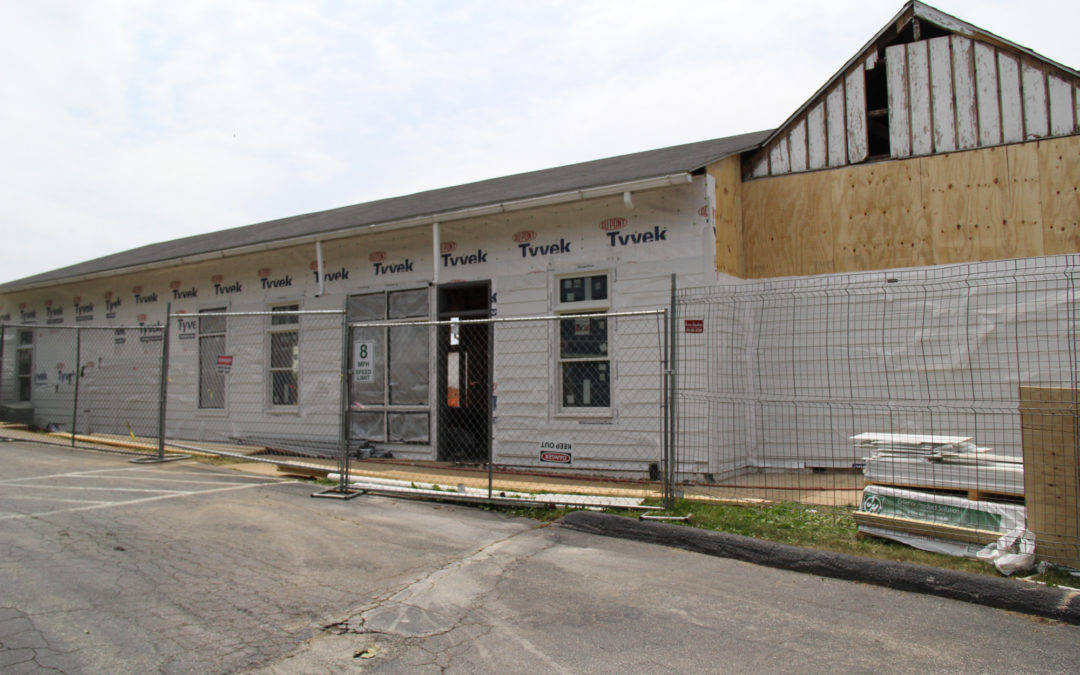
 Though the ample spring rains have been trying at times, the project found a much more productive rhythm in May. After spending April in a battle of wills with the vein of Cockeysville Marble running through the site, rock breaking yielded to a considerable amount of grading and foundation preparation. The new addition’s configuration has taken form as footings have been poured—their purpose is to support the foundation and prevent settling, and the site has been cleared of all remaining intrusive elements—electrical and internet cables and less difficult sections of rock.
On the interior, load bearing walls have been demolished and structural steel beams and columns await installation, the existing slab has been cut in various places for plumbing rough-ins, new plywood sheathing has been installed, and window and door openings cut throughout. With a little imagination – ok, maybe a lot – you can see the new classroom building taking shape. June’s efforts will bring far greater clarity to the image.

Written by Margaret Jarrell, former Greenspring Elementary Guide
“The child is capable of developing and giving us tangible proof of the possibility of a better humanity. He has shown us the true process of construction of the human being. We have seen children totally change as they acquire a love for things and as their sense of order, discipline, and self-control develops within them…. The child is both a hope and a promise for mankind.” – Dr. Maria Montessori
Peace education is a major component of the Montessori classroom. Maria Montessori saw the education of young children as the human race’s opportunity to recreate itself in a way that would eliminate war. As with most things, Dr. Montessori did not think that meant children needed to be lectured on the subject, but rather that they needed to be given an opportunity to discover peace for themselves. Adults model peaceful and respectful behavior, and because Montessori classrooms are composed of mixed age groups, older students serve as role models for younger children.

We start building conflict resolution skills with our youngest students. Most classrooms have a peace corner or peace table, at which two students can go to resolve a conflict or a single child can go to calm down and feel peaceful. One strategy is the use of a peace rose. Children learn to take turns holding the peace rose while speaking about how they feel. They stay at the peace table until they have heard each other and resolved their conflict. With very young children, adults model and coach the children with words they can use. Older students can do this independently.
At the Elementary level, “community time” is set aside to help establish a sense of responsibility and place within the group. Students encourage and acknowledge one another. They also help establish rules of conduct for the classroom and the playground. These meetings are student-led and a forum in which conflicts are discussed, brainstormed, and resolved as a group. Role-playing and discussion can be helpful in finding ways to handle challenging situations.

Once students enter our Adolescent Community, they begin exploring questions like, “Are all humans created equal?” and “What brings humans together into groups?” These questions are taken very seriously and are never assumed to have simple answers. We help adolescents seek insight by looking at world history, at the differing cultures of the world’s people, and at the interactions between humanity and the environment. Perhaps most importantly, we think about how future history might be written in a way more in keeping with the harmony that seems possible between people and the world, or between one group of people and the next.
Peace is also, essentially, a habit that Montessori students learn. Lessons in Grace and Courtesy teach our students the habit of viewing and treating others with respect, and then to continue to try to forge understandings where they encounter conflict. Young students practice simple lessons such as how to greet others, say please and thank you, tuck in chairs. Elementary students may practice introducing themselves or the etiquette for making a telephone call. And Adolescents may send thank you letters to experts who have helped them along the way. These lessons are present in Montessori classrooms from such an early age that the habits they create become as natural to our students as using a spoon, or putting on shoes.
At the core of these lessons is respect for others, self, and the environment. Montessori students engage in community service at every level – within the classroom for youngest students and outside the classroom and the school for older students. We encourage our students to be involved by asking, “How can we help others?” This can begin with caring for the environment, such as weeding and sweeping public areas. It can also take the form of volunteering to help others in our school. For example, Lower Elementary students may participate in a campus-wide recycling project. Upper Elementary students may tend community gardens and Adolescents are serving others lunch as a part of the micro-economy. It also involves thinking about the needs of others. Our students often remind each other, “We must be quieter. The toddlers are sleeping next door!”

The benefits of peace education are not just altruistic, but eminently practical. Most adults who have navigated the many changes to the world (or even just the job market) in the last several years have had reason to think about how much more connected everything seems to be getting – countries thousands of miles away can be regular business partners in ways that they might not have a decade or two ago, and people are truly mobile on a global scale for the first time in our planet’s history. Prejudice in favor of one’s own tribe – whether that tribe is formed by religion or geography or your school’s alumni association – has become more and more counterproductive to operating in a world where diversity cannot be avoided and is to be celebrated.
Peace is an amazing concept, a useful tool, and, through Montessori education, an attainable goal. Children are born with innate instincts toward compassion and the practice of compassion becomes ingrained when cultivated over time. Montessori students develop into involved citizens!
“Within the child lies the fate of the future.” -Dr. Maria Montessori
Written by Terriann Lane, Children’s House Guide
“A child is an eager observer and is particularly attracted by the actions of the adults and wants to imitate them. In this regard, an adult can have a kind of mission. He can be an inspiration for the child’s actions, a kind of open book, wherein a child can learn how to direct his own movements.” – Dr. Maria Montessori
Recently, I read an article titled, “Grace and Courtesy Beyond Please and Thank You.” The author shared an experience during a hotel stay that left her awestruck. An incident occurred that involved teenagers who chose to trash their hotel rooms, blast loud music, and run wild in the hallways, while unattended by their parents. The housekeeping staff was overwhelmed by the disaster created by the teens’ behaviors. The author wondered why and how the teenagers considered their actions to be appropriate behavior?
As a parent, I can presume that it is important to parents that their children learn to be kind, polite, considerate of others, and mindful of their actions. Consider the actions of the teenagers. What can we do as parents to instill appropriate social behaviors in our children? Society offers innumerable examples of antisocial and pro-social behaviors. Therefore, the onus is on us to model behaviors beyond please and thank you.

Children learn from those within their environments. Therefore, it is important to demonstrate grace and courtesy to children all of the time. Modeling behaviors in preparation for or in response to specific situations helps the children to practice new skills to use later when interacting with others and caring for environments. As adults, we must do what we expect the children to do and never model what we do not want them to do. Demonstrating grace and courtesy should be true, brief, and shown as many times as necessary until the child repeats the skill.
P. Donahue Shortridge wrote, “So if there is anything you want your child to know how to do, or a way you want him or her to behave, you should first model it, then show him or her how to do it, offer lots
of opportunities for practice, and finally, hold the child accountable. First, modeling: In the early years of life, we learn mostly by taking
in the sensorial impressions of the world around us. A series of neural connections helps us imprint that which we see. The child watches what other people do and attempts to do it, too. ” If we want our child to wait his or her turn to speak, stay seated at the dinner table, say thank you in response to being helped, say excuse me when interrupting, help someone who is need of assistance, and know how to conduct him/herself in a restaurant, grocery store, or at a hotel, we must set the example and model the behaviors.

There are many opportunities to provide examples. Modeling should be demonstrated daily, naturally, habitually, slowly, and simply. Parents can demonstrate how to push one’s chair under the table after being excused from the dinner table, return an object to its original location, hang a wet towel to dry after use or place a soiled towel in a clothes hamper, hold a door for someone carrying a load, etc.
Taking the time to model and practice social protocols and good manners, as well as holding children accountable, will empower them to respond appropriately to specific situations and encourage self-discipline.
Parent Challenge: Choose one behavior you would like to model for your child. (For example, placing a hand on a family member’s arm rather than interrupting.) First, invite your child to try something new. Your child will pick up on the excitement in your voice. With as few words as possible and moving slowly and carefully, demonstrate the way you wish your child to wait. Then invite your child to try it! Your child may wish to give a lesson to another family member. She may also enjoy role-playing scenarios of how to do this and how not to do this correctly. Switch roles and have fun!
Reference: Shortbridge, P. Donohue. “Grace and Courtesy Beyond Please and Thank You.” Montessori Life, Spring 2016.