Many of us do not have fond memories of our grammar studies. But Montessori grammar is different. Instead of being presented as a boring set of rules, Montessori students are first introduced to “The Story of Language,” which tells the story of the evolution of language from its earliest beginnings to modern day. And instead of waiting until middle school, grammar is introduced to children at the age when children are fascinated by words – between the ages of 5 and 7. Best of all, Montessori grammar is hands-on, colorful, and active!
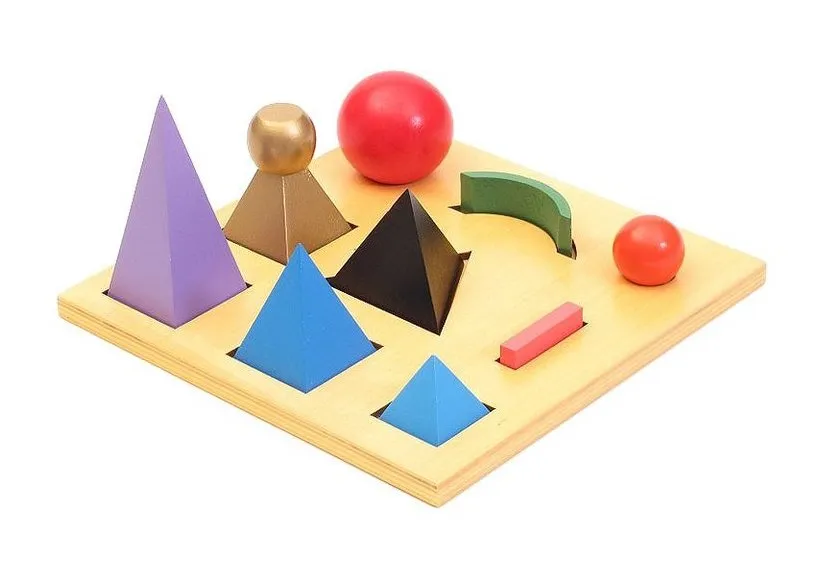

In Montessori grammar, each part of speech is represented by a shape and color with a special meaning. For example, the Noun is represented by a black pyramid. The pyramid, one of the first human structures, is solid and does not move. It is black to represent carbon, believed to be the first mineral discovered by humans. We can imagine nouns (naming words) being among the first words spoken by early humans. The Verb, on the other hand, is a red sphere, to represent the shape and energy of the sun which gives life. The verb gives life and movement to objects, just as the sun gives life to all living things.
Dr. Montessori designed a series of Grammar materials that bring this work to life.
“The study of grammar is to language what the study of anatomy is to science. By studying grammar, we become better writers and readers.”
– Lori Bourne, Montessori for Everyone
Key Experiences
Each part of speech is introduced in an interactive story or game that leaves a lasting impression. For example, when introducing the adjective, the guide will gather a group of children and ask the children to get something for her: a book. When the children return with various books, the guide responds, “No, not that one! Sorry, I was thinking of another.” The children continue fetching different books until they realize that they need more information. The guide then explains that when there are many of something, we must use more specific language. “I want the small book with the green spine.”
The Farm
Early introductions to grammar can begin in the Children’s House classroom. One Children’s House material, called The Farm, usually consists of a wooden farm set, including a barn and miniature farm animals. It also comes with cards on which are written different nouns, verbs, adjectives, and other parts of speech.
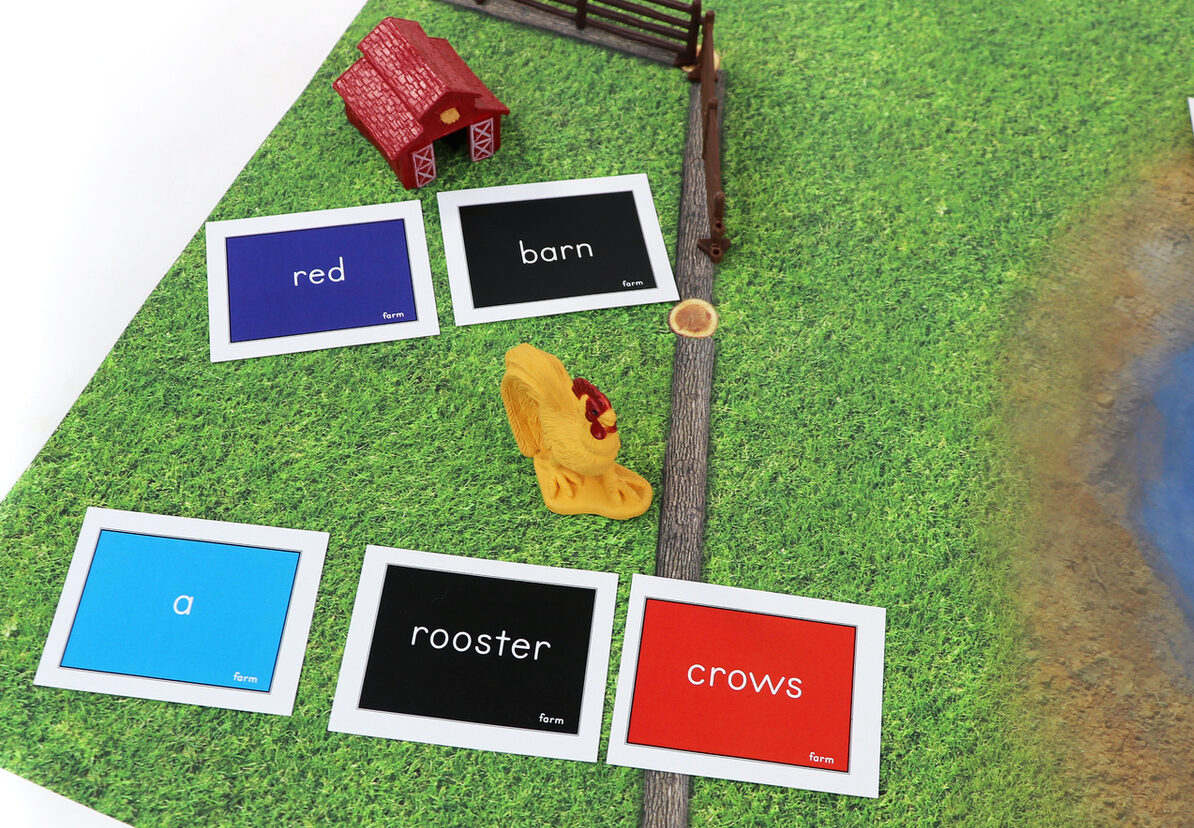
A child who has been introduced to the function of the noun can practice this new skill by putting out labels naming the nouns they find on the farm, such as sheep, goat, farmer. A child who has had a lesson on the article and the adjective can practice differentiating between items or using more descriptive language, such as the brown cow vs. the black cow or a fluffy, white sheep. And a child who is working with the verb might add some action by placing out cards that say, The farmer plants tiny seeds.
This material allows the child to practice reading isolated words in context, to understand the function of words, and is preparation for reading and creative writing. After children have been introduced to grammar on a sensorial level, they are ready to understand it in a deeper way.
Grammar Commands & Grammar Boxes
In the Lower Elementary classroom, students begin working with the Grammar Boxes. There are eight grammar boxes, each isolating a new part of speech to be studied. After the key experience introducing a new part of speech, the children first work with the grammar commands. These involve student acting out the new part of speech. “Throw the eraser out the door” is a favorite!
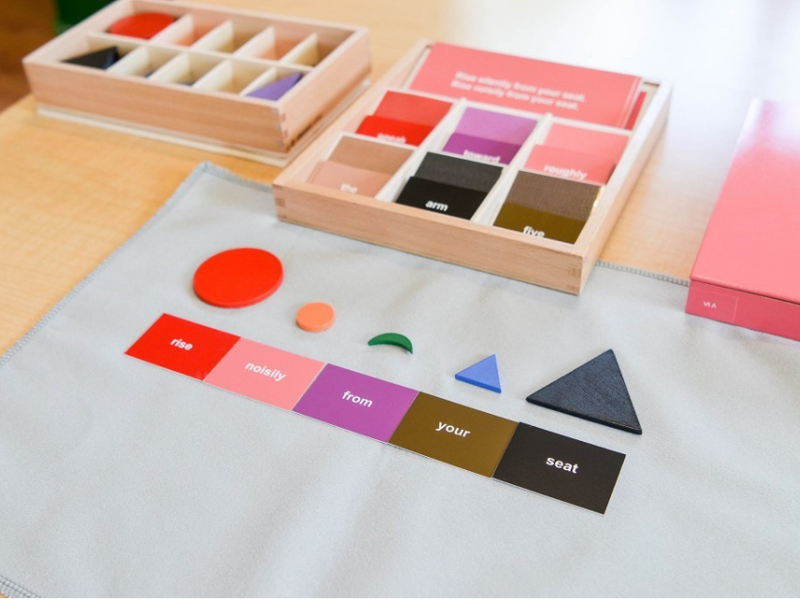

Then the child will work with the grammar box corresponding to the new part of speech. The child will select a sentence and then form this sentence by placing the word cards out in the correct order. They can experiment with syntax by exchanging the order of words in a phrase or sentence. Next the child will select the correct grammar symbols and place them above each word.
Extensions & Classification
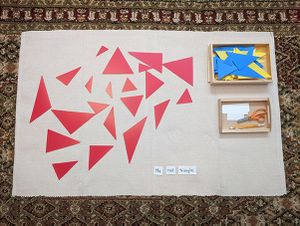
There are many grammar extension activities. One large, exciting one is the Detective Triangle Game. The child spreads out all the triangles on a rug or table. Then must sort them by type, matching the labels to each triangle – for example, “the small, red, isosceles, right triangle.” The child can clearly see how using adjectives gives us the information we need to distinguish one thing from another.

Students dive deeper into their grammar studies through classification. As they continue with the adjective, for example, children will have the experience of classifying the degree of adjectives, such as soft, softer, softest. Next, they will use the Classification Chart for Adjectives to practice identifying adjectives as either proper (e.g., Canadian), descriptive (e.g., rectangular), numerical (e.g., third), or pronominal (e.g., that), and make even finer distinctions within those categories.
Symbolizing
When students have worked through all the grammar boxes, they are ready to apply their knowledge to “real world” writing. Students can select a sentence from their own writing to symbolize or select a passage from a favorite piece of literature or poem. Students can also select a grammar pattern and create their own sentences that fit the pattern. These more abstract applications of grammar allow students to demonstrate a deep knowledge and understanding of the function of words.
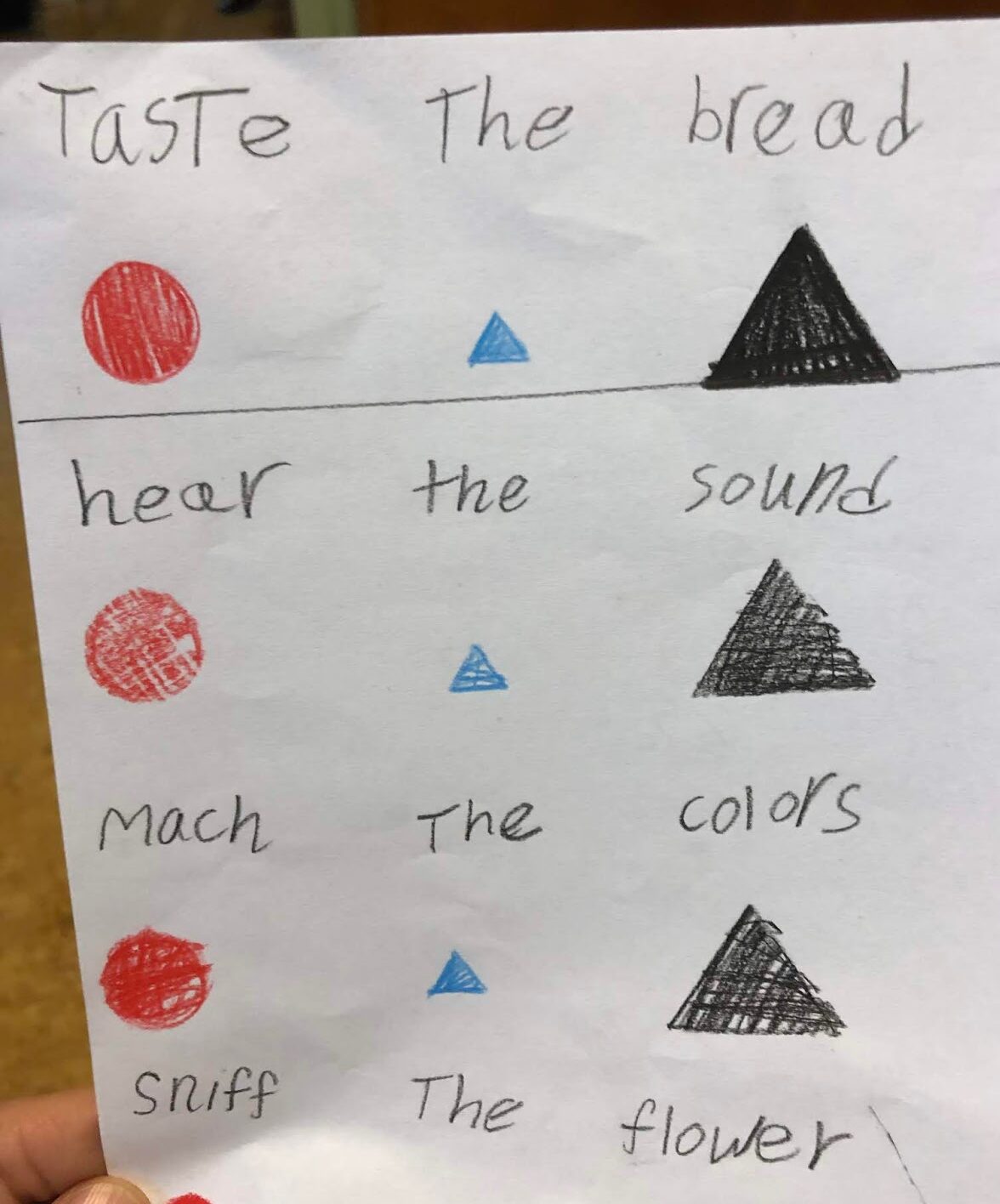

In Montessori, grammar is tactile, active, and fun! It goes hand and hand with Montessori sentence analysis, which both provide a foundation for agile writers with a solid understanding of the function of words.