Creating globally minded citizens is a fundamental value of Montessori education. Puzzle Maps are a key component of the Cultural curriculum and are found in both the Children’s House and Lower Elementary classrooms. They are arranged intentionally, starting with the top shelf and working downward:
- The planisphere: two blue circles with removable colored continents
- A map of the child’s continent: puzzle pieces indicate countries
- A map of the child’s country: puzzle pieces indicate states or provinces
- Maps of the other continents of the world: pieces indicating countries
There is also a set of “control maps,” which are corresponding laminated paper maps that have the pieces drawn to scale and labeled.
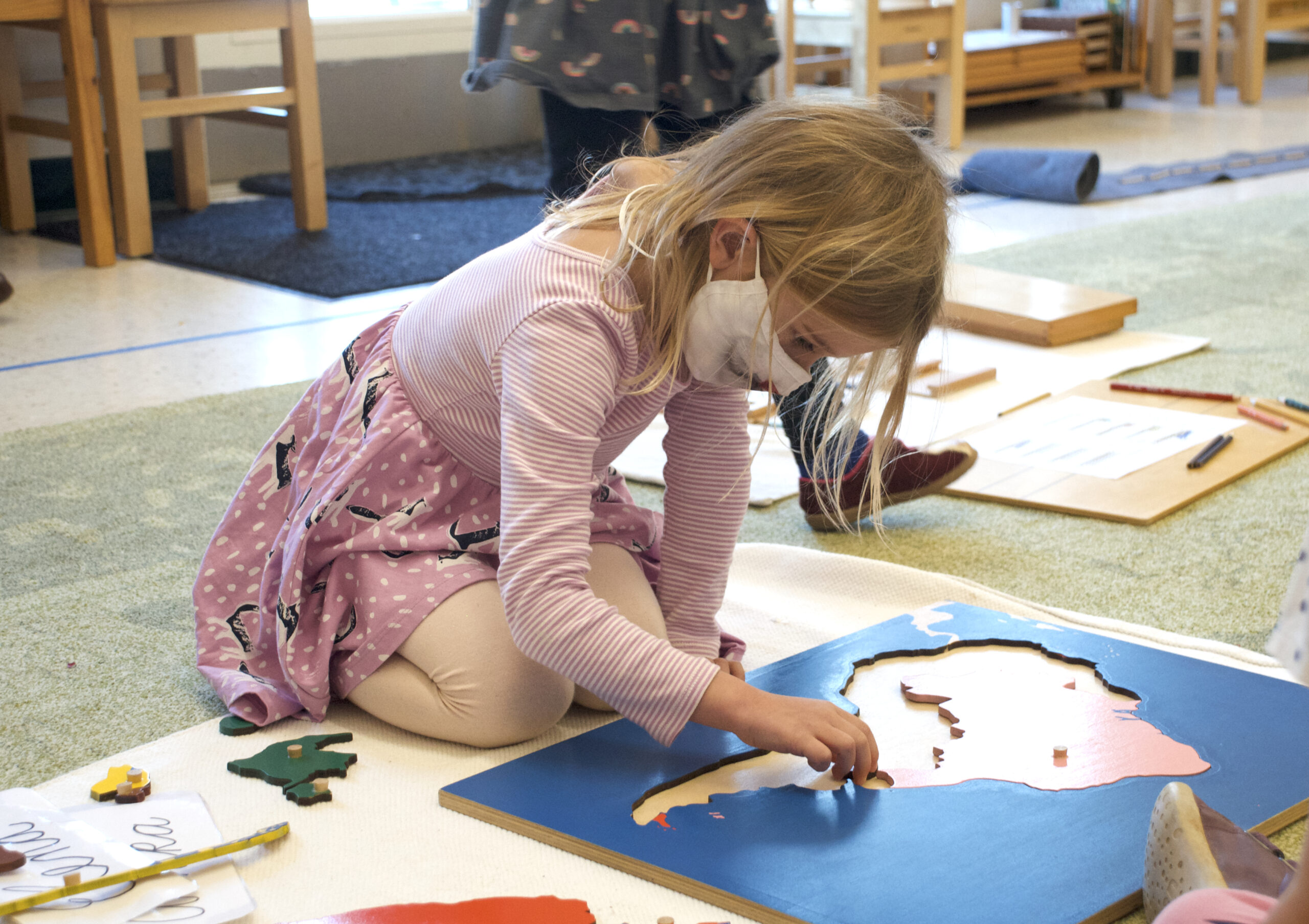
A Children’s House student works with the Puzzle Map of South America.
The initial introduction to the work in Children’s House is presented as a puzzle. Children become aware of the relative position, size, and shape of the continents of the world and the countries of those continents. Because the 3 to 6-year-old is learning with an absorbent mind, the names, locations, and orientation of the continents and countries are easily learned and remembered. When they are ready, students begin labeling the countries. Students also have the option of tracing and coloring a paper map of the world or country they are studying.

Sra. Emily works with a Children’s House student to learn more about the flag of China.
The Puzzle Maps help students memorize continents and countries, but memorization is only one benefit. Montessori students use these maps to gain a deeper, more rich understanding of how countries relate to one another. The pegged puzzle pieces have indirect purposes as well. The knob itself is placed at the location of the capital city, subtly reinforcing this concept. In addition, when a child grips the pegs, their hand muscles are strengthened and the pincer grip developed, preparing the hand to use a pencil. When a child later begins tracing and labeling the puzzle pieces, this work also builds dexterity and writing skills. Work with the Puzzle Maps often inspires children to read and write about various continents or countries, serving as a launching pad for exploration of biomes, animals, culture, and more.
In Elementary, the child moves to the reasoning mind and wants to understand why countries have these shapes and differences, as well as additional details about the areas. This leads to the knowledge that landforms often create borders, that there are political and cultural differences in adjacent countries, and an awareness of how the geography and resources of an area played a significant role in the settling of that region. We encourage Elementary students to use an atlas alongside the puzzle maps. They are now building the skills to find answers for themselves.