Social emotional learning (SEL) is how children and adults learn, acquire, and apply the skills and attitudes needed to develop groundedness, empathy, and healthy identities throughout life. SEL is arguably the foundation for all other forms of learning to take place.
Through SEL we practice managing our emotions in order to achieve personal and communal goals, and to learn the art of self-regulation. Through SEL we build our capacity for emotional intelligence, as we learn to show empathy for others while establishing and maintaining supportive relationships. Effective SEL helps us to make caring and responsible decisions when needed. SEL is best taught through language that is used regularly. For students, staff, parents, and all community stakeholders to use it effectively, it must be incorporated into everyday interactions, opportunities for conflict resolution, and as part of everyday culture.
Greenspring Elementary students have been weaving the language of SEL into their everyday experiences and when it comes time to problem solve or resolve conflicts. Through Character Education lessons, students have learned about social emotional topics, such as tattling versus reporting, personal space, taking a walk in the shoes of another (empathy), digital citizenship, friendship building skills, bucket filling, among other topics. With each lesson comes valuable social emotional language that is referenced even well after the lessons are given, thus making lessons learned part of the culture. (The goal is to then create SEL work that will be displayed on the shelves for children to further practice their skills with.)
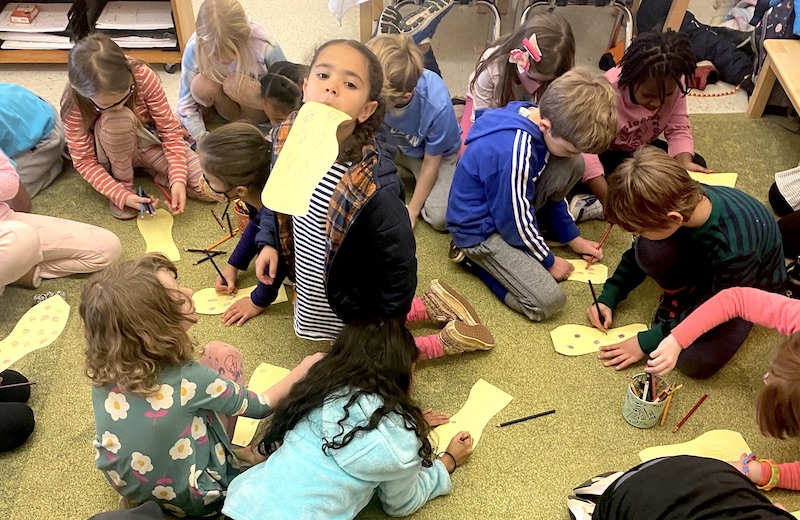
For example, Lower Elementary students enjoyed a Character Education lesson about the differences between Tattling and Reporting. Students learned that tattling occurs when one “tells” on another for doing something that may be annoying, but does not hurt anyone else. They also learned that reporting is something that we are expected to do, when one’s body or heart could get hurt. Reporting is very important and necessary when someone could be in danger. Tattling is something we can avoid, when no one is in danger physically or emotionally. We also talked about what else we could do instead of tattling when something “annoying,” but nothing dangerous is happening. We could be problem solvers, for example, and ask the person who is doing something annoying to stop directly, or maybe we could move our own selves away. Focusing on what we CAN do versus what we CAN’T do is a big step in knowing how to problem solve in any situation. Students read the book “A Bad Case of Tattle Tongue” by Julia Cook, and discussed what they could do instead of tattling, and how they should always report a dangerous or scary situation, when necessary! During the final part of the lesson, as students were discussing and role playing different scenarios and trying to decipher which would be cases for “tattling” or “reporting,” everyone made their own “tattle tongues” as a reminder try to not tattle, when they could solve the problem independently!
Lower El also learned about the four different types of “Personal Space” this year, and how they can respect the personal space of others. Students learned that personal space can be broken down into four different categories. Those categories are body space, seeing space, hearing space, and property space. Body space refers to when someone is getting physically too close to another’s body, and how can make someone feel uncomfortable. Students learned that they can tell if they are invading someone’s body space because that person might take a step back or arch their back away. If they see someone doing this, they will know that they need to take a step back so that they do not invade the body space of another. Students also used a hula hoop to determine how close or far away someone could get from them without invading their body space “bubble.” Seeing space invasion is when an object is being held too close or too far away from someone’s eyes. Hearing space invasion is when others are being too loud or too quiet. Property space invasion is when someone’s property is being touched without permission. For each type of personal space students role-played, how to both invade and respect someone else’s different types of personal space. By role-playing different scenarios students practiced what they would do in real life should either they be invading someone else’s personal space or if somebody else is invading their personal space. The specific breakdown of language: Body space seeing space hearing space and property space allows students to give greater meaning to what type of space feels invaded or respected to them. It also gave them a chance to practice advocating for themselves by saying something like “Please back up a bit. My body space is feeling invaded.” As we know, specific language is such a valuable tool in communicating our thoughts and feelings, so giving students the language for what it means to both respect and invade someone’s personal space can be really helpful to them, their friends, and their community in the future.

Upper Elementary students learned about gossip language versus considerate language when interacting with peers. During this lesson students squeezed toothpaste out of a tube, imagining that the toothpaste was gossip. They quickly realized that they could not get the toothpaste all the way back in the tube. This signified that hurtful words/gossip cannot ever really be taken back fully, so we need to think before we speak, and take responsibility for hurtful words. We need to imagine the word THINK. (An acronym for, “Is it True, Helpful, Inspiring, Necessary, and Kind?) If they are not THINK words, we should try to replace them with more considerate words that are. Students focused on the power of positive words we speak to and about one another. The considerate language spreads just as fast as gossip language— so it is important to choose considerate language! (And the impact is much better for all!) Students also talked about how reporting hurtful words someone else said to a parent or trusted adult, is NOT gossip, and it is absolutely necessary.
In a Upper El digital citizenship lesson, students took gossip language versus considerate language a step further. They learned what it meant to leave a digital footprint, and how they must THINK (acronym) before posting online. Students discussed how the internet, apps, and social media can be wonderful tools when used right, just like our spoken words—- AND we need to do our best to be responsible in what we say/what we post, so that the words and images we put out to the world portray consideration and kindness, and not gossip or hurt. We read the book “Technology Tail” by Julia Cook. This book gave us some language and good examples of what it meant to leave a digital footprint, for better or worse.
We are so grateful to be incorporating more SEL lessons and language at Greenspring!