Written by Margaret Jarrell
“Movement, or physical activity, is an essential factor in intellectual growth, which depends upon the impressions received from outside. Through movement we come in contact with external reality, and it is through these contacts that we eventually acquire even abstract ideas.” – Dr Maria Montessori, The Secret of Childhood
We use our senses to perceive and understand the world around us. Our brain then processes that information to tell our body how to respond. Sight, hearing, smell, taste and touch are the five senses most commonly identified. But did you know that there are two more senses that affect our ability to interact with the environment?
The vestibular system, also known as our balance center, is responsible for receiving information regarding our body’s movement in space. The vestibular sense helps us balance while we walk and run and stay upright when we sit and stand. The receptors in this system are located in the inner ear and are stimulated by changes in head position. The inner ear communicates with the brain to help keep us maintain our balance as we move through space.

Balance boards (also known as wobble boards) are curved wooden boards that allow children to receive vestibular input. As children stand on them, they will naturally shift their body weight and respond in the right way as the stimuli change. This tool helps children with their balance, posture, and coordination. It also helps children develop core strength because of the tiny adjustments a person needs to make in balancing.

The proprioceptive sense informs us of our body position in space. The receptors for this system are found in our skin, muscles, and joints and they send information to our brain about where our different body parts are, how they move, and how much strength our muscles need to use. Proprioception is important in building body awareness, coordination, and posture. Playing the piano, handwriting, and playing sports are all activities that require a lot of proprioceptive input.
Believe it or not, proprioception also plays a large role in self-regulation, the ability to focus, and even speech. When receptors known as proprioceptors are stimulated, the arousal centre of the brain (the cortex, limbic system, and cerebellum) is activated, which impacts a child’s level of alertness. Therefore, by providing children with proprioceptive input throughout the day, they can be assisted to maintain an optimal state for learning and focused attention.
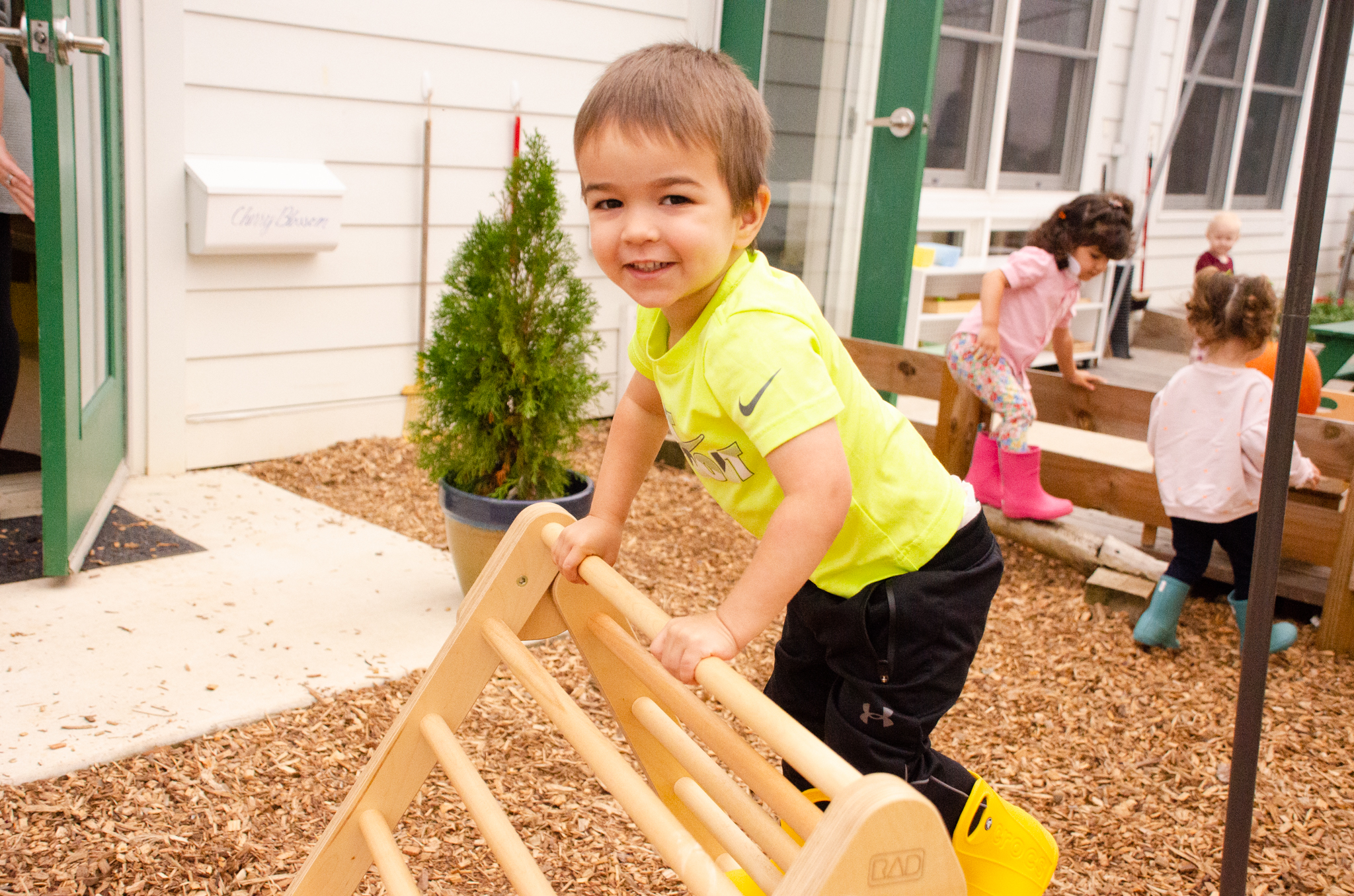
The Pikler triangle is a climbing tool that provides many benefits for young children, including proprioceptive input. It also helps children with gross motor development, grasping, balance, and confidence.
Other proprioception activities include heavy muscle work activities or activities that apply deep pressure to the muscle and joints. Heavy work activities involve pushing, pulling, carrying heavy objects and weight-bearing, such as, carrying a pile of heavy books, or doing a wheelbarrow walk.
Montessori classrooms include equipment and activities that provide children opportunities to stimulate and develop their vestibular and proprioceptive senses. Dr. Montessori wrote, “The senses, being explorers of the world, open the way to knowledge.”